ChatGPT is an AI assistant built by OpenAI that you talk to in plain language. Ask it to explain quantum computing like you are twelve, draft a complaint letter, debug your spreadsheet formula, or summarize a 30-page report — and it responds in seconds. Launched in late 2022, it became the fastest-growing consumer app in history and turned "AI" from a research term into a household verb.
This guide covers what ChatGPT actually is, how it works without the math, the tasks it handles brilliantly — including how to get a genuinely useful summary with ChatGPT — and the limits you should know before trusting it.
How ChatGPT Works (The Two-Minute Version)
ChatGPT is powered by a large language model (LLM) — a neural network trained on enormous amounts of text. Training taught it the patterns of language so deeply that it can predict what words should come next in any context. Stack enough of that predictive power together, add training to follow instructions helpfully, and you get a system that can converse, reason through problems, and generate original text. Modern versions also handle images, voice conversations, file uploads, and web search.
What People Actually Use ChatGPT For
- Writing: drafts, edits, and rewrites for emails, essays, and posts.
- Summarizing: compressing articles, reports, and threads into key points.
- Learning: explanations at any level, with unlimited follow-up questions.
- Coding: writing, explaining, and debugging code in most languages.
- Brainstorming: names, angles, plans, and counterarguments on demand.
- Translation and language practice: across dozens of languages.
How to Get a Great Summary with ChatGPT
Summarization is one of ChatGPT's strongest skills — if you prompt with structure. "Summarize this" produces a vague paragraph; these patterns produce something usable:
- Set the format: "Summarize in 5 bullets, each under 15 words."
- Set the audience: "...for an executive who has 30 seconds."
- Demand extractions: "List every deadline, number, and action item separately."
- Ask what is missing: "What questions does this document leave unanswered?"
For recurring summary work, purpose-built tools cut the prompting overhead — an AI summarizer handles documents in one step, and our guide to summarizing emails has copy-ready prompts for the inbox.
ChatGPT for the web, Notie for your conversations
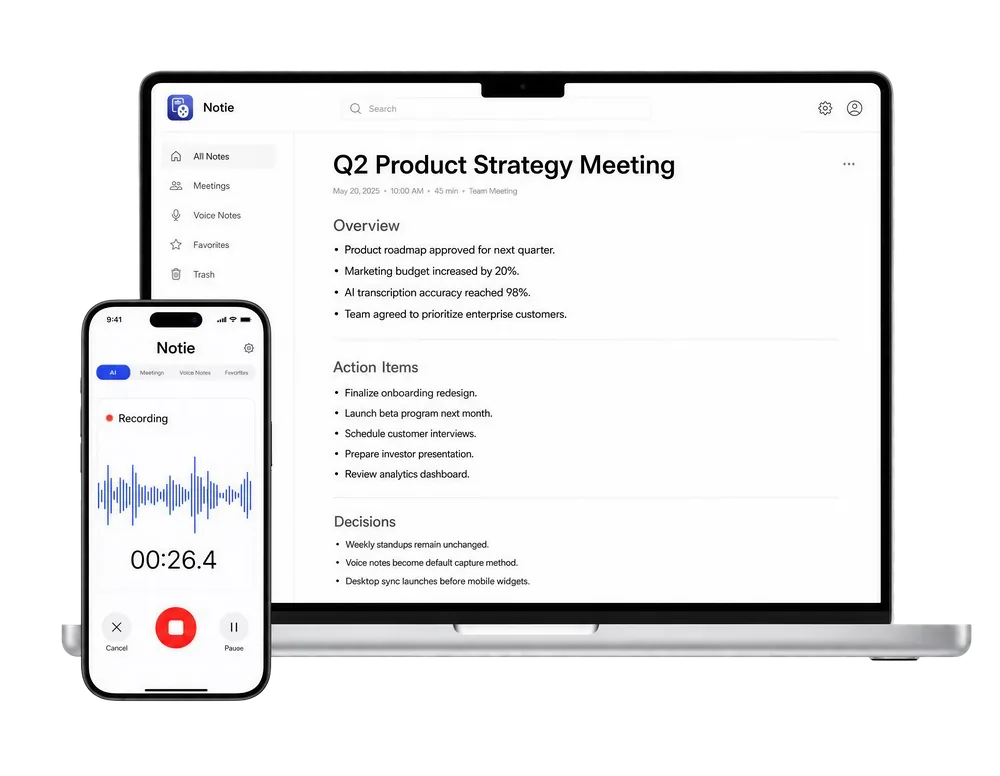
ChatGPT summarizes what you paste. Notie captures what you say — recording meetings and voice notes, then delivering transcripts and AI summaries with action items automatically. Free on iOS and Android.
Start for FreeFree vs. Paid ChatGPT
| Free tier | Paid tiers | |
|---|---|---|
| Model access | Capable default models with usage limits | Frontier models, higher limits |
| Features | Chat, search, basic uploads | Advanced voice, deep research, agents, custom GPTs |
| Best for | Casual and first-time users | Daily professional use |
Honest Limitations
- Hallucinations: it can state falsehoods with total confidence — verify facts, citations, and numbers before relying on them.
- Knowledge gaps: without web search enabled, it may miss recent events.
- Generic voice: unedited output reads as AI; your judgment and specifics make it yours.
- Privacy: avoid pasting confidential data unless your settings and company policy allow it.
ChatGPT and Its Rivals
ChatGPT is no longer alone: Claude is renowned for writing and long-document work, Gemini is woven through Google's ecosystem, and OpenAI itself now ships a browser — see our look at ChatGPT Atlas. All are excellent; the differences show up in workflow fit more than raw intelligence. The bigger lesson is that conversational AI is becoming a layer across everything — including apps like Notie, whose AI chat answers questions grounded in your own meeting transcripts rather than the open internet.
Start free, learn to prompt with structure, verify what matters, and ChatGPT becomes what it actually is: not magic, but the most versatile assistant you have ever had.