Somewhere in that 14-message thread is one decision and two action items. The rest is scheduling ping-pong, reply-all courtesy, and a signature block repeated fourteen times. Learning to extract the signal — whether by hand or by typing "summarize this email" into an AI assistant — is one of the highest-leverage micro-skills in modern work.
This guide gives you both routes: prompts that make AI summaries genuinely useful (not just shorter), and a 60-second manual method for threads too sensitive to paste anywhere.
The Fast Route: AI Summarization
Every major assistant — ChatGPT, Claude, Gemini, and built-in features in Gmail and Outlook — can compress a thread in seconds. The difference between a mediocre summary and a great one is the prompt. "Summarize this email" alone produces a vague paragraph; adding structure produces something you can act on.
Copy-Ready Prompts
- The action extractor: "Summarize this email thread in 3 bullets, then list every action item with its owner and deadline."
- The decision finder: "What decisions were made in this thread, and what questions remain open?"
- The catch-up: "I was added late to this thread. Give me a 5-sentence chronological summary of what happened and what is expected of me."
- The reply-prep: "Summarize what the sender is asking of me specifically, and draft a 3-sentence reply agreeing to it."
- The tone check: "Summarize this email and note anything that reads as urgent, frustrated, or ambiguous."
Prompt Anatomy: Why These Work
| Prompt element | What it does |
|---|---|
| Fixed format ("3 bullets") | Prevents rambling paragraphs |
| Role context ("I was added late") | Focuses the summary on your needs |
| Explicit extraction ("owners and deadlines") | Surfaces what generic summaries bury |
| Follow-up question space | Lets you drill into specifics after the overview |
Summarize more than email with Notie
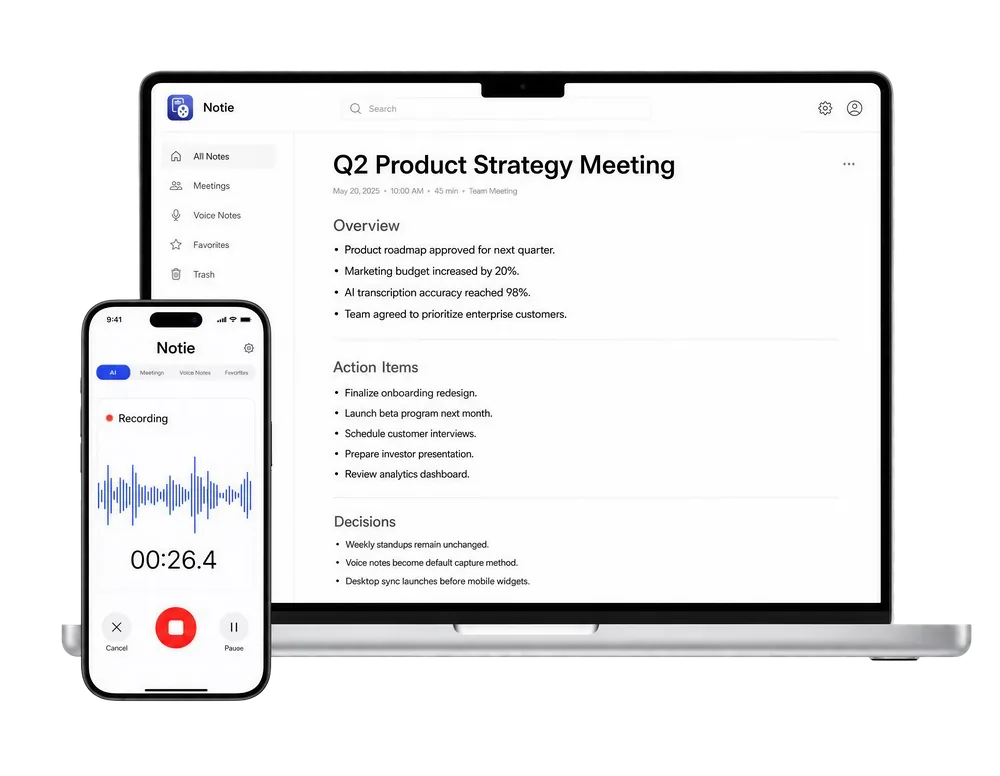
Notie applies the same magic to meetings and voice notes — record any conversation and get an instant summary with action items. Your inbox is not the only thing that needs compressing. Free on iOS and Android.
Start for FreeThe Manual Method: 60 Seconds, No AI
For confidential threads — HR matters, legal topics, unreleased numbers — summarize by hand with this scan pattern:
- Read the newest message first. Threads resolve upward; the latest message often contains the conclusion.
- Scan for question marks. Direct questions are where your obligations hide.
- Note names + verbs. "Sarah will send," "can you review" — these are the action items.
- Write one sentence: who wants what from whom, by when.
- File or act. If your sentence contains your name, it goes on the task list.
When Not to Trust an AI Summary
- Legal, medical, or contractual emails — nuance is the content; read every word.
- Emotionally loaded messages — summaries flatten tone, and tone is the message.
- Anything you will be quoted on — verify against the original before repeating a "fact" from a summary.
- Confidential content — use on-device or policy-approved tools only, and check your company's AI rules.
Build the Habit Beyond the Inbox
Summarization is a workflow, not a trick. The same skills compress every long input in your day: run reports through an AI summarizer, condense research with an article summarizer, and interrogate contracts with Chat PDF. And for the conversations that never reach text at all, Notie records meetings and produces AI summaries with decisions and action items automatically — the "summarize this email" reflex, applied to everything you hear.
Ten minutes saved per day on reading is a full week reclaimed per year. Start with one prompt from this list and make it a reflex.