Ask ten people what artificial intelligence is and you will get ten answers, ranging from "robots" to "that chatbot my kid uses for homework." The honest definition is simpler: artificial intelligence is software that performs tasks that normally require human intelligence — understanding language, recognizing images, making predictions, and generating new content.
This guide skips the hype and the doom. You will learn how AI actually works, the main types you will encounter, and where it already sits inside the apps you use every day.
Artificial Intelligence, Defined
AI is a branch of computer science focused on building systems that learn from data rather than following hand-written rules. A traditional program does exactly what a developer tells it. An AI model studies millions of examples — sentences, photos, recordings — and learns patterns it can apply to inputs it has never seen before.
That learning step is why AI feels different from ordinary software. A spell checker follows a dictionary; an AI writing assistant understands context. A tape recorder stores sound; an AI transcription tool understands who said what and can summarize it.
The Main Types of AI
Researchers slice AI many ways, but three categories cover almost everything you will meet in practice:
| Type | What it means | Examples |
|---|---|---|
| Narrow AI | Excels at one specific task | Spam filters, face unlock, route planning |
| Generative AI | Creates new text, images, audio, or video | ChatGPT, Claude, Midjourney, AI note takers |
| General AI (AGI) | Hypothetical AI matching humans across all tasks | Does not exist yet; an active research goal |
How AI Actually Works
Under the hood, most modern AI relies on machine learning: algorithms that improve through exposure to data. A few key techniques do the heavy lifting:
- Machine learning: the umbrella approach of learning patterns from examples instead of explicit rules.
- Deep learning: neural networks with many layers, loosely inspired by the brain, that power image and speech recognition.
- Natural language processing (NLP): teaching machines to read, write, and understand human language.
- Large language models (LLMs): massive NLP systems trained on huge text datasets — the engines behind modern chatbots.
Where You Already Use AI Every Day
You do not need to "adopt AI" — you already have. Common examples include:
- Autocomplete and autocorrect on your phone keyboard
- Streaming and shopping recommendations
- Voice assistants that set timers and answer questions
- Photo apps that recognize faces and objects
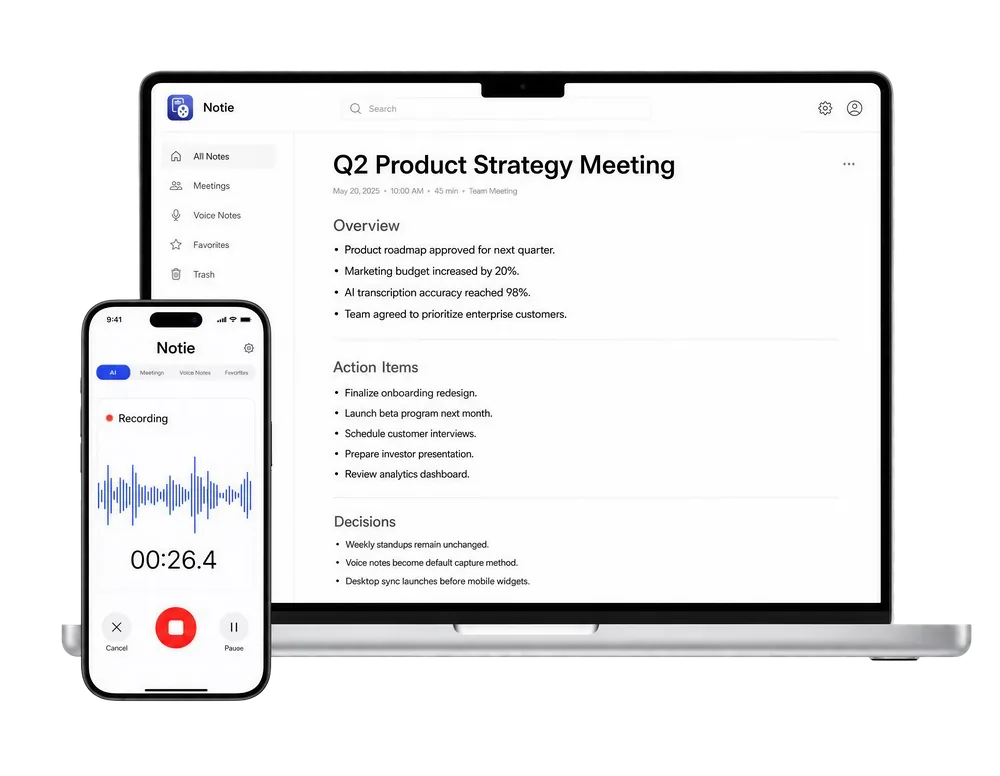
- Meeting apps like Notie that transcribe conversations and generate summaries automatically
Experience practical AI with Notie
Notie uses AI to record, transcribe, translate, and summarize your meetings and voice notes. No prompts to learn — just press record and get organized notes. Download it free for iOS and Android.
Start for FreeBenefits and Honest Limitations
AI saves time on repetitive knowledge work: drafting, summarizing, transcribing, translating, and searching. But it has real limits. Models can "hallucinate" confident-sounding errors, they reflect biases in their training data, and they lack genuine judgment. The practical rule: let AI produce the first draft, and keep a human responsible for the final call.
How to Start Using AI Today
The fastest way to understand AI is to use it on your own work. Try a general assistant — our guides to what ChatGPT is and conversational AI are good starting points — then pick one recurring task to automate. If that task is meetings or voice notes, an AI note taker like Notie will show you the payoff in a single afternoon: you talk, and the AI chat lets you ask questions about everything that was said.
Artificial intelligence is not magic and it is not a fad. It is a new layer of software that learns — and the people who benefit most are the ones who put it to work on ordinary tasks first.