Claude is an AI assistant built by Anthropic, a company founded by former OpenAI researchers with a specific focus on safety and reliability. Like ChatGPT or Gemini, you talk to Claude in plain language and it writes, summarizes, analyzes, and reasons through problems. What sets it apart in daily use is a writing style many people find less robotic, a large context window for handling long documents, and a public commitment to careful, well-reasoned answers over flashy ones.
This guide explains what Claude is, how it works at a high level, what it is genuinely good at, and how it stacks up against other assistants — including how it fits alongside a purpose-built tool like Notie for meetings and voice notes.
Who Makes Claude, and Why It Exists
Anthropic was founded in 2021 by siblings Dario and Daniela Amodei along with a group of colleagues who previously worked on AI safety at OpenAI. The company's stated mission is to build AI systems that are helpful, honest, and harmless — a framework Anthropic calls Constitutional AI, where the model is trained against a set of explicit principles rather than relying purely on human feedback after the fact. Claude is named after Claude Shannon, the mathematician often called the father of information theory.
How Claude Works (Without the Math)
Claude is a large language model: a neural network trained on enormous amounts of text to predict language patterns, then fine-tuned to follow instructions and hold a conversation. Anthropic releases Claude in different sizes — typically a fast, lightweight tier and a larger, more capable tier — so users can trade off speed against depth of reasoning. Newer versions can read images and files, browse for current information, and work through multi-step tasks with visible reasoning steps.
What Claude Is Genuinely Good At
- Long documents: Claude handles very long inputs — contracts, research papers, entire codebases — in a single conversation without losing track of earlier context.
- Writing quality: many users find Claude's prose feels more natural and less formulaic than other assistants, especially for essays, emails, and creative work.
- Careful reasoning: it tends to show its work and flag uncertainty rather than guessing confidently.
- Coding: Claude is widely used for writing, explaining, and refactoring code, including large existing codebases.
- Following detailed instructions: it is reliable at sticking to formatting rules, tone, and constraints across a long conversation.
Common Ways People Use Claude
- Summarizing long reports or research into structured, digestible sections.
- Drafting and editing emails, proposals, and articles in a specific voice.
- Analyzing documents — pasting in a contract or transcript and asking targeted questions.
- Coding assistance for writing new features or debugging existing projects.
- Brainstorming and planning, from business strategy to trip itineraries.
Claude answers questions — Notie captures the conversation first
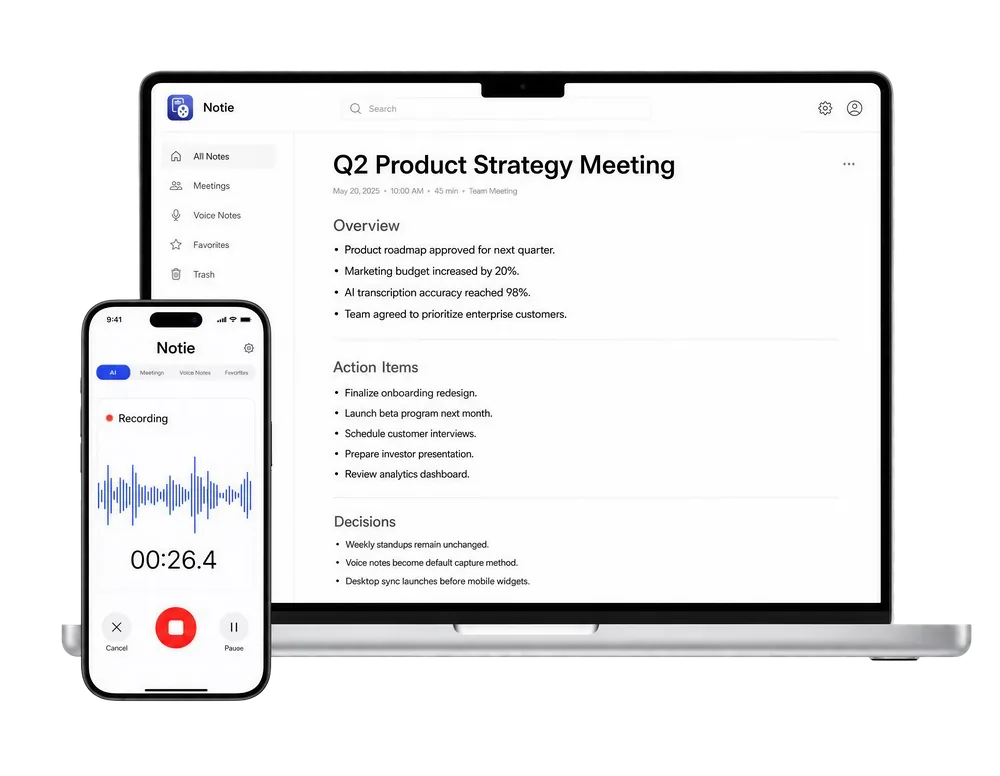
General assistants like Claude are excellent at working with text you give them. Notie handles the step before that: it records meetings and voice notes, transcribes them, and lets you chat with your own transcripts through built-in AI chat. Free on iOS and Android.
Start for FreeClaude vs. ChatGPT vs. Gemini
| Claude (Anthropic) | ChatGPT (OpenAI) | Gemini (Google) | |
|---|---|---|---|
| Known for | Long documents, careful writing | Broadest feature set, plugins | Google ecosystem integration |
| Context length | Very large, strong for long docs | Large, growing steadily | Very large, strong for video/multimodal |
| Best for | Writing, analysis, coding | General-purpose everyday use | Search-heavy, Workspace users |
| Access | Web, app, API | Web, app, API, browser | Web, app, API, Android built-in |
Getting Good Summaries and Answers from Claude
As with any AI assistant, structured prompts beat vague ones. Instead of "summarize this," try: "summarize this document in five bullet points for someone who has never read it, then list any dates or numbers separately." Claude tends to follow multi-part instructions precisely, so it rewards specificity. For recurring summarization tasks outside a chat window, a dedicated AI summarizer or article summarizer can save the copy-paste step entirely.
Where Claude Fits Next to a Tool Like Notie
Claude, ChatGPT, and Gemini are general-purpose assistants — you bring them text, images, or files, and they respond. They do not, by default, listen to your meetings or organize your voice notes. That is where a purpose-built AI note taker like Notie comes in: it records conversations, transcribes them with speaker labels, and produces AI summaries automatically, with an AI chat feature that answers questions grounded in your own transcripts rather than the open internet.
The two are complementary rather than competing. Use Claude, ChatGPT, or Gemini for open-ended writing and research; use Notie to capture and organize the conversations happening in your day. For a closer look at Claude's biggest rival, see our guide to what ChatGPT is and how the two compare in practice.