Transcribing by hand takes roughly four to six minutes for every minute of audio — longer if multiple people are talking over each other. A one-hour meeting can eat an entire afternoon. The good news is that how do you transcribe audio has a much faster answer now than it did even a couple of years ago: AI transcription tools do in seconds what used to take hours, often with better accuracy than a tired human typist at 11 p.m.
This guide covers every practical way to transcribe audio to text, from manual typing to AI-powered apps, plus the habits that make transcripts genuinely useful instead of just accurate.
Method 1: Manual Transcription
Typing out a recording yourself, word by word, while pausing and rewinding. It remains the gold standard for absolute accuracy on short, high-stakes clips — a legal quote, a single tricky phrase — because you control every word. For anything longer than a couple of minutes, it is rarely worth the time anymore.
- Best for: short clips, verifying a specific quote, sensitive content you cannot upload anywhere.
- Downside: extremely slow, four to six times the length of the recording.
- Tip: slow playback to 0.75x speed and use keyboard shortcuts to pause/play without touching the mouse.
Method 2: Built-In Voice Typing
Your phone's keyboard microphone or your computer's dictation feature can transcribe live speech in a text field. It works, but it is designed for short bursts, not long recordings — it tends to time out after silence and cannot process a pre-recorded audio file directly. For dictating in the moment, see our guide on how to do voice to text on any device.
Method 3: AI Transcription Tools (The Fast Option)
This is where nearly all transcription work has moved. Upload or record audio, and an AI model converts it to text in a fraction of the recording's length, often adding speaker labels, punctuation, and timestamps automatically. Accuracy on clear audio regularly exceeds 90 to 95 percent.
- Record or upload your audio file into an audio to text converter or a recording app with built-in transcription.
- Let the AI process the file — most tools return a transcript in well under the length of the recording itself.
- Review for names and jargon, which are the most common source of small errors in any AI transcript.
- Export or share the cleaned-up transcript as text, or keep it inside the app for search and summaries.
Transcribe it, then let AI summarize it too
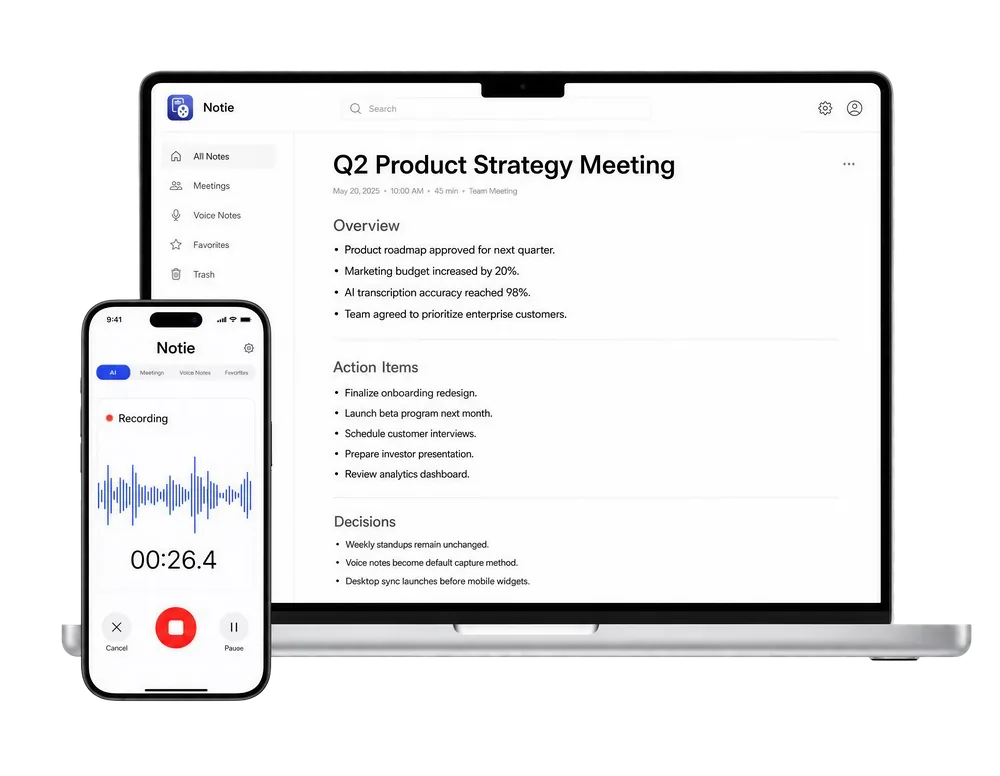
Notie doesn't just transcribe — it records meetings, calls, and voice notes, transcribes them with speaker labels in 100+ languages, and generates AI summaries with action items automatically. Try it free on iOS and Android.
Start for FreeChoosing the Right Method for Your Situation
| Situation | Recommended method |
|---|---|
| Single short quote to verify | Manual transcription |
| Quick text message or note | Built-in voice typing |
| Meeting or interview recording | AI transcription app (Notie) |
| Existing audio or video file | Audio to text converter |
| Video with dialogue | Video transcript generator |
| Multilingual conversation | AI tool with translation built in |
Transcribing Video Instead of Audio
If your source is a video rather than a standalone audio file, you have two options: extract the audio first with a tool like MP4 to MP3, or use a video transcript generator that handles the extraction automatically. The same applies to YouTube content — a YouTube transcription tool pulls text directly from a video URL without downloading anything.
5 Tips for a Cleaner Transcript
- Record close to the source. A phone six inches from the speaker beats one across the table, regardless of software quality.
- Minimize crosstalk. Ask people to speak one at a time when possible; overlapping speech is still the hardest case for every transcription engine.
- Reduce background noise by choosing a quieter room or muting non-essential devices before recording.
- Name speakers early in the recording ("Hi, this is Dana") so speaker-labeling features have a hook to work with.
- Always review names and technical terms, the most common place AI transcripts introduce small errors.
Once you have a clean transcript, the real value often comes next: turning it into a summary. Our guide on how to summarize an email covers prompt patterns that apply just as well to transcripts, and Notie's built-in AI summaries handle the same job automatically.