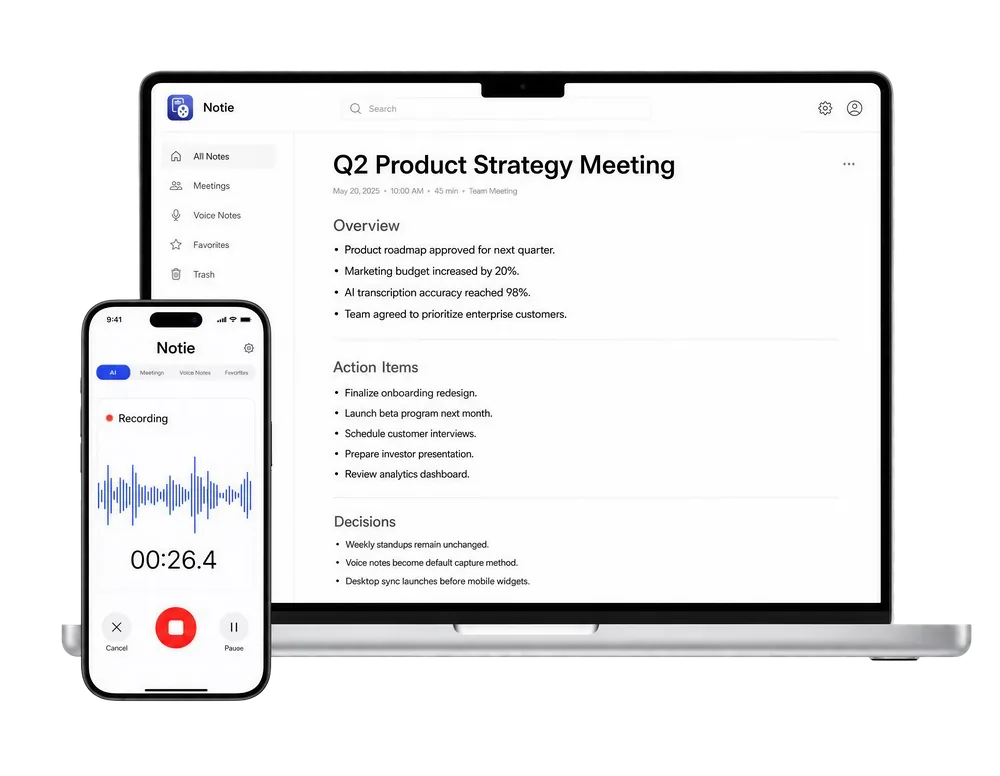
Speech recognition used to mean stilted, error-prone software that only worked if you spoke slowly into a headset. That era is over. Modern speech to text tools handle natural conversation, multiple speakers, background noise, and dozens of languages with accuracy that regularly tops 95 percent. The harder question is no longer "does it work" but which tool fits how and where you actually talk.
We compared the leading speech-to-text options across accuracy, language support, and what they do with a transcript once it exists — because a wall of raw text is very different from a searchable, summarized, action-item-ready note.
Speech to Text Tools at a Glance
| Tool | Best for | Standout strength |
|---|---|---|
| Notie | Meetings, calls, in-person conversations | Transcription plus AI summaries and live translation |
| Otter.ai | Web-conference transcription | Deep Zoom, Meet, and Teams integration |
| Rev | Highest-accuracy human review | Human transcription option alongside AI |
| Google's built-in voice typing | Free, casual short-form dictation | Built into every Android keyboard at no cost |
| Otter competitors like Fireflies | Sales call transcription | CRM and pipeline integrations |
1. Notie — Best Overall for Everyday Speech to Text
Notie is built around the idea that most important speech happens outside a browser tab: in-person meetings, phone calls, lectures, interviews, and voice memos. It transcribes with speaker labels, works in more than 100 languages, and turns raw transcripts into structured AI summaries with key points and action items automatically — so you are not left combing through a giant text file.
- Works anywhere: in-person conversations, calls, and video meetings all transcribe the same way.
- Live transcription: watch text appear in real time during a conversation with transcribe live.
- Built-in translation: translate audio to text across languages, useful for multilingual teams and travel.
- Honest tradeoff: it is mobile-first, so if your workflow is 100 percent desktop video calls with no phone nearby, a browser bot may feel more native.
2. Otter.ai — Best for Web-Conference-Only Teams
Otter's assistant joins Zoom, Google Meet, and Teams calls automatically and produces a live transcript alongside slide capture. For teams whose meetings happen entirely inside those three platforms, that automation is genuinely convenient. Its weak spots are in-person capture and language range, both of which lag mobile-first tools.
3. Rev — Best for Guaranteed High Accuracy
Rev offers both AI and human transcription, and its human-reviewed tier is close to 99 percent accurate — useful for legal depositions, medical transcripts, or anything that will be quoted publicly. The tradeoff is turnaround time and cost compared to fully automated tools.
4. Built-In Voice Typing (iOS and Android)
Every modern phone has a free microphone icon on the keyboard for short dictation — texts, quick notes, search queries. It is genuinely good for that purpose and costs nothing. It is not designed for long recordings: it typically stops after a pause and does not produce speaker labels or summaries.
Skip the raw transcript — get the summary too
Most speech-to-text tools stop at a wall of text. Notie records your conversations, transcribes them accurately, and delivers an organized summary with action items automatically. Try it free on iOS and Android.
Start for FreeWhat Actually Determines Accuracy
Before comparing brand names, understand what moves the accuracy needle in any tool:
- Audio quality: a close, quiet microphone beats any algorithm improvement.
- Number of speakers: overlapping speech is still the hardest case for every tool on the market.
- Accents and jargon: industry terms and less common accents reduce accuracy across the board; look for tools with custom vocabulary support.
- Language: English still leads in most tools' accuracy benchmarks, though the gap with other major languages is closing fast.
How to Choose the Right One
- Map where you talk. Mostly in-person or on your phone? Choose a mobile-first tool like Notie. Exclusively desktop video calls? A browser-bot tool may suit you fine.
- Decide if you need summaries. If you just need raw text for search, any accurate transcriber works. If you need action items and decisions extracted, prioritize AI summaries.
- Test with your actual audio. Run the same 5-minute recording through two candidates before committing to a subscription.
- Check language coverage if your conversations mix languages or happen outside English.
For a deeper walkthrough of turning any recording into text, see our step-by-step guide on how to transcribe audio to text, and for meeting-specific workflows, our comparison of the best AI note taking apps.