Conversational AI is the branch of artificial intelligence that lets software understand human language and respond in kind — by text or voice, across turns, with memory of what was said before. It is the technology behind modern assistants like ChatGPT and Claude, voice interfaces, customer-support agents, and note apps that let you ask questions about your own recordings.
The term gets used loosely, so this guide draws the lines clearly: what conversational AI actually is, how it differs from the clunky chatbots of the past, and where it delivers real value today.
How Conversational AI Works
A conversational system chains together several capabilities in milliseconds:
- Input processing: speech recognition converts voice to text (skipped for typed input).
- Natural language understanding (NLU): the system extracts meaning — intent, entities, and tone.
- Dialogue management: it tracks context across turns, so "what about Tuesday?" makes sense after a scheduling question.
- Response generation: a language model composes a relevant, natural reply.
- Output: the reply is delivered as text, or converted back to voice with speech synthesis.
The breakthrough of the last few years is the large language model (LLM). Older systems matched keywords against scripted flows; LLM-based systems genuinely model language, which is why talking to them feels natural rather than like navigating a phone menu.
Conversational AI vs. Traditional Chatbots
| Aspect | Rule-based chatbot | Conversational AI |
|---|---|---|
| Understanding | Keyword matching | Meaning and intent |
| Off-script questions | "Sorry, I didn't get that" | Handles novel phrasing |
| Context memory | None or minimal | Tracks the whole conversation |
| Setup | Hand-built decision trees | Pre-trained models, tuned with your data |
| Feel | Phone menu in text form | Natural dialogue |
Where Conversational AI Shines Today
- Customer support: resolving routine questions instantly and escalating the rest with full context.
- Personal assistants: drafting, planning, and answering questions — see our explainer on what ChatGPT is.
- Voice interfaces: hands-free control in cars, homes, and accessibility tools.
- Knowledge retrieval: asking questions of your own documents and meetings instead of scrolling through them.
- Language learning and translation: practicing conversation and bridging languages in real time.
Talking to Your Own Notes
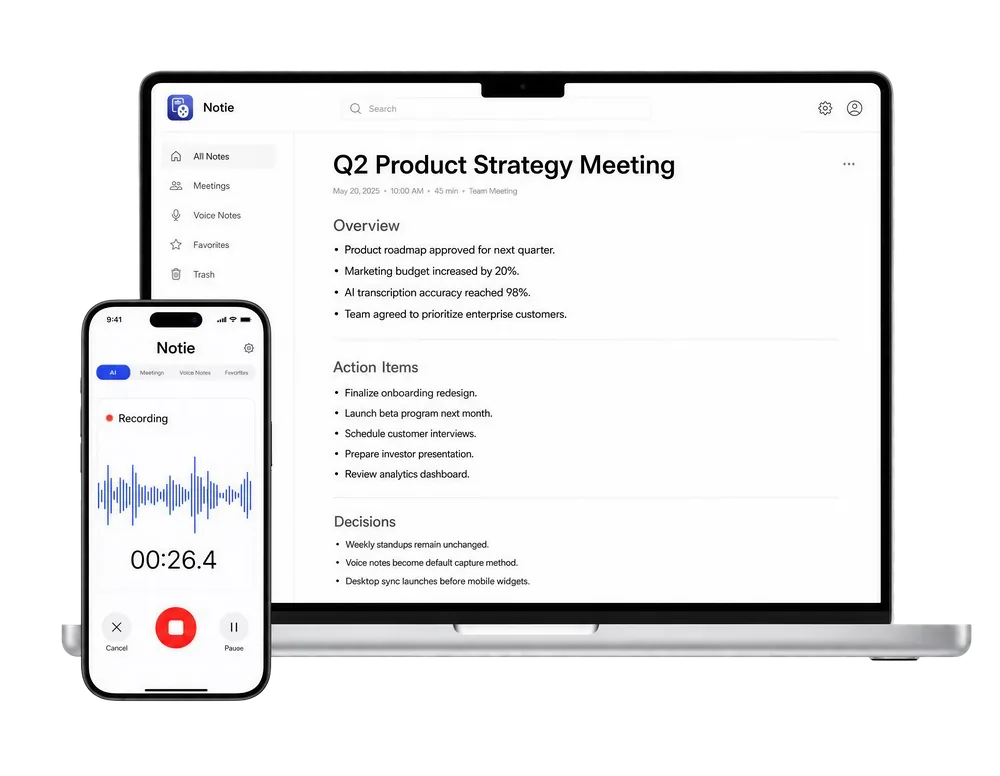
One of the most practical applications is conversational access to your own information. Notie applies this to meetings and voice notes: after recording and transcribing, its AI chat lets you ask things like "What did we decide about pricing?" or "List every task assigned to me" — and get answers grounded in the actual transcript, not a generic guess.
Have a conversation with your meetings
Notie records and transcribes your conversations, then lets you chat with them — ask for decisions, action items, or a summary in any language. Download Notie free on iOS and Android.
Start for FreeBenefits and Limitations
The benefits are speed and scale: instant answers, 24/7 availability, and no more digging through documents. The limitations are equally real. Conversational AI can state wrong things confidently, struggles with genuinely ambiguous requests, and raises privacy questions when conversations contain sensitive data. The mitigation is grounding: systems that answer from a specific source — your transcript, your knowledge base — are far more reliable than open-ended generation, and choosing tools with clear privacy policies matters when your input is business conversation.
What Comes Next
Conversational AI is moving from answering to acting: agents that book, schedule, and execute multi-step tasks from a natural-language request. Voice is becoming a first-class interface again, and multilingual conversation is approaching real-time. If you want the foundations first, start with our plain-English guide to what artificial intelligence is — then try a grounded assistant like Notie's AI answer generator to feel the difference between scripted bots and real conversational AI.