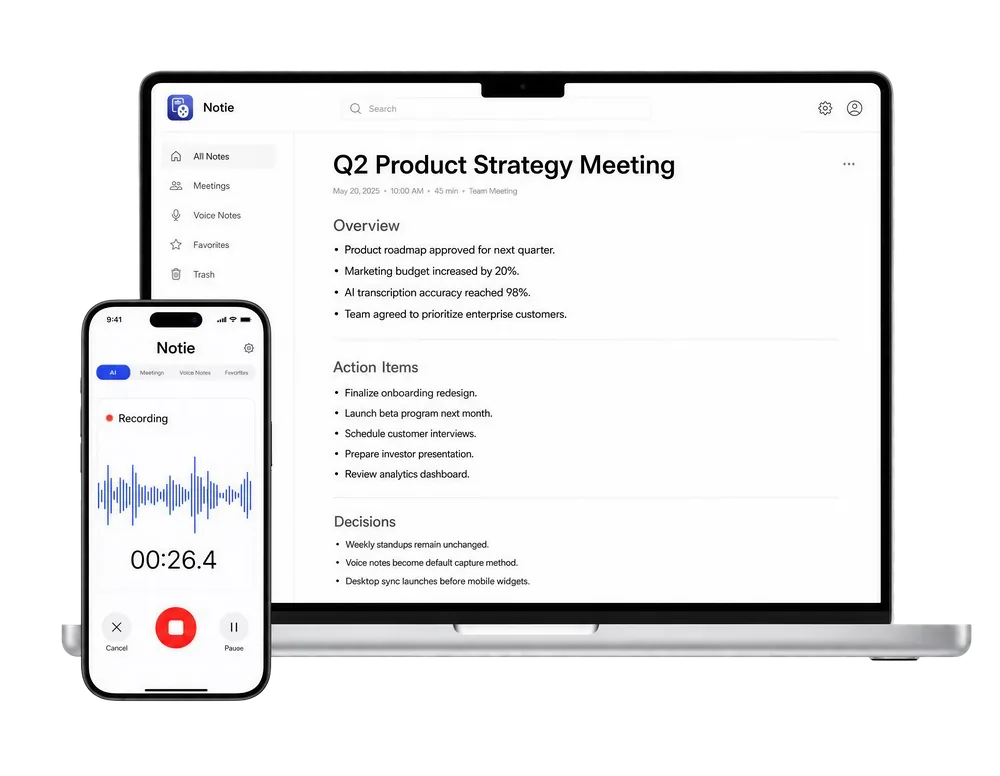
A phone recorder used to be a gadget-drawer curiosity. Today it is a professional necessity: client calls carry commitments, interviews carry quotes, and support calls carry the details you will be asked about next week. Memory is not a system — recordings are.
But two questions stop most people: is it legal, and what do I do with an hour of audio afterward? This guide answers both, covering consent rules in plain English, your recording options on iPhone and Android, and how call recording software with AI insights turns raw audio into summaries and action items automatically.
First Things First: Is Recording Calls Legal?
In the United States, recording laws are set state by state and fall into two camps:
- One-party consent (majority of states): if you are part of the call, you may record it without telling the other person.
- All-party consent (states including California, Florida, Illinois, Pennsylvania, Washington): everyone on the call must agree to the recording.
- Cross-state calls: when callers are in different states, the safest assumption is that the stricter law applies.
The practical rule that keeps you safe everywhere: announce the recording and get a yes. "I'd like to record this call so I can focus instead of taking notes — is that okay?" Almost nobody refuses, and the announcement itself is captured on the recording. This is not legal advice — for sensitive situations, check your state's current statute.
Your Phone Recorder Options
| Method | How it works | Consider |
|---|---|---|
| Built-in call recording | Native feature on newer iPhones and many Android phones | Availability varies by region and carrier; announcements may play |
| AI recorder app (e.g., Notie) | Records via microphone, often on speakerphone, then transcribes | Works everywhere; pairs recording with AI notes |
| Carrier or VoIP features | Recording built into business phone systems | Best for call centers; admin setup required |
| External recorder | A second device captures speakerphone audio | Simple and reliable; extra hardware to manage |
Recording on iPhone
Recent iOS versions added native call recording with automatic announcement to participants, and Apple pairs it with transcripts in supported regions. For everything the native option does not cover — in-person meetings, older devices, region limits — a recorder app on speakerphone remains the universal fallback.
Recording on Android
Availability depends on manufacturer, carrier, and country: some Pixel and Samsung phones include call recording in the dialer, others block it entirely. As with iPhone, a microphone-based recorder app works regardless of those restrictions.
Why AI Insights Beat Raw Recordings
Here is the dirty secret of call recording: nobody re-listens. An hour-long file is write-only storage unless something converts it into text you can scan. That is what separates modern call recording software with AI insights from a simple recorder:
- Transcription: every word becomes searchable text — see how AI transcription works.
- Summaries: key points, decisions, and commitments extracted automatically.
- Action items: the "I'll send that Friday" moments pulled out with owners.
- Q&A: ask the recording questions — "what price did we agree on?" — instead of scrubbing the timeline.
Notie handles the entire pipeline on your phone: record the call or meeting (with background recording so you can check other apps mid-call), get a transcript with voice to text accuracy, and receive an AI summary before you have poured your next coffee.
Record less busywork, keep more detail
Notie turns calls and meetings into transcripts, summaries, and action items automatically — in over 100 languages. Download it free on iOS and Android and stop trusting your memory.
Start for FreeBest Practices for Useful Call Recordings
- Announce and confirm consent at the start — every call, every state.
- Use speakerphone in a quiet room when recording via microphone; audio quality drives transcript quality.
- Name recordings immediately (client, date, topic) or use an app that organizes them for you.
- Review the AI summary within a day and move commitments into your task list.
- Delete what you do not need. Old recordings are liability, not archive.
A phone recorder is only half a workflow. Pair it with transcription and summaries — our guide on how to transcribe audio to text covers the second half — and every call you take becomes a document you can search, quote, and act on.