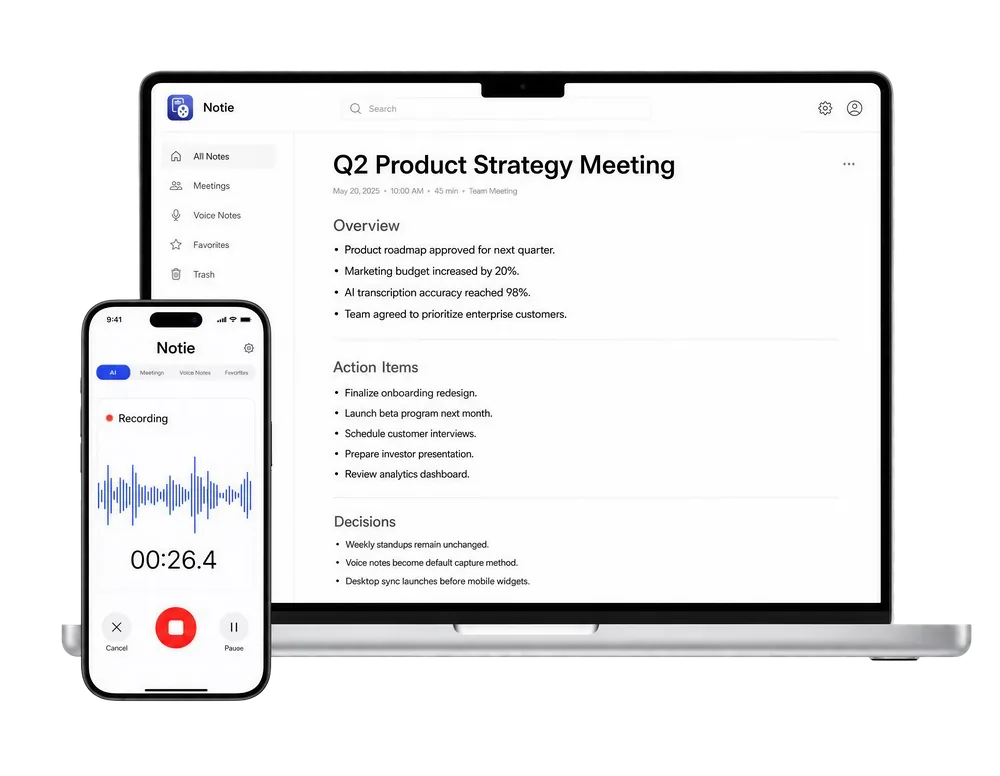
Most meeting notes fail for the same reason: they capture what people said instead of what the team decided. A week later, nobody remembers who owns the follow-up, the deadline is fuzzy, and the same topic lands on next week's agenda. The fix is not writing faster. It is starting from a meeting notes template with action items built in from the first line.
In this guide you will get a copy-ready template, learn which elements matter for different meeting types, and see how AI tools can fill most of the template automatically so you can stay present in the conversation.
Why a Meeting Notes Template Matters
A template removes decision fatigue. Instead of staring at a blank page while the meeting races ahead, you drop information into pre-labeled slots. Teams that standardize their notes see real benefits:
- Faster follow-up: action items with owners and due dates are visible at a glance.
- Fewer repeat discussions: decisions are recorded once and referenced later.
- Easier onboarding: anyone who missed the meeting can catch up in two minutes.
- Searchable history: consistent headings make old notes easy to scan and search.
The Core Elements of a Meeting Notes Template with Action Items
Whatever tool you use, a strong template contains six elements, in this order:
- Meeting basics: date, attendees, and the goal of the meeting in one sentence.
- Agenda: the topics you planned to cover, so gaps are obvious.
- Key discussion points: short bullets, not transcripts, grouped by topic.
- Decisions: every decision on its own line, phrased as a statement, not a question.
- Action items: task, owner, and due date. If any of the three is missing, it is not an action item yet.
- Parking lot: topics raised but deferred, so they do not get lost.
A Simple Template You Can Copy
Paste this structure into your notes app and duplicate it before every meeting. It works for standups, client calls, and project reviews alike:
- Meeting: [name] | Date: [date] | Attendees: [names]
- Goal: what a successful meeting looks like in one sentence
- Discussion: 3 to 6 bullets per agenda topic
- Decisions: "We will..." statements only
- Action items: [task] — [owner] — [due date]
- Parking lot: deferred topics and open questions
Let Notie fill the template for you
Notie records your meeting, transcribes it, and generates structured notes with decisions and action items automatically. You review and share instead of typing. Try it free on iOS and Android.
Start for FreeMatching the Template to the Meeting Type
The skeleton stays the same, but the emphasis shifts depending on the meeting. Use this quick reference:
| Meeting type | What to emphasize | Ideal length |
|---|---|---|
| Daily standup | Blockers and action items only | 5 to 8 lines |
| One-on-one | Feedback, career topics, private follow-ups | Half a page |
| Client call | Requests, commitments, and next steps | One page |
| Project kickoff | Scope, roles, milestones, risks | One to two pages |
| Brainstorm | Ideas grouped by theme, then shortlist | One page |
How to Keep Notes Actionable After the Meeting
A template only pays off if the notes get used. Build these three habits into your routine:
- Share within an hour. Notes lose accuracy and urgency fast; send them while context is fresh.
- Open the next meeting with the last action list. Nothing enforces accountability better.
- Move tasks into your task manager. Notes are the record; your to-do tool is the tracker.
Let AI Handle the Typing
Even with a great template, taking notes by hand splits your attention. An AI note taker like Notie records the conversation, transcribes it with speaker labels, and produces AI summaries that map neatly onto the template above: key points, decisions, and action items. You stay engaged in the discussion and spend two minutes editing instead of thirty minutes writing.
Start with the template, then automate it. If you want to sharpen the manual side of your craft first, read our guide on how to take meeting notes — the two approaches work best together.