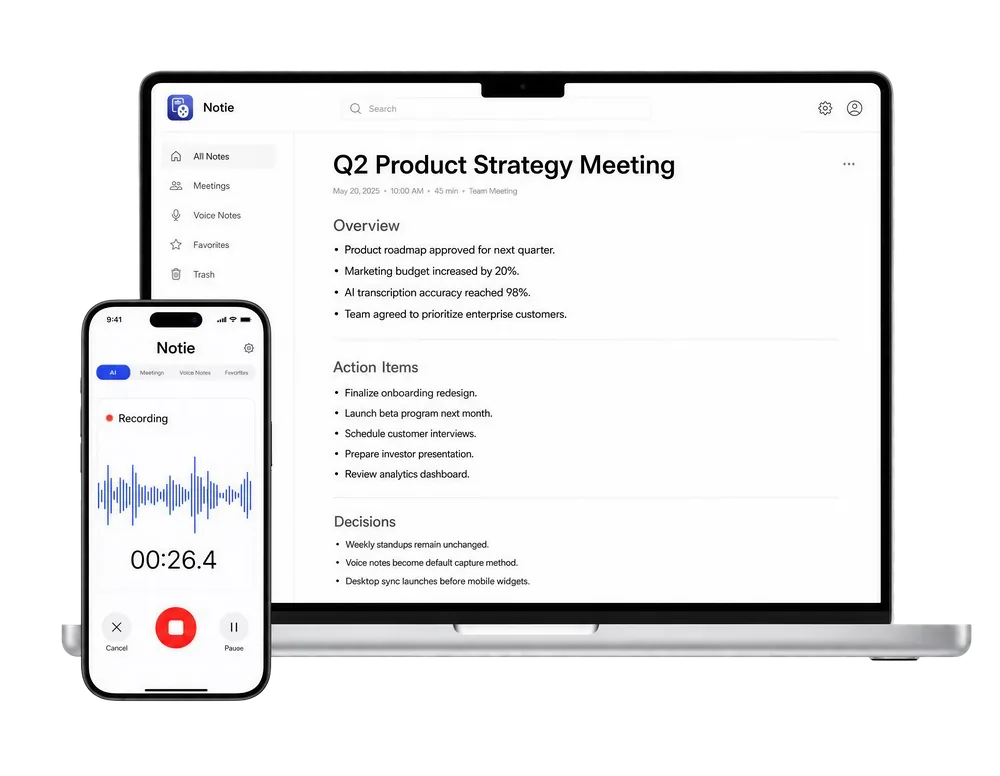
Every AI note taker makes the same pitch: stop typing, stay present, get perfect notes. But use three of them for a week and the differences jump out — one only works in web-conference calls, another buries action items in a wall of text, a third falls apart the moment someone switches languages. Picking the best AI note taking app for meetings means matching a tool to how you actually meet.
We compared the leading options across accuracy, summary quality, language support, and where they can record — desktop calls, phone calls, or in-person conversations. Here is what stands out.
Top AI Note Taking Apps at a Glance
| App | Best for | Standout strength |
|---|---|---|
| Notie | Mobile-first and in-person meetings | Transcription plus live translation in 100+ languages |
| Otter.ai | Web-conference heavy teams | Mature Zoom/Meet/Teams integrations |
| Fireflies.ai | Sales and CRM workflows | Pipeline integrations and topic trackers |
| Fathom | Free desktop call recording | Generous free tier for video calls |
| Notion AI | Teams already living in Notion | Notes and summaries inside your wiki |
1. Notie — Best for Mobile, In-Person, and Multilingual Meetings
Notie takes a different angle from the bot-joins-your-call crowd: it lives on your phone, which means it captures the meetings other tools miss — in-person standups, client lunches, site visits, lectures, and phone conversations. It records (including background recording while you use other apps), transcribes with speaker labels, and generates structured AI summaries with key points and action items.
- Works anywhere: in-person, on calls, or next to your laptop during video meetings.
- Live translation: translate meetings in real time across 100+ languages — rare among note takers.
- AI chat with your notes: ask questions about any transcript and get grounded answers.
- Honest tradeoff: it does not auto-join calendar meetings as a bot; you press record. For bot-style automation on desktop calls, pair it with your meeting platform's recorder.
2. Otter.ai — Best for Web-Conference Teams
Otter is the veteran. Its assistant joins Zoom, Meet, and Teams calls automatically, produces live transcripts, and generates summaries with slide capture. It is a strong choice if virtually all your meetings happen in a browser. Weaknesses: English-centric compared to multilingual tools, and in-person capture is not its focus.
3. Fireflies.ai — Best for Sales Workflows
Fireflies leans into revenue teams: it transcribes calls, tracks topics like pricing and objections, and pushes notes into CRMs. If your meetings are mostly pipeline calls, its integrations justify the price. For general note taking it can feel heavier than needed.
4. Fathom — Best Free Option for Desktop Calls
Fathom offers a genuinely useful free tier for recording and summarizing video calls, with clip sharing for highlights. Its scope is narrower — desktop video calls — but within that scope it is excellent value.
5. Notion AI — Best if You Already Live in Notion
Notion's AI meeting notes keep everything in your existing workspace, which beats juggling another app. Transcription depth and audio handling trail dedicated tools, but the convenience is real for Notion-first teams.
Try the note taker that goes where you go
Notie records in-person meetings, calls, and video meetings alike — then delivers transcripts, translations, and action-item summaries in minutes. Download Notie free on iOS and Android and never retype a meeting again.
Start for FreeHow to Choose
- Map where your meetings happen. Mostly in-person or on mobile? Choose Notie. Exclusively Zoom/Teams? Otter or Fathom fit naturally.
- Check language needs. Multilingual teams should test translation quality first — it varies more than transcription accuracy.
- Judge the summary, not the transcript. Run the same meeting through two tools and compare which summary you would actually send to your team.
- Verify privacy controls. Meetings contain sensitive content; look for features like private summaries and clear data policies.
Whichever tool you pick, the payoff is the same: you stop splitting attention between listening and typing. For the manual skills that still matter — what to verify, how to share — see our guide on how to take meeting notes.