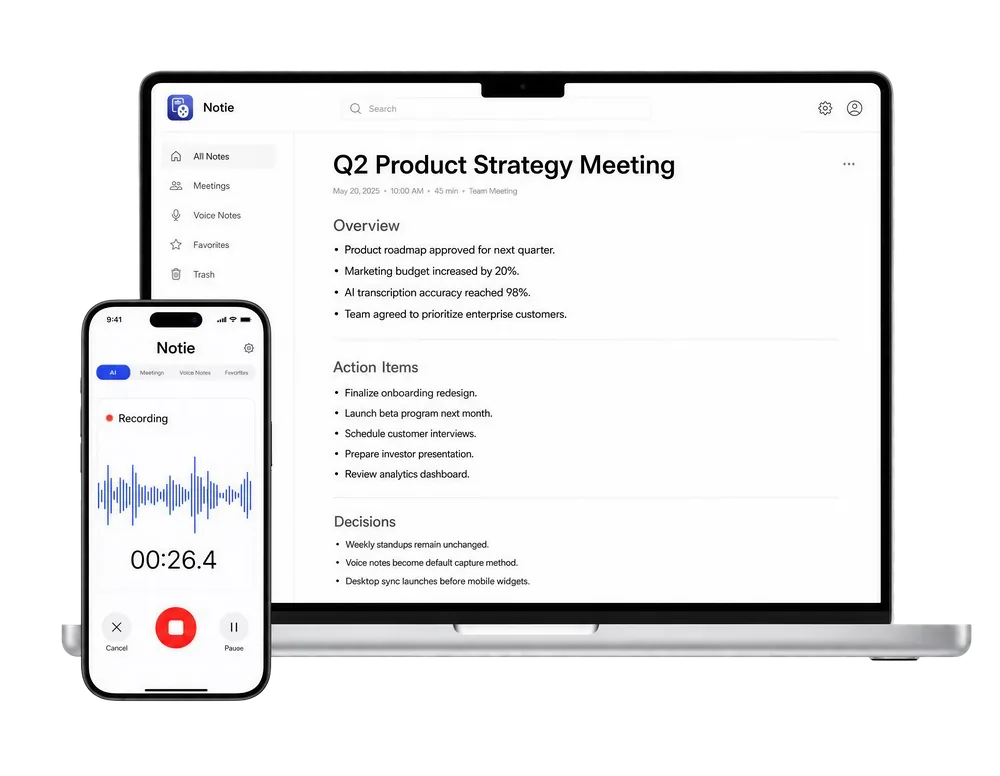
There are two kinds of meeting notes: the kind you never look at again, and the kind that runs your week. The difference is not handwriting speed or a fancy app — it is a system. People who take useful notes know exactly what to capture (decisions, owners, deadlines) and what to let go (everything else).
This guide walks through how to take meeting notes end to end: what to do before the meeting, which note-taking method to use during it, and how to close the loop afterward — including where AI can take over the typing entirely.
Before the Meeting: Two Minutes of Prep
Great notes start before anyone speaks. Spend two minutes on these steps:
- Duplicate your template. Pre-fill the date, attendees, and agenda so you only capture new information live. Our meeting notes template guide has a copy-ready structure.
- Write the meeting goal as a question. "Which vendor do we pick?" tells you what your notes must answer.
- Review the last meeting's action items. Half of most meetings is follow-up; have the list ready.
During the Meeting: Pick a Method
You do not need to invent a structure mid-conversation. Three proven methods cover almost every meeting:
| Method | How it works | Best for |
|---|---|---|
| Outline method | Topics as headings, details as indented bullets | Structured meetings with an agenda |
| Quadrant method | Page split into notes, decisions, actions, questions | Fast-moving discussions |
| Cornell method | Notes on the right, cues on the left, summary at bottom | Learning-heavy sessions and trainings |
The Golden Rule: Capture Outcomes, Not Dialogue
Do not transcribe. Write down decisions ("We will launch March 3"), action items (task, owner, due date), and genuine surprises. If a sentence does not change what someone will do next week, it probably does not belong in your notes. Aim for 10 to 20 lines per hour of meeting.
Use Shorthand That Survives a Week
- [AI] = action item, [D] = decision, [?] = open question
- Names as initials, dates as MM/DD
- Arrows for cause and effect: "budget cut -> timeline slips two weeks"
Or let Notie take the notes for you
Notie records the meeting, transcribes every word with speaker labels, and generates a structured summary with decisions and action items. You participate fully and review the notes in two minutes. Free on iOS and Android.
Start for FreeThe Note-Taker's Dilemma — and the AI Fix
Here is the uncomfortable truth: the person taking notes participates least. Splitting attention between listening and writing means doing both at half capacity. This is exactly the problem an AI note taker solves. Notie captures the full conversation with live transcription, then its AI produces the summary, decision list, and action items automatically. Your job shifts from stenographer to editor — you verify and refine instead of racing the conversation.
The hybrid approach works best: let AI capture everything, and jot only your personal reactions — commitments you made, ideas you want to pursue, questions to raise later.
After the Meeting: The 24-Hour Rule
- Clean up within an hour. Expand shorthand while memory is fresh; five minutes now saves twenty later.
- Share the same day. Notes that arrive tomorrow get read; notes that arrive next week get ignored.
- Move action items into your task manager. Notes record; task tools track.
- Open the next meeting with the action list. This single habit makes your notes the team's source of truth.
Common Mistakes to Avoid
- Writing everything down — volume is the enemy of usefulness.
- Action items without owners — a task nobody owns is a task nobody does.
- Keeping notes private — unshared notes help exactly one person.
- Never reviewing — notes are a system input, not a diary.
Learn one method, apply the golden rule, and close the loop within a day. Then let AI handle the mechanical half — you bring the judgment, Notie brings the AI summaries.