Here is the paradox of productivity tools: the time you spend researching, installing, and configuring them is often greater than the time they save. The people who get the most done rarely have the biggest stacks — they have one dependable tool per job and the discipline to stop shopping.
This guide organizes the entire productivity landscape into six categories. Pick one tool in each, skip the rest, and reinvest the saved attention in actual work.
The Six Categories That Cover Everything
| Category | Job it does | Solid picks |
|---|---|---|
| Task management | Tracks what needs doing and by when | Todoist, TickTick, Things |
| Notes & knowledge | Stores what you know and decide | Notion, Obsidian, Apple Notes |
| Meetings & capture | Turns conversations into records | Notie, Otter.ai, Fathom |
| Calendar & scheduling | Protects your time | Google Calendar, Fantastical, Calendly |
| Focus | Defends attention from interruptions | Forest, Freedom, One Sec |
| Automation | Connects tools so you do not copy-paste | Zapier, Make, Shortcuts |
Task Management: One List to Rule Them All
The tool matters less than the rule: everything you commit to goes in one place. A task in your head is a background process draining focus; a task in your system is a decision already made. Choose the simplest app you will actually open daily.
Meetings and Capture: The Overlooked Time Sink
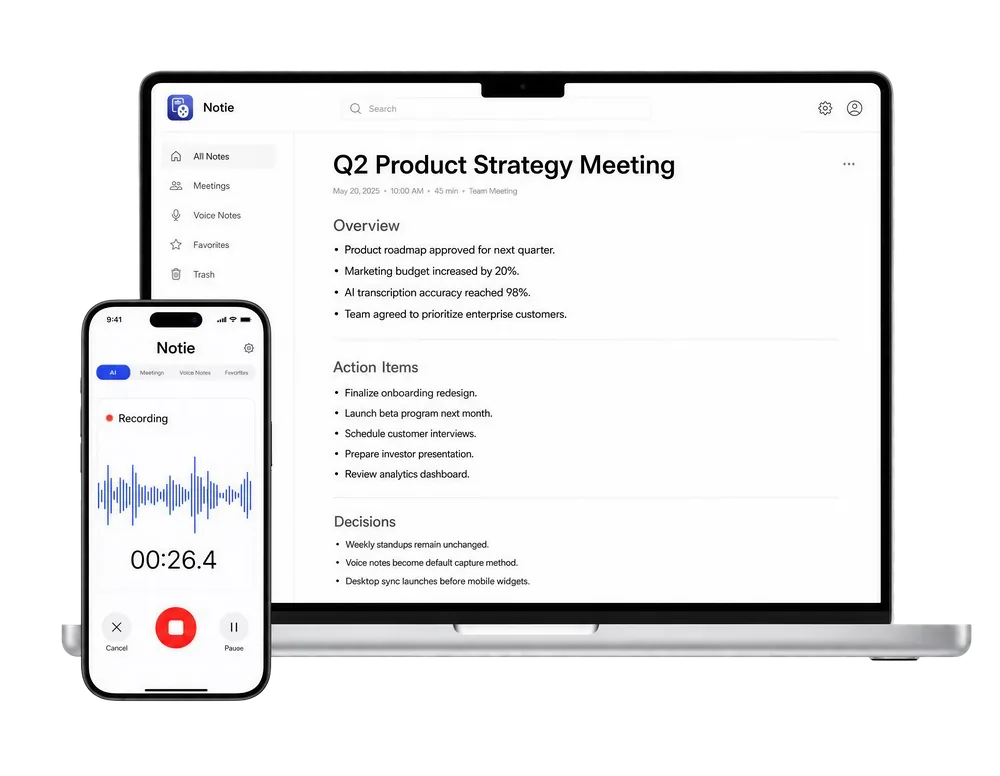
Most professionals spend 10 to 20 hours a week in meetings and calls, then lose the output to bad notes. This is the single biggest productivity leak in knowledge work — and the easiest to fix with AI. An AI note taker like Notie records meetings, transcribes them, and delivers summaries with action items, converting hours of conversation into two minutes of review. It works for in-person meetings, calls, and voice notes alike, and its AI summaries flow straight into your task manager.
Reclaim your meeting hours with Notie
Notie records, transcribes, and summarizes your meetings so nothing gets lost and nothing needs retyping. Try it free on iOS and Android — your task list will thank you.
Start for FreeFocus Tools: Subtraction Beats Addition
The highest-ROI productivity moves are subtractive: fewer notifications, fewer open tabs, fewer meetings. Focus apps that block distractions during deep-work sessions often outperform every fancy organizational system, because they attack the real bottleneck — attention.
AI Across the Stack
AI is not a seventh category; it is a layer being added to all six. The most useful examples today:
- Summarization: condense long documents and threads with an AI summarizer before deciding what deserves a full read.
- Transcription: turn voice notes and meetings into searchable text automatically.
- Drafting: get first drafts of emails and documents in seconds, then edit.
- Document Q&A: ask questions of PDFs and reports with tools like Chat PDF instead of skimming.
For a deeper dive into which assistants and generators are worth your time, see our roundup of the best AI tools.
How to Build Your Stack (and Stop)
- Audit one week. Note where hours actually go — meetings and communication usually dominate.
- Fix the biggest leak first. For most people, that is meeting capture or focus, not task management.
- One tool per category. Overlap creates sync problems and decision fatigue.
- Give each tool two weeks. Adopt or delete; no zombie subscriptions.
- Stop shopping. A finished stack you use beats a perfect stack you keep rebuilding.
Productivity tools cannot create motivation, and they cannot prioritize for you. What they can do is remove friction — the retyping, the searching, the "what did we agree?" — so your effort lands on work that matters.