Recruiters spend roughly seven seconds on a first resume scan, and most of that lands on the top third of the page. That is exactly where your resume summary sits — three or four lines that either buy you a full read or send you to the archive. It is the highest-leverage real estate in your entire application.
This guide gives you a formula that works for any role, examples by career stage, and the honest way to use AI as a drafting partner without sounding like everyone else who used AI.
What Is a Resume Summary?
A resume summary is a 2 to 4 sentence pitch at the top of your resume that answers three questions instantly: who are you professionally, what results have you delivered, and why do you fit this role. It replaced the old-fashioned objective statement for a simple reason — objectives describe what you want; summaries describe what the employer gets.
| Resume objective (outdated) | Resume summary (use this) | |
|---|---|---|
| Focus | What you want from the job | What you deliver to the employer |
| Tense | Forward-looking wishes | Evidence from your track record |
| Example | "Seeking a growth role..." | "Marketing manager who grew organic traffic 3x..." |
| Best for | Almost no one today | Everyone with any experience |
The Formula
Strong summaries follow the same skeleton. Fill in four slots:
- Identity: title plus years of experience — "Senior accountant with 8 years in SaaS."
- Proof: one or two quantified achievements — "cut month-end close from 10 days to 4."
- Skills that match the posting: mirror two or three keywords from the job description.
- Direction: one clause connecting you to this role — "now focused on scaling finance ops for growth-stage teams."
Examples by Career Stage
- Entry level: "Recent CS graduate with internship experience shipping two production React features. Built a course-scheduling app used by 1,200 students. Seeking to bring strong fundamentals and fast learning to a junior developer role."
- Mid-career: "Project manager with 6 years delivering B2B software launches. Led a 12-person cross-functional team to ship 9 releases on schedule, cutting cycle time 30%. PMP-certified, now focused on enterprise implementation programs."
- Career changer: "Former teacher turned UX researcher who ran 40+ usability studies during a fellowship year. Brings a decade of classroom insight into how real people learn interfaces. Seeking a research role on an education product team."
- Executive: "Operations executive who scaled a logistics company from 40 to 300 employees while raising margins 8 points. Known for building systems before they are needed. Exploring COO roles in high-growth supply-chain businesses."
Draft it out loud with Notie
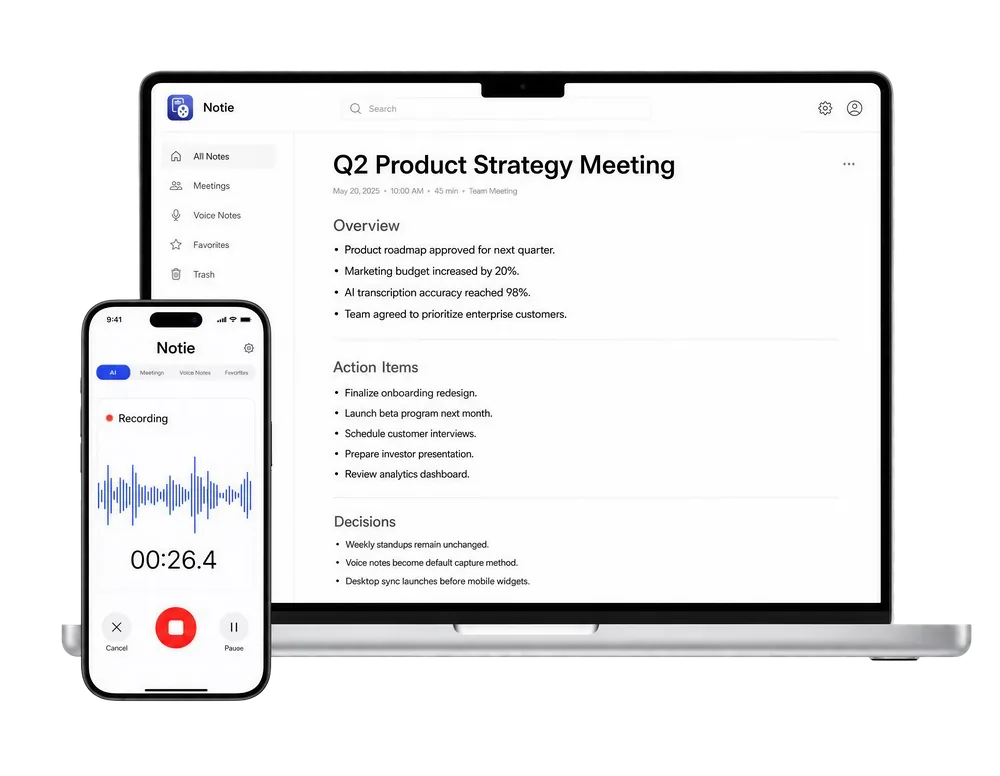
Struggling to summarize your own career? Talk it out. Record yourself describing your proudest wins in Notie, get an instant transcript, and let the AI summary surface your strongest lines. Free on iOS and Android.
Start for FreeMistakes That Get Summaries Skipped
- Buzzword soup: "results-driven team player with a passion for excellence" says nothing — every phrase must survive the question "could my competitor claim this too?"
- No numbers: unquantified claims read as opinions; quantified ones read as facts.
- One-size-fits-all: adjust the skills slot for every application; recruiters and applicant tracking systems both check for keyword fit.
- Too long: four sentences maximum. The summary earns the read; it is not the read.
Using AI Without Sounding Like AI
AI is an excellent drafting partner and a terrible ghostwriter. Feed an AI paragraph generator your raw wins and the job description to get structural drafts, then rewrite in your own voice — a paragraph rewriter helps you iterate on tone, and an AI sentence rewriter can tighten a clunky line. The details that make a summary land — the specific number, the odd career turn — come from you. The same skill applies across work life; if you enjoy the craft of compression, our guide on how to summarize an email applies the same muscles to your inbox.
Write the summary last, after the rest of the resume is done. By then your best evidence is on the page — the summary just moves it to the top, where those seven seconds are spent.