Summarizing an article sounds simple — read it, then say it shorter — yet most summaries fail in one of two ways. Either they're a haircut (the original text lightly trimmed, sentence by sentence) or they're a vibe (a vague gesture at the topic with none of the substance). A real summary is neither: it's the article's core argument and essential support, restated in your own words at a fraction of the length.
It's also a genuinely valuable skill. Students need it for essays and study notes, professionals for briefings and research, writers for literature reviews. And in the age of AI, knowing how to summarize well matters twice: it makes your own summaries better, and it makes you a sharper editor of the machine-generated ones.
This guide covers the manual method step by step, a worked example, the classic mistakes, and where AI shortcuts like an article summarizer fit into a smart workflow.
What Makes a Good Summary
- Complete: It captures the main claim and the key supporting points — a reader who never sees the original understands what it argued.
- Faithful: No added opinions, no distorted emphasis. The author would nod at your version.
- Concise: Typically 10–25% of the original length; a 2,000-word article becomes 200–400 words, or 3–5 bullets.
- In your own words: Paraphrase, don't patchwrite. Copying sentence structures with swapped synonyms is still copying.
- Properly attributed: Name the source and author, especially in academic or professional writing.
How to Summarize an Article in 5 Steps
Step 1: Skim for the Skeleton
Before reading closely, spend two minutes on the title, subheadings, first and last paragraphs, and any figures. This reveals the article's structure and likely thesis, so when you read properly, you're confirming a hypothesis rather than wandering.
Step 2: Read Actively and Mark Sparingly
Read the full piece once without highlighting anything — highlighting on the first pass marks what sounds impressive, not what matters. On a second pass, mark only the thesis, one key point per section, and any pivotal evidence. If you've highlighted more than 10% of the article, you're hoarding, not selecting.
Step 3: Answer the Core Questions
- What is the author's main claim, in one sentence?
- What are the 2–4 pieces of support that carry that claim?
- What conclusion or implication does the author land on?
- Who is this written for, and does that shape the argument?
Step 4: Write Without Looking
Close the article and draft your summary from memory using your answers from Step 3. This single habit — writing away from the source — is the most reliable way to force genuine paraphrasing and reveal what you actually understood. Start with a sentence naming the source and its main claim, then the supporting points in logical order.
Step 5: Verify Against the Original
Reopen the article and check your draft for accuracy: numbers, names, causal claims, and anything you stated more confidently than the author did. Trim anything that isn't essential. Done.
A Worked Example
Imagine a 1,800-word article titled "Why Four-Day Workweeks Keep Passing Their Trials." It reports that companies piloting four-day weeks maintained productivity, cites employee wellbeing data and two company case studies, notes scheduling challenges in customer-facing roles, and concludes that adoption will grow in knowledge work but stay rare in service industries. A strong three-sentence summary:
In "Why Four-Day Workweeks Keep Passing Their Trials," the author argues that four-day week pilots consistently succeed because output holds steady while burnout drops, citing trial data and two company case studies. The article acknowledges that customer-facing businesses struggle with coverage scheduling. It concludes that the model will spread through knowledge work but remain uncommon in service industries.
Notice what's absent: no minor statistics, no quotes, no opinion about whether the author is right. Claim, support, caveat, conclusion — 60 words.
Summarize Articles, Lectures, and Meetings in Seconds
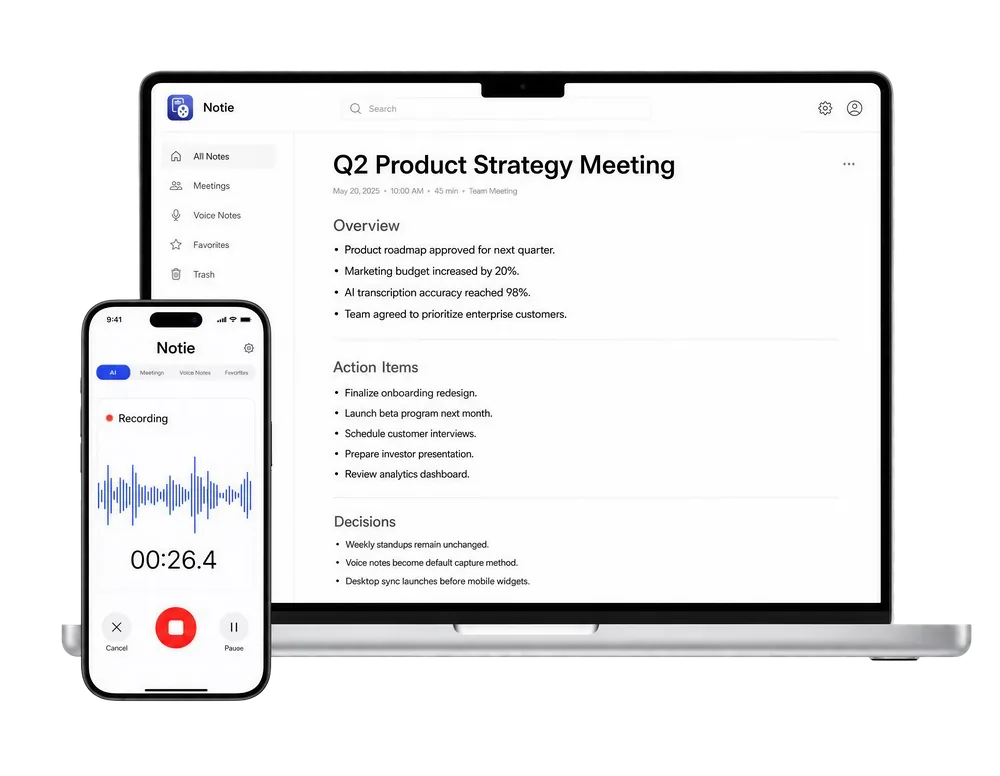
Notie's AI turns long content into clear, structured summaries — and it doesn't stop at text. Record a lecture or meeting and get the transcript, key points, and action items automatically. Download Notie free for iOS and Android.
Start for FreeCommon Summarizing Mistakes
- Patchwriting: Rearranging the author's sentences with synonyms — plagiarism detectors and professors both catch it.
- Equal weight for unequal points: A summary that gives one sentence per section flattens the argument; the thesis deserves more space than a side note.
- Smuggled opinion: "The author unconvincingly claims..." is analysis, not summary. Keep them separate.
- Detail hoarding: Statistics are supporting cast; include a number only when the argument collapses without it.
- Missing attribution: Always anchor the summary to its source in the first sentence.
Manual vs. AI Summarizing: When to Use Which
| Situation | Best Approach | Why |
|---|---|---|
| Studying for an exam | Manual | The struggle of condensing is what encodes memory |
| Academic writing / citations | Manual, AI-assisted checking | You're accountable for accuracy and voice |
| Triaging 20 articles for research | AI first, read the survivors | Speed matters more than depth at the filtering stage |
| Team briefing on one long report | AI draft + human edit | Fast, but a human verifies numbers and tone |
| Newsletters and general reading | AI | Low stakes, high volume |
AI Shortcuts That Actually Help
AI summarizers have become genuinely good, and using them is not cheating when the goal is comprehension or triage. A dedicated AI summarizer condenses pasted text or links in seconds; for research papers and reports, a PDF summarizer preserves document structure; and for spoken content — lectures, interviews, podcasts — apps like Notie transcribe first and then generate AI summaries with key points you can question afterward. Two rules keep AI summaries honest: always spot-check numbers and causal claims against the source, and for anything you'll be tested on or quoted about, do the final pass yourself.
For a full comparison of the current options, see our tested ranking of the best AI summary tools.
Quick Reference: The 5-Step Method
- Skim the structure — title, headings, first and last paragraphs.
- Read fully once, then mark the thesis and one point per section.
- Answer: main claim, key support, conclusion, audience.
- Write the summary from memory, source named in sentence one.
- Verify facts against the original and cut the non-essential.
Summarizing is compression with judgment — and judgment improves with reps. Do it manually where learning matters, delegate to AI where volume matters, and you'll get through more reading with better retention than either approach alone.