The average knowledge worker now faces more text, audio, and video in a day than anyone can honestly process: meeting recordings, reports, newsletters, hour-long YouTube explainers, group chats that scroll forever. AI summary tools have become the practical answer — software that reads or listens for you and hands back the points that matter.
But "summarizer" now describes wildly different products. Some are chatbots you paste text into. Some live inside your meetings. Some specialize in PDFs, videos, or podcasts. Picking the right one depends less on which AI model is smartest and more on where your content lives and how you want the summary delivered.
We spent weeks testing the leading options across four content types — articles, documents, meetings, and video — grading each on summary quality, speed, format options, and price. Here's what we found.
What Separates a Great Summarizer from a Mediocre One
- Faithfulness: The summary must reflect what the source actually says — no invented claims, no dropped caveats.
- Compression judgment: Good tools know a 40-minute meeting needs decisions and action items, while a research paper needs methodology and findings.
- Input flexibility: The best tools accept text, links, PDFs, audio, and video rather than forcing copy-paste gymnastics.
- Output control: Bullet points, paragraphs, action items, chapter breakdowns — you should choose the shape.
- Follow-up ability: Being able to ask questions about the source after the summary is the difference between a snippet and real understanding.
The Best AI Summary Tools, Ranked
1. Notie — Best for Meetings, Voice, and Anything You Hear
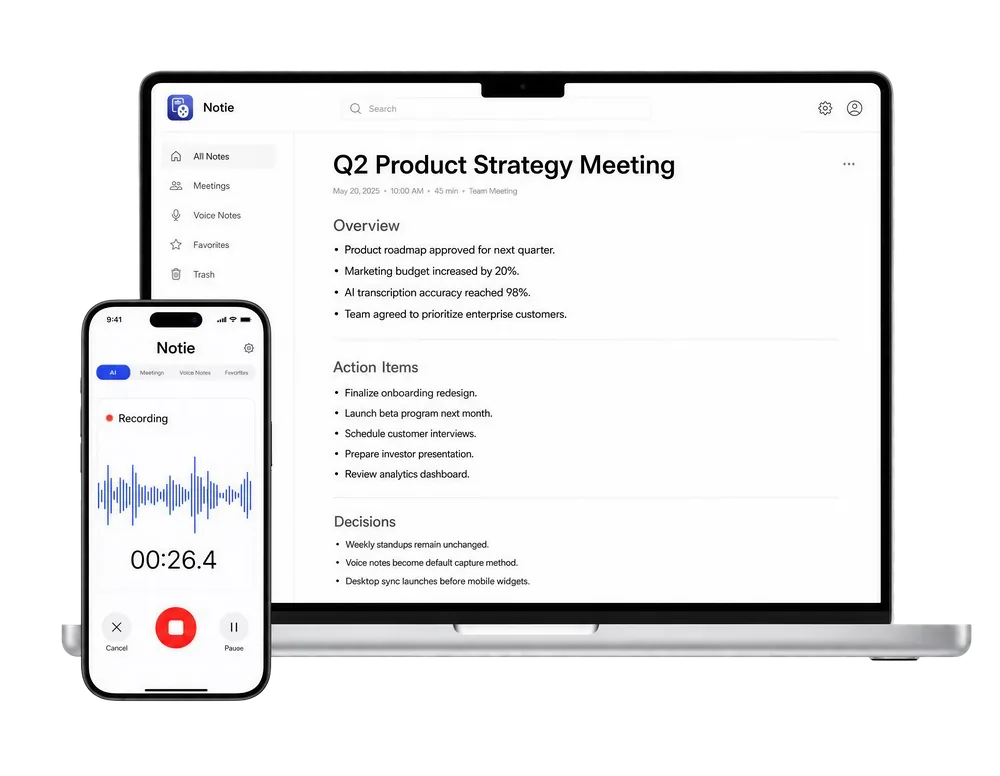
Notie takes the top spot for spoken content because it handles the entire pipeline in one mobile app: record a meeting, lecture, or interview (or import audio and video files), get an accurate transcript, and receive structured AI summaries with key points and action items in seconds. It transcribes and translates in dozens of languages, works with live transcription during the conversation, and lets you chat with your notes afterward to pull out details the summary didn't surface. For students, journalists, and anyone whose day runs on conversations, it replaces three separate tools.
2. ChatGPT — Best General-Purpose Summarizer
Paste in text, upload a file, and ChatGPT produces solid summaries with fully customizable format and tone. Its strength is flexibility: you can request an executive summary, an ELI5 version, or a table of pros and cons. Its weakness is workflow — it wasn't built for recurring summarization, so every session starts from scratch, and audio or video requires transcribing elsewhere first.
3. Claude — Best for Long Documents
Anthropic's Claude handles very long documents gracefully, keeping track of arguments across hundreds of pages where other tools lose the thread. If your work involves contracts, research papers, or book-length reports, Claude's long-context summaries are consistently among the most faithful we tested.
4. Otter.ai and Fireflies — Best for Teams in Scheduled Meetings
Both tools focus on calendar-connected meeting capture: they join your Zoom, Meet, or Teams calls, transcribe them, and email recaps to attendees. They're strong for distributed teams with heavy meeting loads, though they're desktop-and-calendar-centric — less useful for in-person conversations, lectures, or spontaneous recordings where a mobile-first tool like Notie fits better.
5. QuillBot and TLDR This — Best Quick Text Summarizers
For fast, free summarization of pasted text or article URLs, QuillBot's summarizer and TLDR This do the job with minimal friction. They lack follow-up chat and multi-format input, but for the occasional long article they're perfectly serviceable.
Summarize Anything You Can Hear
Meetings, lectures, voice memos, interviews — Notie records, transcribes, and summarizes them automatically, then lets you ask questions about any note. Join millions of users saving hours every week. Download Notie free for iOS and Android.
Start for FreeComparison Table: AI Summary Tools at a Glance
| Tool | Best For | Inputs | Follow-up Chat | Free Option |
|---|---|---|---|---|
| Notie | Meetings, voice, mobile | Audio, video, live recording | Yes | Yes |
| ChatGPT | General text | Text, files, images | Yes | Yes |
| Claude | Long documents | Text, files | Yes | Yes |
| Otter.ai | Scheduled team calls | Zoom/Meet/Teams, audio | Yes | Limited |
| Fireflies | Sales and team meetings | Calendar meetings | Yes | Limited |
| QuillBot | Quick text summaries | Pasted text | No | Yes |
| TLDR This | Articles and URLs | Text, links | No | Yes |
Choosing by Content Type
Articles and Web Pages
For news, blog posts, and research articles, a dedicated article summarizer is faster than opening a chatbot — paste the text or link and get key points instantly. If you do this constantly, learn the manual skills too; our guide on how to summarize an article covers when human judgment beats automation.
PDFs and Reports
Long PDFs deserve tools that respect structure — headings, tables, appendices. A PDF summarizer extracts the document's core arguments, and pairing it with a chat-with-PDF workflow lets you interrogate specific sections without rereading.
Video and Podcasts
Video is the most time-expensive format, which makes summarization most valuable here. A video summarizer or podcast summarizer can turn an hour of content into a two-minute read — ideal for triaging which episodes actually deserve a full watch.
Meetings and Conversations
This is where summarization pays the biggest dividends, because meetings produce obligations, not just information. The best tools identify decisions, owners, and deadlines — not just topics. Notie's AI meeting assistant approach was the strongest we tested for in-person and mobile scenarios, while Otter and Fireflies serve calendar-heavy remote teams well.
Tips for Better AI Summaries (Whatever Tool You Use)
- Tell the tool who the summary is for. "Summarize for an executive who missed the meeting" beats a generic request every time.
- Ask for structure. Request sections like Key Decisions, Action Items, and Open Questions to make summaries scannable.
- Verify numbers and names. Summarizers occasionally garble figures; spot-check anything you'll repeat or act on.
- Keep the source linked. A summary should be an index into the original, not a replacement — good tools keep transcript and summary connected.
- Summarize on a schedule. A weekly pass over your notes and saved articles compounds; ad-hoc summarizing doesn't.
The Verdict
There's no single best summarizer — there's a best summarizer per content type. For spoken content and mobile-first capture, Notie leads. For pasted text and one-off documents, ChatGPT and Claude are excellent. For calendar-bound team meetings, Otter or Fireflies fit naturally. Most heavy users end up with two: one for text, one for audio and meetings. Given that summarization now saves the average user several hours weekly, that's a stack worth building.