With AI writing tools everywhere, a parallel industry has exploded: AI detectors that claim to tell whether a piece of text was written by a human or a machine. Teachers run essays through them, editors screen freelance submissions, and SEO teams check content before publishing. But the detectors themselves vary wildly in accuracy — and even the best ones make mistakes with real consequences.
The honest answer to "what is the best AI detector" is more nuanced than most listicles admit. No detector is reliable enough to serve as sole proof that someone used AI, and every major tool produces false positives that have flagged human writing — including, famously, historical documents — as machine-generated.
In this guide we compare the leading AI text detectors, explain how the technology works, show where it breaks down, and offer practical advice for teachers, editors, and writers on both sides of the detection question.
How AI Text Detectors Work
Most detectors analyze statistical patterns in text. Two concepts come up constantly:
- Perplexity measures how predictable each word is. AI models tend to choose statistically likely words, producing lower-perplexity text than humans, who make quirkier choices.
- Burstiness measures variation in sentence length and structure. Human writing swings between long, winding sentences and short punches; AI output is often more uniform.
- Classifier training: Modern detectors are machine-learning models themselves, trained on millions of samples of known human and known AI text to recognize subtle fingerprints.
The core problem: these are probabilistic signals, not proof. A skilled human writing plainly can look "AI-like," while AI text that's been edited, paraphrased, or generated with a creative prompt can sail through undetected. Non-native English speakers are flagged disproportionately because their prose tends toward safer, more predictable phrasing — a bias documented in academic research.
The Top AI Detectors Compared
| Detector | Best For | Free Tier | Notable Strength | Notable Weakness |
|---|---|---|---|---|
| GPTZero | Educators | Yes, limited | Sentence-level highlighting, education focus | Can flag formulaic human writing |
| Originality.ai | SEO and publishers | No (paid credits) | High sensitivity, plagiarism combo | Sensitivity raises false positives |
| Copyleaks | Enterprises and LMS | Limited trial | Multi-language support, API, integrations | Interface geared to organizations |
| Turnitin | Universities | Institutional only | Built into existing academic workflow | Not available to individuals |
| Winston AI | Agencies | Trial credits | Readable reports, OCR for scanned docs | Smaller track record |
| ZeroGPT | Casual checks | Yes | Free and fast | Least consistent accuracy of the group |
GPTZero
GPTZero became the household name in AI detection after launching as a student project in early 2023. It's built with educators in mind: reports highlight which sentences look AI-generated, and it offers class-level dashboards and integrations with learning platforms. Its documentation is unusually honest about limitations, recommending results be treated as signals for conversation rather than verdicts.
Originality.ai
Originality.ai targets content marketers and publishers who need to screen freelance work at scale. It combines AI detection with plagiarism checking and fact-check aids, and independent tests generally rank its detection sensitivity among the highest available. The flip side of high sensitivity is a real false-positive rate, so its scores should be a starting point for review, not grounds for automatic rejection.
Copyleaks, Turnitin, and Winston AI
Copyleaks stands out for multi-language detection and enterprise APIs. Turnitin, the academic-integrity incumbent, added AI detection to the plagiarism checker universities already use — powerful placement, though only institutions can access it. Winston AI has carved out a niche with clean reports and OCR support for scanned documents, useful for handwritten or printed submissions.
The Best Defense: Notes That Prove Your Work
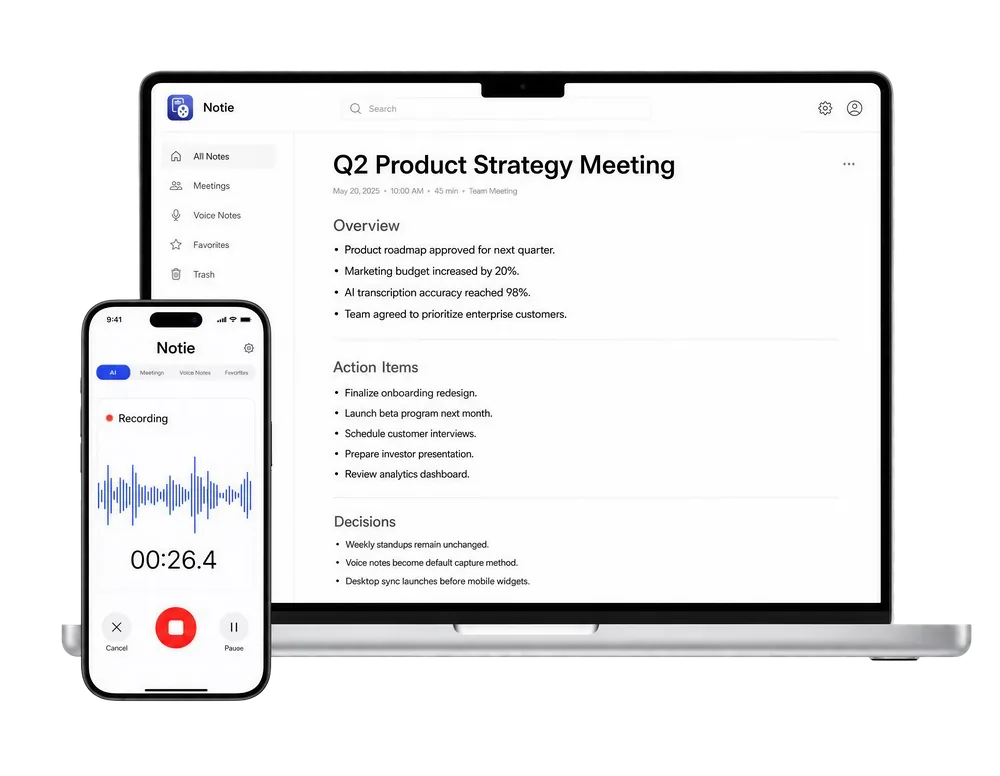
Worried about false positives? Document your process. Notie captures your interviews, brainstorms, and voice notes with timestamped transcripts and AI summaries — a verifiable trail showing your ideas are genuinely yours. Try Notie free on iOS and Android.
Start for FreeHow Accurate Are AI Detectors, Really?
Vendor-claimed accuracy figures (often 98%+) come from controlled tests on unedited AI output. Real-world conditions are messier. Independent studies and journalist tests consistently find three things: detectors catch raw, unedited AI text fairly well; accuracy drops sharply once text is paraphrased or lightly edited by a human; and false positives on genuine human writing are rare per-document but inevitable at scale. If a detector with a 1% false-positive rate screens 10,000 student essays, roughly 100 innocent students get flagged. That math is why many universities have disabled automatic AI detection entirely and treat scores as one input among many.
- Never treat a score as proof. Use it as a prompt to look closer — version history, drafts, and a conversation reveal far more.
- Check multiple detectors. Agreement across two or three tools is a stronger signal than any single score.
- Beware of "humanizer" arms races. Paraphrasing tools designed to beat detectors also degrade writing quality, and detectors retrain against them constantly.
Advice for Writers Worried About False Positives
If you write for clients, school, or publications, protect yourself before disputes happen. Draft in tools with version history (Google Docs tracks every edit), keep your research notes and outlines, and develop a distinct voice — specific examples, personal experience, and varied sentence rhythm are things generic AI output lacks. If you record interviews or brainstorm out loud, an AI note taker like Notie preserves timestamped voice notes and transcripts that document your process from idea to draft — evidence no detector score can argue with.
And if you use AI legitimately as an assistant, be transparent about it. Summarizing sources with an article summarizer, cleaning up grammar with a paragraph rewriter, or restructuring your own sentences with an AI sentence rewriter are widely accepted uses — the line most institutions draw is at passing off wholly machine-generated work as your own.
So, What Is the Best AI Detector?
For most people, GPTZero is the best starting point: free to try, transparent about limitations, and designed for the education scenarios where detection matters most. Originality.ai is the pick for publishers screening content at volume, and Copyleaks wins for enterprise and multi-language needs. Whichever you choose, adopt the rule every responsible institution has landed on: a detector score opens a conversation. It should never end one.