YouTube is the world's biggest library, but its books can't be skimmed. A 45-minute tutorial might contain four minutes of the information you need, and the only built-in navigation is scrubbing and hoping. That's why summarizing YouTube videos has become one of the most common AI use cases — and why the quality gap between a lazy prompt and a good one is enormous.
"Summarize this video" gets you a vague paragraph. A well-built video summarizer prompt gets you timestamps, key arguments, action steps, and quotes — the difference between a book jacket and actual CliffsNotes.
This guide gives you copy-paste prompts for every situation, explains the one technical requirement most people miss (the AI needs the transcript), and covers when a dedicated YouTube video summarizer beats prompting altogether.
First, Understand What the AI Can Actually See
The most common failure in video summarization isn't the prompt — it's the input. Most AI chatbots cannot watch video. When you paste a YouTube link into ChatGPT or Claude, they generally cannot access the video content itself, and some will confidently summarize based on the title alone, inventing details. (Gemini is the notable exception, with genuine YouTube video understanding in many contexts.) Reliable workflow:
- Get the transcript. Use YouTube's built-in transcript (tap "...more" in the description, then "Show transcript") or a YouTube transcription tool that extracts it from any video link in seconds.
- Paste the transcript with your prompt. Now the AI is summarizing real content, not guessing from a title.
- Or use a purpose-built tool that handles both steps invisibly.
The All-Purpose YouTube Summary Prompt
This is the workhorse — structured enough to be useful for almost any video type:
Summarize the following YouTube video transcript. Structure your answer as: (1) One-sentence overview of what the video is about and who it's for. (2) 5-8 key points in bullet form, in the order presented. (3) Any specific numbers, tools, or resources mentioned. (4) The creator's main conclusion or recommendation. Keep the summary under 300 words and do not add information that is not in the transcript. Transcript: [PASTE TRANSCRIPT]
The closing instruction — "do not add information that is not in the transcript" — is the single highest-value line in any summary prompt. It measurably reduces hallucinated details.
Specialized Prompts by Video Type
Tutorial / How-To Videos
From this tutorial transcript, extract: (1) the end goal of the tutorial, (2) required tools or prerequisites, (3) numbered step-by-step instructions I can follow without watching the video, (4) warnings or common mistakes the creator mentions. Format the steps as a checklist. Transcript: [PASTE]
Podcasts and Interviews
Summarize this interview transcript. Identify each speaker's main positions, the 3 most interesting or controversial claims made (with approximate quotes), any stories or examples used as evidence, and points where the speakers disagreed. End with 3 takeaways worth remembering. Transcript: [PASTE]
Lectures and Educational Content
Turn this lecture transcript into structured study notes: main topic, key concepts with one-line definitions, important examples, and 5 quiz questions with answers to test my understanding. Use headers and bullets. Transcript: [PASTE]
Product Reviews
From this review transcript, extract: the product being reviewed, the reviewer's overall verdict, pros and cons in a table, specific measurements or test results mentioned, who the reviewer says should and shouldn't buy it, and any alternatives suggested. Transcript: [PASTE]
Skip the Prompt Engineering Entirely
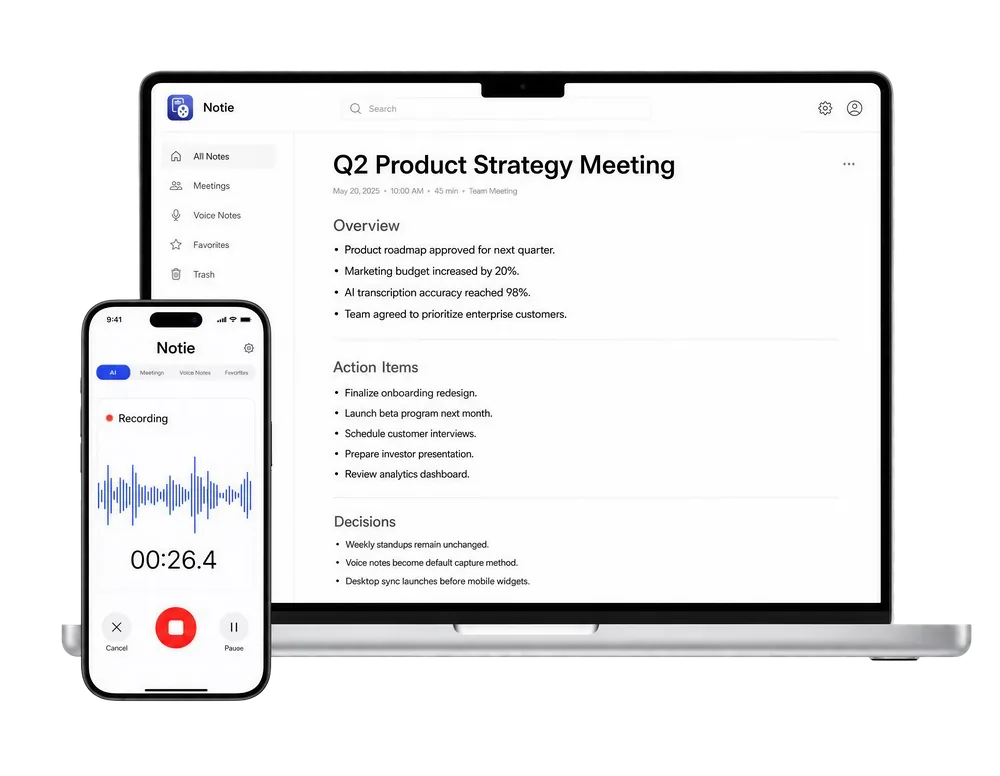
Notie summarizes any video or recording without a single prompt — import the file or record live, and get an accurate transcript plus a structured AI summary with key points automatically. Then chat with the content to dig deeper. Free on iOS and Android.
Start for FreePrompt Patterns That Improve Any Summary
- Name the audience: "Summarize for a beginner who has never used Photoshop" changes vocabulary and depth appropriately.
- Set a hard length: "Under 200 words" or "exactly 5 bullets" prevents the AI from padding.
- Demand fidelity: "Only include claims made in the transcript" and "mark anything uncertain with (?)" keep summaries honest.
- Ask for order preservation: "In the order presented" makes the summary navigable alongside the video.
- Request timestamps if available: When the transcript includes them, "include timestamps for each key point" turns your summary into a clickable index.
- Chain follow-ups: After the summary, ask "What did the creator say about X specifically?" — the transcript is still in context.
Prompting vs. Dedicated Summarizer Tools
| Approach | Setup Effort | Quality Control | Best For |
|---|---|---|---|
| Chatbot + manual transcript | Medium (copy transcript each time) | Full prompt control | Custom formats, deep analysis |
| Gemini with YouTube link | Low | Limited format control | Quick summaries of public videos |
| Dedicated YouTube summarizer | Lowest (paste link) | Consistent structure | High-volume triage |
| Notie (mobile app) | Low (import or record) | Summary + chat with content | Videos, meetings, lectures on the go |
The pattern that emerges: prompting wins when you need a custom output format or analytical depth; tools win on volume and convenience. A video summarizer that accepts any link or file removes the transcript-fetching step, and for content you recorded yourself — lectures, webinars, meetings — an app like Notie handles video to text conversion and summarization in one motion. Many heavy users triage with a tool, then paste transcripts of the few videos that matter into a chatbot for deeper Q&A. For the wider toolbox, see our ranked guide to the best AI summary tools.
Common Mistakes to Avoid
- Pasting only the link into ChatGPT or Claude. If the tool can't fetch video content, you may get a fluent hallucination. Always verify the summary mentions details a title couldn't predict.
- Summarizing hour-long transcripts in one shot with a weak prompt. For very long videos, ask for a section-by-section summary first, then a final condensation.
- Trusting numbers blindly. Stats and prices are the most commonly garbled details; check them against the transcript before quoting.
- Ignoring the video's structure. Chapters in the description are free structure — tell the AI to organize the summary by those chapters.
- Using summaries as a full replacement. For skill-based tutorials, the summary tells you whether to watch; the demonstration itself is often the value.
Your Prompt Library, Assembled
Save the all-purpose prompt plus the specialized version matching what you watch most, and you've got a system: transcript in, structured knowledge out. Total time per video: about a minute — versus the 20, 40, or 90 you would have spent watching. Combine that with a one-tap summarizer for daily triage, and YouTube finally becomes what it always claimed to be: a library you can actually skim.