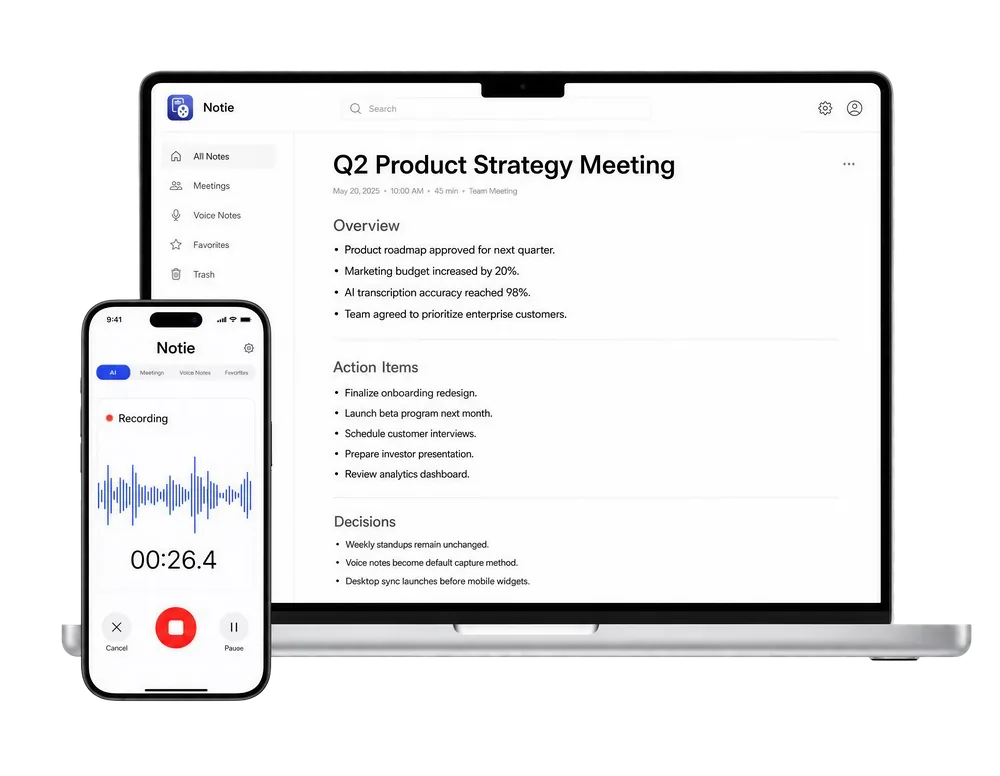
"AI note taking app" now describes two very different products. One camp captures speech — recording meetings, lectures, and voice memos, then transcribing and summarizing them. The other camp organizes text — supercharging typed notes with AI search, drafting, and structure. Most "best of" lists mash them together; choosing well starts with knowing which camp your problem lives in.
We tested the leading options in both camps. Here are the best AI note taking apps in 2026, with honest strengths and tradeoffs for each.
The Best AI Note Taking Apps at a Glance
| App | Camp | Best for |
|---|---|---|
| Notie | Voice capture | Meetings, lectures, and voice notes on mobile |
| Otter.ai | Voice capture | Zoom/Meet/Teams-centric teams |
| Fireflies.ai | Voice capture | Sales calls and CRM pipelines |
| Fathom | Voice capture | Free desktop call recording |
| Notion AI | Text organization | All-in-one workspaces |
| Obsidian + AI plugins | Text organization | Personal knowledge bases |
| Microsoft OneNote + Copilot | Text organization | Microsoft 365 organizations |
1. Notie — Best Overall for Voice-First Notes
Notie is built around a simple bet: your most valuable notes start as speech. It records anything — in-person meetings, phone calls, lectures, or thoughts spoken on a walk — transcribes with speaker labels, and produces structured summaries with key points and action items via its AI note taker.
- Strengths: works for in-person and mobile scenarios that bot-based tools miss; AI transcription plus live translation across 100+ languages; chat with your notes to find any detail; background recording keeps capturing while you use other apps.
- Tradeoffs: mobile-first by design — teams wanting an auto-joining meeting bot for desktop calls should pair it with their conferencing platform's recorder.
2. Otter.ai — Best for Web-Conference Teams
Otter's assistant joins your video calls automatically and delivers live transcripts and summaries. Deep Zoom, Meet, and Teams integration makes it the default for remote-first teams; it is less suited to in-person capture and heavily multilingual work.
3. Fireflies.ai — Best for Sales Workflows
Fireflies transcribes calls and pipes insights into CRMs, with topic tracking for things like objections and pricing mentions. Excellent for revenue teams; heavier than necessary for personal notes.
4. Fathom — Best Free Option for Calls
Fathom's free tier records and summarizes desktop video calls with shareable highlight clips. Narrow scope, great value.
5. Notion AI — Best for Typed Notes in a Workspace
If your notes are typed and live next to docs, wikis, and projects, Notion AI adds drafting, Q&A across your workspace, and meeting summaries. Its audio capture trails dedicated voice tools, but the everything-in-one-place convenience is real.
6. Obsidian with AI Plugins — Best for Knowledge Builders
Local-first Markdown files, linked notes, and community AI plugins for search and summarization. Maximum ownership and privacy, highest setup effort.
7. OneNote + Copilot — Best Inside Microsoft 365
For organizations standardized on Microsoft, Copilot brings summarization and drafting into the notebook your company already uses. Capability depends on your license tier.
Your notes start as speech — capture them that way
Notie records, transcribes, translates, and summarizes your meetings and voice notes automatically. Stop typing what you could be reviewing. Download Notie free on iOS and Android.
Start for FreeHow to Choose in Three Questions
- Do your notes start as speech or typing? Speech points to Notie or Otter; typing points to Notion or Obsidian.
- Where do conversations happen? Mobile and in-person favor Notie; exclusively desktop video calls favor Otter or Fathom.
- Do you need more than English? Translation quality varies enormously — multilingual users should test it before committing. Our deeper meeting-app comparison covers this in detail.
Whichever camp you choose, pair the tool with good habits — our guide on how to take meeting notes covers the human half that no app replaces.