Everyone has had both experiences: you ask an AI something and get back a generic essay that answers nothing — or you ask slightly differently and get exactly the insight you needed. The models are identical in both cases. The variable is the question, and question-asking has quietly become a core professional skill.
The good news is that it's learnable, and the rules are few. This guide covers how to frame questions AI answers well, the follow-up moves that turn a mediocre reply into a great one, the verification habit that keeps you out of trouble, and which tool to ask for which type of question.
The Anatomy of a Good AI Question
- Context: who you are and what you're working on. "I run a 12-person sales team" changes everything downstream.
- The actual question: specific beats broad. "Why did my open rates drop after switching subject line styles?" beats "email tips?"
- Constraints: budget, timeline, tools you already use, things you've ruled out.
- Output shape: "a table comparing options" or "three bullet points with a recommendation" — you get what you specify.
- Success criteria: what a good answer would let you do next.
Compare: "How do I get better at meetings?" versus "I lead weekly 45-minute project meetings that run long and end without clear owners for action items. Give me a tighter agenda structure and a closing ritual that assigns ownership." The second gets a usable answer on the first try.
Follow-Up Moves That Sharpen Any Answer
- "What would change your answer?" — surfaces hidden assumptions.
- "Argue against your own recommendation." — stress-tests the advice.
- "Give me a concrete example with numbers." — vague answers can't survive this.
- "What am I not asking that I should be?" — the highest-value question in the list.
- "Simplify that for someone new to the topic." — reveals whether the answer had substance or just vocabulary.
Match the Question to the Right AI
| Question type | Best tool |
|---|---|
| Facts, current events, anything checkable | Cited answer engines like Perplexity or Google's AI Overviews |
| Reasoning, drafting, thinking out loud | Chatbots like ChatGPT, Claude, or Gemini |
| Quick one-off questions without an account | A free ai answer generator |
| Questions about a document | Chat-with-PDF tools |
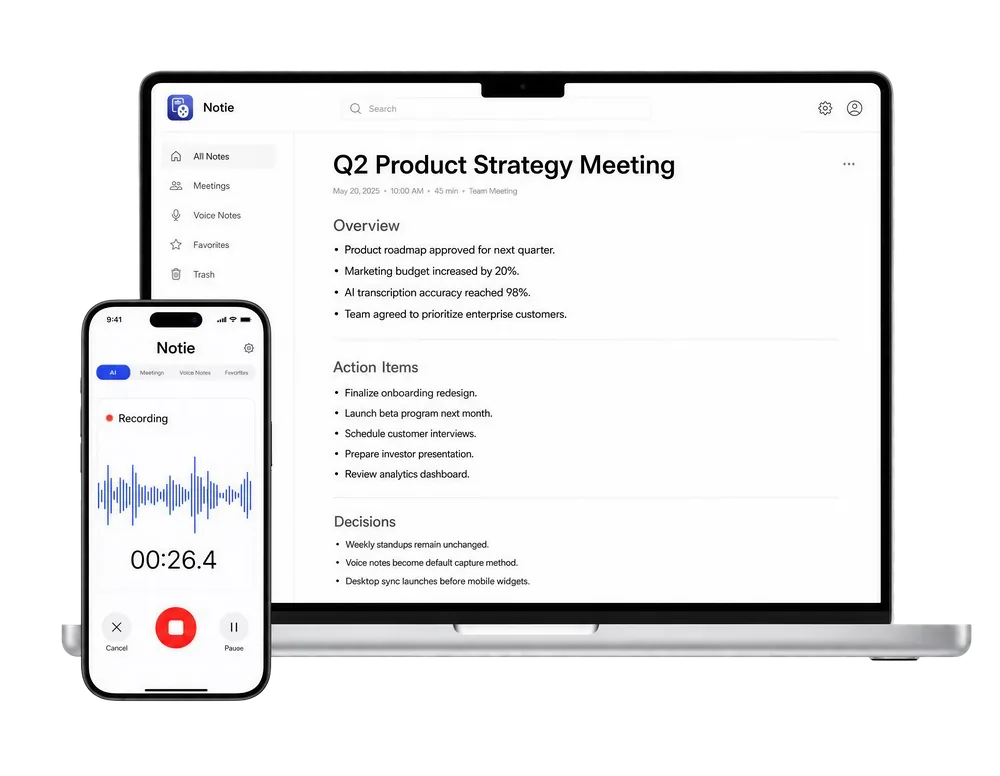
| Questions about your meetings and conversations | Notie's AI chat over your transcripts |
The tool choice matters more than most people realize: asking a creative chatbot for checkable facts invites confident errors, while asking a citation engine to brainstorm gets you a bibliography instead of ideas. Our Perplexity vs ChatGPT comparison unpacks that split in detail.
Ask AI about what was actually said
The most valuable questions aren't about the internet — they're about your own conversations. "What did the client object to?" "What deadlines did we agree on?" Notie records and transcribes your meetings, then lets you ask AI questions about them directly. Download Notie free on iOS and Android.
Start for FreeVerify Before You Rely: The 30-Second Habit
- Numbers, names, dates, quotes: assume they need checking — these are the classic hallucination zones.
- Ask for sources, then confirm the key claim actually appears in one.
- Cross-ask a second tool for anything you'll repeat publicly; disagreement between AIs is your signal to dig.
- Stakes set the bar: trivia needs no audit, medical and financial decisions need a professional, and everything in between needs the 30 seconds.
Asking AI About Your Own Content
The frontier of AI questioning isn't the open web — it's your own material. Upload a contract and interrogate it with a chat PDF tool, get one-shot answers from an AI answer generator, or point questions at your recorded life: Notie's AI chat works over your meeting transcripts, so "what did we decide about pricing?" gets answered from the actual conversation, not from memory. Grounded questions like these are also where AI answers are most reliable — the source of truth is right there.
Ask with context, follow up ruthlessly, verify what matters, and point the question at the right tool. Do those four things and AI stops being a novelty and starts being the sharpest colleague you have.