Search Google today and, for many questions, the first thing you see isn't a link — it's a paragraph. Google AI Overviews are AI-generated answers assembled at the top of the results page, synthesizing multiple sources into a direct response with citations tucked alongside. For quick factual questions, they often end the search before it starts.
They are also controversial: publishers report fewer clicks, early versions produced infamous errors, and users are still calibrating when to trust the summary versus reading the sources. Here is how AI Overviews actually work, where they excel and fail, and how to search smarter now that they're everywhere.
What Exactly Is an AI Overview?
An AI Overview is generated by Google's Gemini models using a technique called retrieval-augmented generation: the system runs your search, reads top-ranking content, and writes a synthesized answer grounded in those pages, with links to the sources it drew from. It is not a static snippet copied from one site (that's the older featured snippet) — it is newly written text assembled per query, which is both its strength and its risk.
Where AI Overviews Help — and Where They Fail
| Query type | AI Overview quality |
|---|---|
| Simple factual questions | Strong — fast and usually accurate |
| How-to and process questions | Good — clear step summaries |
| Comparisons and recommendations | Mixed — nuance gets flattened |
| Medical, legal, financial questions | Use with care — verify with primary sources |
| Fresh news and fast-moving topics | Weaker — synthesis can lag or blend outdated info |
| Niche expertise and edge cases | Weakest — thin sources produce confident errors |
AI Overviews vs Chatbots vs Answer Engines
AI Overviews compete in a crowded field. A chatbot like ChatGPT offers conversation and follow-ups; an answer engine like Perplexity leads with citations for every claim (see our Perplexity vs ChatGPT comparison); AI Overviews win on zero friction — the answer appears inside the search you were already doing. The practical difference is depth: Overviews are built for one-shot answers, while chatbots reward digging. For the broader landscape, our ChatGPT vs Gemini breakdown covers the models behind these experiences.
AI answers for the conversations Google can't see
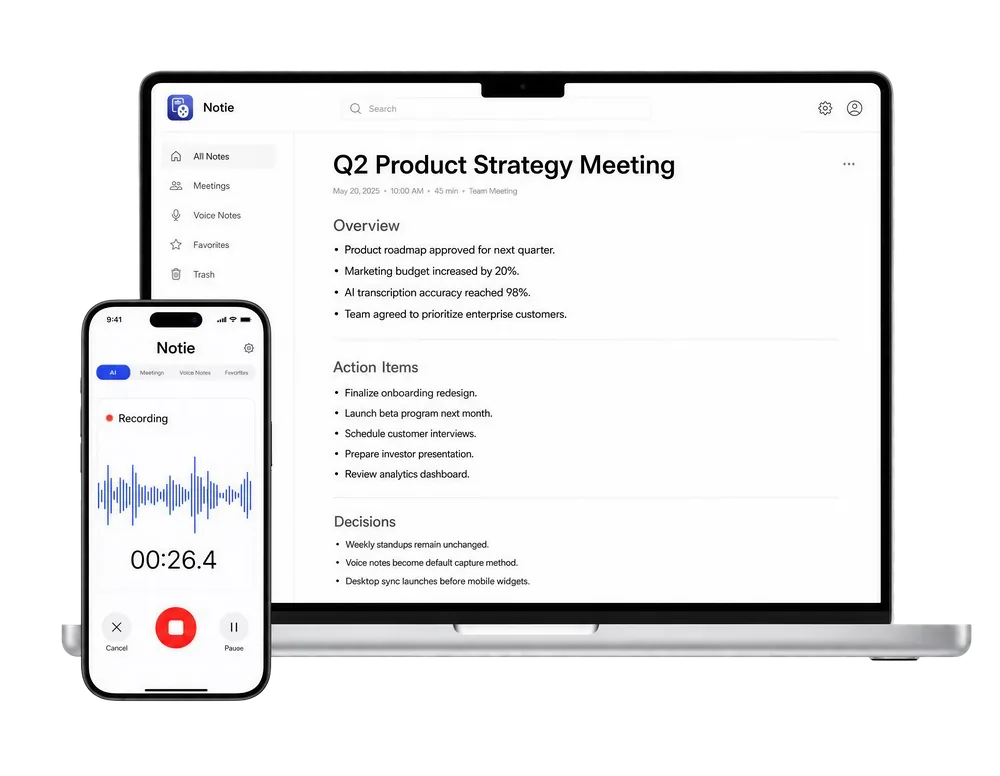
AI Overviews summarize the public web — Notie does the same for your private world. Meetings, lectures, and interviews get recorded, transcribed in 100+ languages, and distilled into AI summaries you can query like a search engine. Try Notie free on iOS and Android.
Start for FreeHow to Use AI Overviews Wisely
- Check the citations before repeating a claim — expand the sources and confirm the key fact appears in at least one credible page.
- Treat stakes as the threshold: trivia can rest on an Overview; health, money, and legal questions cannot.
- Scroll anyway for comparisons — flattened nuance is where Overviews mislead most.
- Use the Web filter when you want classic link results without AI synthesis.
- Cross-check important answers with a cited tool or an AI answer generator, and summarize long sources with an article summarizer instead of trusting one paragraph.
What AI Overviews Mean for Publishers and Readers
The economics are real: when the answer sits above the links, fewer people click through, and studies consistently show reduced traffic to informational pages that trigger Overviews. For readers, the takeaway is subtler — the quality of AI answers depends entirely on the quality of the pages they summarize, so a web where fewer people visit sources is a web where AI answers slowly degrade. Rewarding good sources with clicks isn't charity; it's maintenance.
The Bottom Line
Google AI Overviews are the biggest change to search in a decade: genuinely convenient for quick facts, genuinely risky for nuanced or high-stakes questions. Read them the way you'd read a smart intern's summary — useful, fast, and always worth a glance at the sources before you act on it.