"AI assistant" has become a catch-all label for everything from Siri setting a timer to an autonomous agent booking your travel. The result is real confusion: people expect a chatbot to join their meetings, or expect a meeting assistant to write their essays. Neither is built for the other's job.
This guide cuts through the branding. There are essentially four types of AI assistant in 2026, each with distinct strengths. Once you can tell them apart, choosing tools — and getting real value from them — becomes dramatically easier.
The Four Types of AI Assistant
| Type | Examples | Best at |
|---|---|---|
| Conversational chatbots | ChatGPT, Claude, Gemini | Writing, answering questions, brainstorming |
| Voice assistants | Siri, Alexa, Google Assistant | Hands-free commands and device control |
| Embedded copilots | Microsoft Copilot, Gemini in Docs | Assisting inside apps you already use |
| Specialized assistants | Notie, coding agents, design tools | One workflow, done end to end |
Type 1: Conversational Chatbots
These are the general-purpose brains: you type (or speak), they respond. They excel at open-ended work — drafting, explaining, summarizing, planning — and struggle when a task requires living inside another workflow. If you want a sense of the market leaders, our top AI platforms guide compares them head to head.
Type 2: Voice Assistants
Built for short spoken commands: timers, messages, navigation, smart home control. Modern versions are much smarter thanks to language models, but they remain optimized for seconds-long interactions, not sustained work. We cover their evolution in AI-powered voice assistants.
Type 3: Embedded Copilots
Copilots live inside software you already use — drafting emails in Outlook, formulas in Excel, code in your editor. Their superpower is context: they can see the document you are working on. Their limit is scope: they rarely help outside their host app.
Type 4: Specialized Assistants
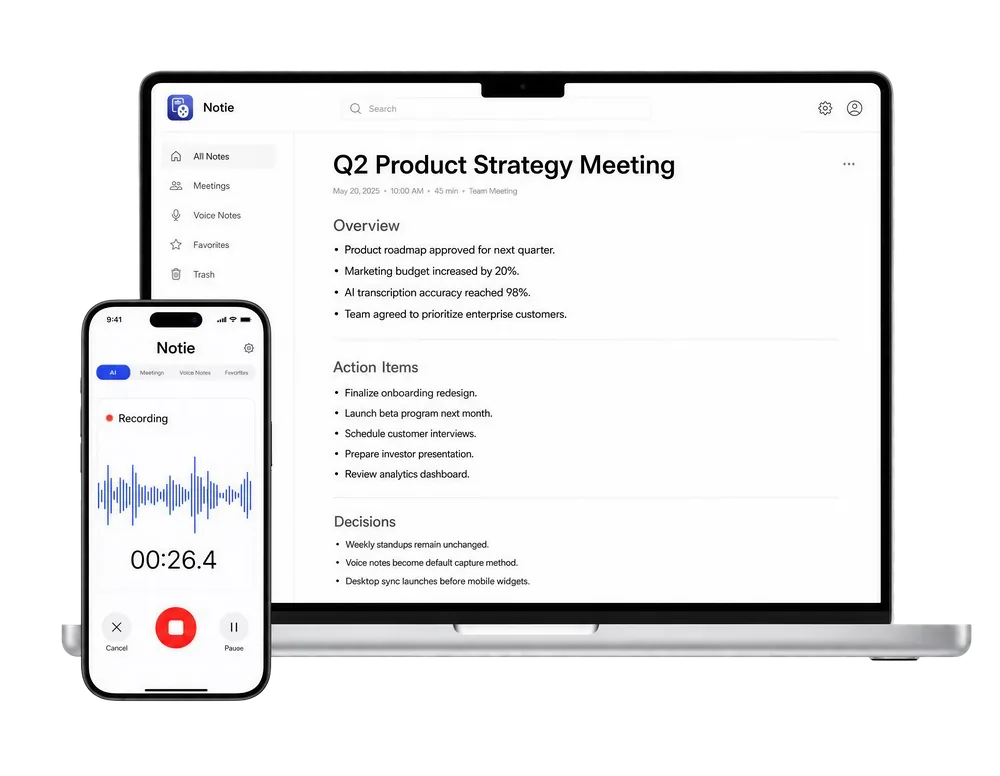
These own one workflow completely. A meeting assistant like Notie is the clearest example: it records audio, produces live transcription, translates across 100+ languages, generates structured AI summaries with action items, and lets you chat with your transcript afterward. A general chatbot can do maybe one of those steps if you feed it the data; the specialist does the whole chain automatically.
See what a specialized assistant feels like
Notie is an AI assistant with one obsession: making sure you never lose what was said. Meetings, lectures, interviews, voice memos — recorded, transcribed, translated, and summarized on your phone. Try Notie free on iOS and Android and retire your messy meeting notes.
Start for FreeHow to Choose the Right Assistant
- Name the recurring job. "Help me with stuff" leads nowhere; "turn my meetings into notes" points directly at a tool.
- Match the type to the job. Open-ended thinking wants a chatbot; a repeatable workflow wants a specialist.
- Check where your data lives. Copilots win when the work is inside one ecosystem.
- Start free. Nearly every assistant, including Notie and the AI chat tool, has a free tier to test.
- Combine, don't crown. Most productive setups use one chatbot plus one or two specialists.
What About AI Agents?
The newest buzzword, "agents," describes assistants that take multi-step actions on their own — researching, clicking, booking, coding — rather than just responding. Early agents are promising but uneven, and the practical guidance stays the same: they are best adopted for well-defined workflows where you can verify the output. For most people in 2026, a chatbot for thinking and a specialist like Notie for capturing conversations delivers more daily value than any autonomous agent.
The label matters less than the fit. Sort any "AI assistant" into one of the four types, match it against a job you actually repeat every week, and the buying decision usually makes itself.