Artificial intelligence has gone from a research curiosity to the single biggest force in technology, and the companies building it are now among the most valuable and closely watched businesses in the world. Whether you follow the space as an investor tracking AI stock movements, a founder scouting partners, or simply someone trying to understand where the industry is heading, knowing who the major players are — and what each one actually does — is essential.
The AI landscape in 2026 is layered. At the top sit the foundation model labs training frontier systems. Beneath them are the cloud giants that host and distribute those models, the chipmakers that supply the compute, and a fast-growing layer of application companies turning raw model capability into products people use every day.
This guide breaks down the top AI companies across all of those layers, explains what differentiates each one, and covers what to watch as the industry keeps evolving. If you want the fast-rising challengers instead of the giants, see our companion piece on the hottest AI startups in Silicon Valley.
What Makes a Top AI Company in 2026?
Not every company that says "AI" in its earnings call belongs on this list. The businesses that genuinely lead the field tend to share a few traits: they either train frontier models themselves, control critical infrastructure like chips or cloud capacity, or own distribution channels that put AI in front of hundreds of millions of users. A few criteria we used when ranking:
- Model capability: Does the company train or meaningfully fine-tune state-of-the-art models?
- Infrastructure position: Does it control compute, chips, or cloud platforms other AI companies depend on?
- Distribution: Does it reach massive audiences through existing products like search, phones, or office software?
- Revenue reality: Is AI actually driving revenue, or is it still a research expense?
- Talent density: Frontier AI research is concentrated among a surprisingly small pool of researchers, and where they cluster matters.
The Foundation Model Leaders
OpenAI
OpenAI remains the most recognizable name in AI thanks to ChatGPT, which turned large language models into a mainstream consumer product. The company continues to push on frontier model releases, multimodal capabilities, and agentic features that let its models complete multi-step tasks. Its partnership with Microsoft gives it enormous distribution through Copilot and Azure, and its consumer subscription business is one of the largest recurring revenue streams in AI.
Anthropic
Anthropic, the maker of the Claude model family, has built its reputation on safety-focused research and models that excel at long-context reasoning, coding, and enterprise work. Claude has become a favorite among developers and businesses that need reliable, steerable AI, and Anthropic's enterprise and API business has grown rapidly on the strength of that reputation.
Google DeepMind
Google merged its Brain and DeepMind teams to consolidate one of the deepest research benches in the world. Its Gemini models power features across Search, Android, Workspace, and YouTube, giving Google arguably the widest AI distribution of any company. DeepMind also continues to produce landmark scientific work, from protein folding to weather forecasting, that few competitors can match.
Meta AI
Meta took a different path by releasing its Llama models with open weights, seeding an entire ecosystem of developers and companies building on its technology. Combined with its massive GPU investments and the reach of Instagram, WhatsApp, and Facebook, Meta has made itself impossible to ignore in any conversation about artificial intelligence companies.
The Infrastructure Giants
Nvidia
No company has benefited more from the AI boom than Nvidia. Its GPUs remain the default hardware for training and running large models, and its CUDA software ecosystem creates a moat that rivals have struggled to cross. When people talk about buying an AI stock, Nvidia is usually the first ticker mentioned — though, as with any fast-moving sector, valuations shift quickly and nothing here is investment advice.
Microsoft, Amazon, and the Cloud Layer
Microsoft embeds OpenAI's models across Windows, Office, and GitHub while running one of the two largest AI clouds in Azure. Amazon counters with AWS Bedrock, its own Trainium chips, and a major investment in Anthropic. Between them, plus Google Cloud, these three companies host the overwhelming majority of AI workloads on the planet — meaning they profit whichever model lab wins.
Turn AI News Overload into 2-Minute Briefings
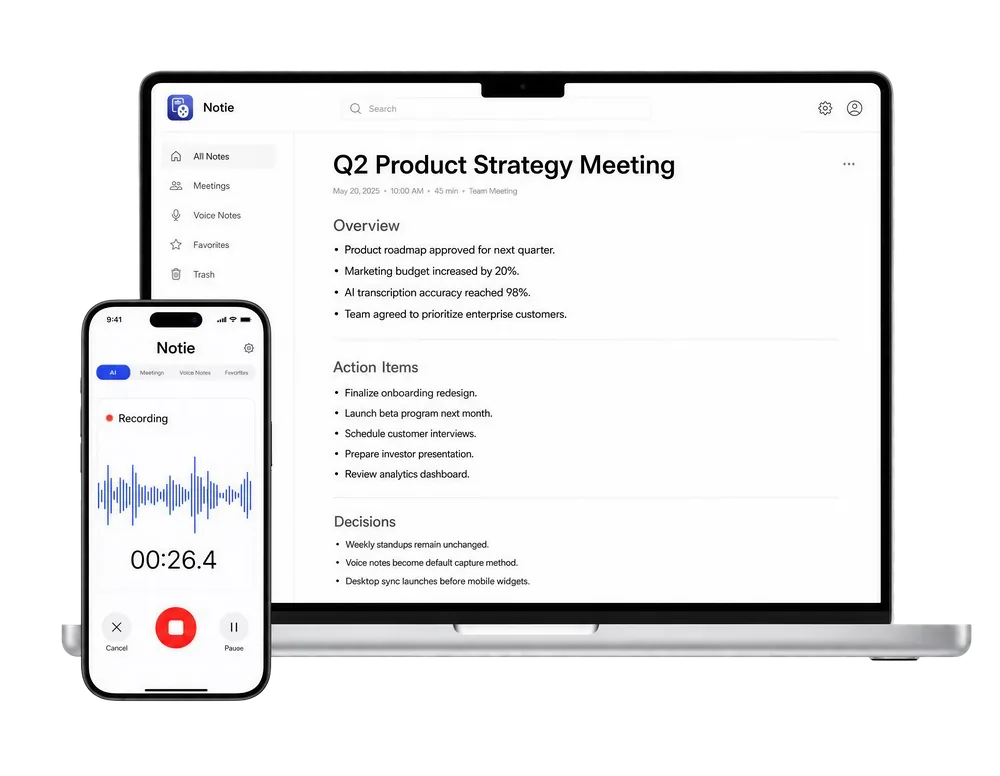
Keeping up with every AI announcement is a full-time job. Notie records earnings calls, keynotes, and podcasts, then delivers AI summaries with the key takeaways — so you stay informed in minutes, not hours. Try Notie free on iOS and Android.
Start for FreeTop AI Companies at a Glance
| Company | Core Strength | Best Known For | Layer |
|---|---|---|---|
| OpenAI | Frontier models + consumer reach | ChatGPT, GPT model family | Foundation models |
| Anthropic | Safety research, enterprise AI | Claude models | Foundation models |
| Google DeepMind | Research depth + distribution | Gemini, AlphaFold | Models + platform |
| Meta | Open-weight models, GPU scale | Llama family | Models + consumer apps |
| Nvidia | AI chips and CUDA ecosystem | H-series and B-series GPUs | Hardware |
| Microsoft | Enterprise distribution | Copilot, Azure AI | Cloud + applications |
| Amazon | Cloud infrastructure | AWS Bedrock, Trainium | Cloud + hardware |
| Apple | On-device AI at scale | Apple Intelligence | Consumer hardware |
The Challengers Worth Watching
Beyond the giants, a second tier of companies is moving fast enough to reshape the leaderboard. xAI has scaled its Grok models with unusual speed and enormous compute clusters. Mistral AI carries Europe's hopes with efficient open-weight models. Perplexity is challenging traditional search with AI-native answers, and companies like ElevenLabs in voice and Anysphere (maker of the Cursor code editor) in developer tools show how much value is being created above the model layer.
- xAI: Aggressive compute buildout and rapid model iteration, tightly integrated with the X platform.
- Mistral AI: Europe's leading lab, known for efficient models and open releases.
- Perplexity: AI answer engine growing quickly as an alternative to classic search.
- ElevenLabs: The leader in AI voice synthesis and dubbing.
- Scale AI and data players: The picks-and-shovels businesses labeling and generating training data.
AI Stocks: How Investors Approach the Sector
Many of the most important AI companies — OpenAI, Anthropic, xAI, Mistral — are still private, so public-market investors typically get exposure through chipmakers like Nvidia, AMD, and Broadcom, cloud providers like Microsoft, Amazon, and Alphabet, or diversified semiconductor and data-center plays. The sector is volatile: sentiment can swing on a single model release or capital-expenditure announcement. Anyone researching an AI stock should look past the label and ask how much of the company's actual revenue and margin comes from AI today versus promised in the future.
How to Keep Up with the AI Industry
The pace of AI news is relentless — model launches, funding rounds, and research papers land daily. A few habits make it manageable. Use an AI summarizer to condense long announcements and research posts into key points. Run earnings calls and interviews through a podcast summarizer instead of listening to two-hour episodes. And for conference keynotes, a YouTube video summarizer can pull the highlights from a 90-minute presentation in seconds.
If you attend industry events or investor briefings yourself, an AI note taker like Notie can record the session, transcribe it, and generate private AI summaries you can search later — far more reliable than scribbled notes when you're comparing what five different companies promised.
The Bottom Line
The top AI companies of 2026 form a stack: labs like OpenAI, Anthropic, and Google DeepMind at the frontier; Nvidia and the cloud giants supplying the infrastructure; and a swelling application layer converting model capability into daily utility. Positions shift quickly, but the companies profiled here combine capability, distribution, and capital in ways that make them the ones to watch. Track them through summaries rather than raw feeds, and you'll stay ahead without drowning in headlines.