Silicon Valley has seen gold rushes before — the dot-com boom, social, mobile, crypto — but nothing quite like the current AI wave. Venture funding has concentrated overwhelmingly into AI companies, San Francisco's Hayes Valley earned the nickname "Cerebral Valley" for its density of AI hacker houses, and startups are reaching hundreds of millions in revenue with teams small enough to fit in one room.
The pace makes any static list obsolete within months, so this guide does something more useful: it maps the categories where the hottest AI startups in Silicon Valley are emerging, names the standout companies in each, and explains the patterns behind who breaks out — so you can evaluate the next batch yourself.
For the established giants these startups are challenging (and selling to), see our companion guide to the top AI companies of 2026.
Why Silicon Valley Still Dominates AI
Despite remote work and rising hubs in New York, London, and Paris, the Bay Area remains AI's center of gravity for structural reasons: the frontier labs (OpenAI, Anthropic, Google DeepMind's US operations, xAI) are headquartered there, which concentrates the researchers everyone wants to hire; the deepest-pocketed venture firms sit on Sand Hill Road and in SoMa; and the informal knowledge network — demo nights, group houses, invite-only Slacks — moves faster than any published research. Proximity still compounds.
The Hottest Categories (and Standout Startups)
AI Coding and Developer Tools
No category has grown revenue faster. Anysphere, the company behind the Cursor editor, became one of the fastest-growing software companies ever measured by revenue ramp, and rivals like Cognition (maker of the Devin coding agent) and Replit are pushing toward agents that complete entire engineering tasks. The bet: every developer — and eventually every non-developer — gets an AI pair programmer.
AI Agents and Automation
The buzzword of the moment is "agentic" — systems that don't just answer questions but take multi-step actions: browsing, filling forms, running workflows. Startups here range from general agent platforms to narrow vertical agents for customer support, recruiting, and back-office operations. The winners so far share a trait: they pick workflows where mistakes are cheap to catch and value per completed task is high.
AI Search and Knowledge
Perplexity leads the charge to reinvent search as direct answers with citations, while Glean applies the same idea inside companies — searching your organization's documents, chats, and tickets. Both prove the same thesis: the interface to information is shifting from links to conversations.
Voice and Audio AI
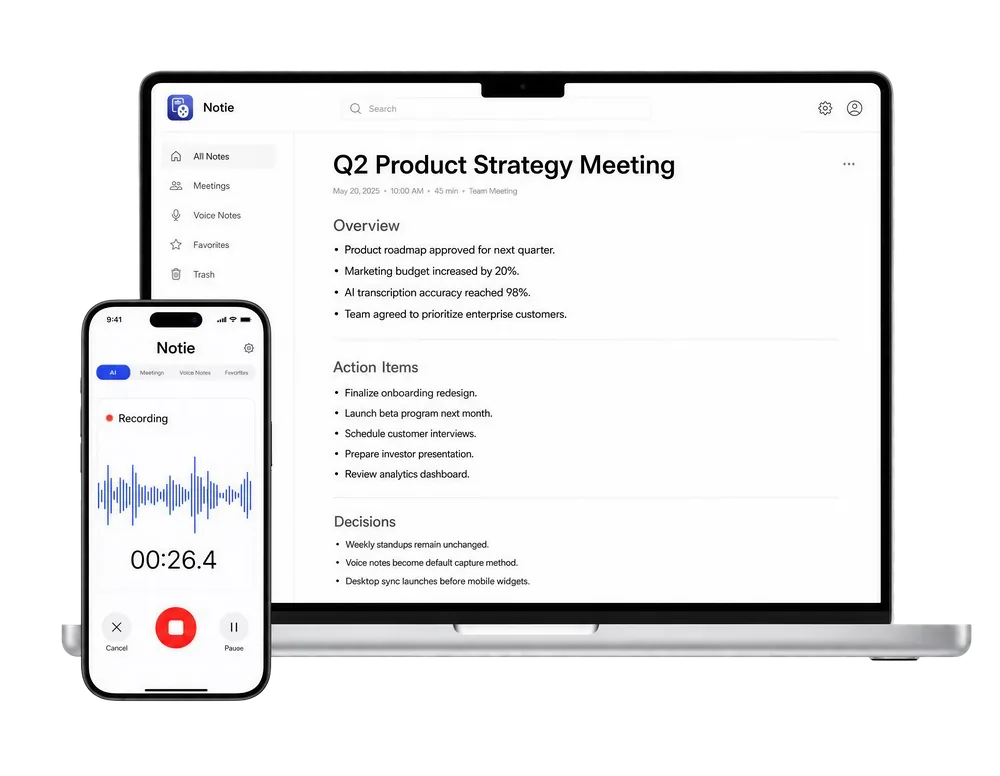
Voice has become one of AI's most commercially proven modalities. ElevenLabs set the standard for synthetic voices and dubbing, while a wave of startups builds real-time voice agents for call centers, drive-throughs, and healthcare intake. Speech recognition accuracy crossing the "good enough to trust" threshold also powers a boom in transcription and note-taking apps — the same technology behind tools like AI transcription in Notie.
Vertical AI: Law, Health, and Finance
Harvey (legal AI) became the template: take a high-billable-hour profession, automate the document-heavy work, sell to the industry's biggest firms. Abridge and others do the equivalent for clinical documentation in healthcare, and a crowded field is attacking financial analysis. Vertical startups win by owning workflow and compliance, not by having better models.
Infrastructure and Inference
Beneath the applications, startups like Together AI, Groq, and Baseten compete to serve models faster and cheaper, while Scale AI built a giant business preparing training data. Infrastructure is capital-hungry but sticky — the picks-and-shovels play of this gold rush.
Take Notes Like a VC
Founders and investors sit through dozens of pitches, demos, and calls every week. Notie records and transcribes every conversation, then generates AI summaries with key points and action items — so nothing from that hallway chat gets lost. Try Notie free on iOS and Android.
Start for FreeStartup Categories at a Glance
| Category | Example Startups | Business Model | Momentum Signal |
|---|---|---|---|
| Coding tools | Anysphere (Cursor), Cognition, Replit | Subscriptions per seat | Fastest revenue growth in software history |
| AI agents | General and vertical agent platforms | Per-task or per-seat pricing | Every major lab shipping agent features |
| AI search | Perplexity, Glean | Subscriptions, enterprise | Users shifting queries away from classic search |
| Voice AI | ElevenLabs, real-time voice agents | Usage-based API, apps | Voice quality reaching human parity |
| Vertical AI | Harvey (legal), Abridge (health) | Enterprise contracts | Top firms in each industry signing on |
| Infrastructure | Together AI, Groq, Scale AI | Compute and data services | Inference demand outpacing supply |
Patterns Behind the Breakouts
- Tiny teams, huge revenue. AI-native startups routinely hit revenue milestones with a tenth of the headcount previous generations needed — often because they use AI aggressively internally.
- Application layer over model layer. Training frontier models costs billions; the breakouts increasingly build on top of OpenAI, Anthropic, and open-weight models instead.
- Distribution beats demos. Viral products (Cursor, Perplexity) grew through word of mouth among power users, not marketing spend.
- Speed as strategy. Model capabilities shift quarterly; the startups that win re-architect around each new capability within weeks.
- The moat question looms. Every AI startup must answer what happens when the model providers ship their feature natively — workflow depth, proprietary data, and brand are the common defenses.
How to Track the Scene Without Living in San Francisco
You don't need a Hayes Valley zip code to stay current. Demo days and launch events stream on YouTube — run recordings through a YouTube video summarizer to extract announcements without watching hours of pitches. Long funding analyses and technical blog posts compress well with an AI summarizer. And founder interviews on podcasts, which is where the real strategy talk happens, are perfect material for a podcast summarizer.
If you attend conferences or investor meetings yourself, capture them properly: Notie records sessions and produces searchable transcripts and summaries, so comparing what ten startups claimed at a demo day takes minutes instead of an evening of deciphering handwriting.
The Takeaway
The hottest AI startups in Silicon Valley cluster around six centers of gravity: coding, agents, search, voice, vertical industries, and infrastructure. Individual names will change — some of today's darlings will be acquired or eclipsed within a year — but the pattern is durable: small teams building on frontier models, distributing through word of mouth, and racing to own a workflow before the giants notice. Watch the categories, not just the logos.