Every time your phone reads a message aloud, your GPS announces a turn, or an app narrates an article while you cook dinner, you are hearing text to speech at work. TTS has quietly become one of the most widely used AI technologies on the planet, yet most people could not explain what happens between the written word and the spoken one.
This is text to speech explained from the ground up: what TTS tools are, how the technology evolved from robotic beeps to voices with personality, what people actually use it for day to day, and how it differs from its mirror image, speech to text.
What Are TTS Tools?
TTS stands for text to speech: software that converts written text into spoken audio. Type or paste a sentence, pick a voice, and the system reads it aloud within seconds. Early versions shipped with operating systems as accessibility aids and sounded unmistakably mechanical. Today, TTS powers smart speakers, navigation apps, screen readers, phone systems, and entire audiobook catalogs, and free versions run right in your browser with nothing to install.
From Robotic to Remarkably Human: A Short History
Concatenative TTS: The Cut-and-Paste Era
For decades, the dominant approach was concatenative synthesis. Engineers recorded a voice actor reading thousands of small sound fragments, then software stitched those fragments together to form new sentences. The result was intelligible but clearly artificial, with choppy seams between sounds and a flat, unnatural rhythm that no amount of tuning could fully hide.
Neural TTS: Machines That Learned to Speak
The breakthrough came when researchers began training deep neural networks on enormous libraries of recorded speech. Instead of gluing snippets together, neural TTS generates the audio waveform from scratch, having learned how humans handle rhythm, stress, and intonation. Modern systems can emphasize a key word, pause for effect, and convey emotion convincingly enough that casual listeners often cannot tell the voice is synthetic.
How Modern Neural TTS Works, Step by Step
You do not need a PhD to follow the pipeline. At a high level, five things happen between your text and the finished audio:
- Text normalization: the system expands abbreviations, numbers, and symbols, turning "Dr." into "doctor" and "$20" into "twenty dollars."
- Linguistic analysis: the text is broken into phonemes, the individual sound units of speech, with markers for stress and phrasing.
- Prosody prediction: a model plans the melody of the sentence, deciding where pitch rises, where to pause, and which words get emphasis.
- Acoustic modeling: a neural network converts those instructions into a detailed acoustic blueprint of the speech.
- Vocoding: a final model renders that blueprint as an actual audio waveform you can play or download.
What People Use Text to Speech For
- Accessibility: screen readers give people with visual impairments or dyslexia full access to websites, documents, and apps.
- Learning on the go: students and busy professionals listen to notes, articles, and study material while commuting or exercising.
- Content creation: creators generate voiceovers for videos, podcasts, and e-learning courses without booking a recording studio.
- Proofreading by ear: hearing your own writing read aloud exposes typos, missing words, and clunky sentences that your eyes skim past.
- Customer experience: businesses use TTS for phone menus, real-time alerts, and multilingual product audio.
Hear Your Notes Out Loud with Notie
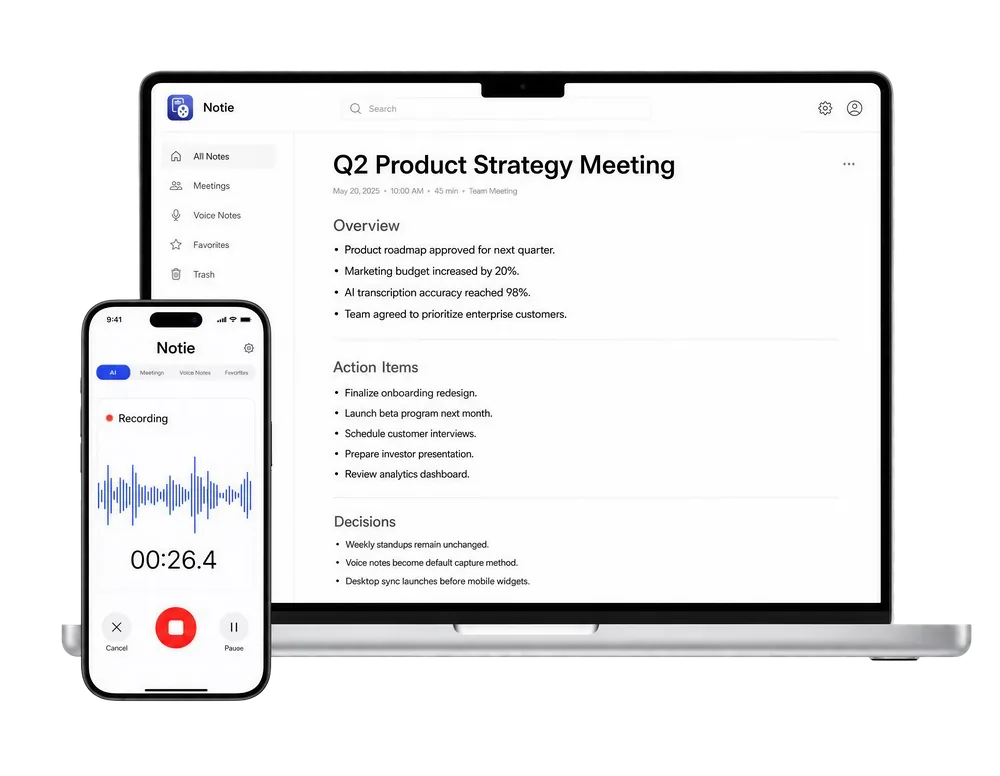
Notie is an AI note taker that pairs meeting transcription and summaries with a free text to speech tool, so you can capture a conversation as text and then replay your notes as audio wherever you are. Download it free on iOS or Android.
Start for FreeTTS vs STT: What Is the Difference?
Text to speech is often confused with speech to text, but they travel in opposite directions. A speech to text converter turns spoken audio into written words; TTS does the reverse. Many people end up using both in the same week without realizing it.
| Aspect | Text to speech (TTS) | Speech to text (STT) |
|---|---|---|
| Direction | Written text becomes spoken audio | Spoken audio becomes written text |
| Typical input | Articles, notes, scripts, documents | Meetings, voice memos, interviews |
| Common uses | Voiceovers, screen readers, phone menus | Transcripts, captions, dictation |
| Example tool | AI voice generators | AI transcription apps like Notie |
Limitations to Keep in Mind
Even the best neural voices have limits. They can mispronounce unusual names and niche jargon, and very long passages sometimes drift into a subtly repetitive rhythm that skilled human narrators avoid. Emotional nuance is improving fast but can still miss the mark on sarcasm or humor. And because voice cloning raises real questions of consent and misuse, reputable platforms require explicit permission before replicating a real person's voice.
How to Try Text to Speech for Free
The fastest way to understand TTS is simply to hear it. Paste a paragraph into Notie's free text to speech tool and listen to how it handles your own words, names, and punctuation. If your reading pile lives in documents, a PDF to text extractor pulls the text out first so you can listen to reports and papers on the move.
Once you have heard the basics, it is easier to judge the premium options. When you are ready to compare platforms for business voiceovers and e-learning, our roundup of the most professional text to speech software walks through the leading tools and what each one does best.