It sounds like the perfect combination: ChatGPT can understand documents, and ChatGPT has a voice mode, so surely you can hand it a Word file and have it read the whole thing aloud while you cook dinner or drive to work. A lot of people search for exactly this, and the honest answer is more nuanced than a yes or no.
This article answers whether ChatGPT voice can read Word documents, explains what it actually does well with uploaded files, and walks through the practical workarounds that get any document into your ears with the least friction.
The Short Answer
ChatGPT's voice mode is designed for conversation, not narration. It speaks its own responses out loud, so if you upload a Word document in a chat and ask for a summary, you can absolutely hear that summary spoken back to you. What it is not built to do is read an uploaded .docx file aloud word for word from start to finish like an audiobook. Long documents get truncated, paraphrased, or summarized rather than narrated faithfully, and voice conversations have practical limits on how much text can be spoken in one go.
It is also worth noting that file upload support, voice features, and usage limits vary by subscription plan and change frequently as OpenAI updates the product. Treat any specific claim about what a given plan supports as something to verify in the app itself.
What ChatGPT Can Actually Do With Word Documents
- Summarize: Upload a .docx file and ask for a summary, key points, or an outline, then have voice mode speak the result.
- Answer questions: Ask about specific sections, terms, or arguments in the document and get conversational answers.
- Read short excerpts: Ask it to read back a particular paragraph or section, which usually works for short passages.
- Rewrite and explain: Simplify dense sections into plain language before listening, which is often more useful than a verbatim read.
For studying or reviewing a report, this conversational pattern can beat straight narration: instead of listening to 40 pages, you ask for the argument, the evidence, and the weak spots. But when you genuinely want every word read aloud, a contract, a manuscript draft, your own essay, you need a different tool.
Workaround 1: Built-In Readers You Already Have
Read Aloud in Microsoft Word
Word itself has a Read Aloud feature on the Review tab that narrates your document from the cursor position, with controls for speed and voice. It is the fastest option when the file is already open, and it highlights words as it reads, which helps with proofreading.
macOS Spoken Content and iOS Speak Screen
On a Mac, enable Spoken Content in System Settings and a keyboard shortcut will read any selected text in any app. On iPhone and iPad, Speak Screen reads everything on screen with a two-finger swipe down from the top. Android offers a similar Select to Speak feature. These work on Word files, emails, and web pages alike, no uploads required.
Listen to Your Documents and Meetings With Notie
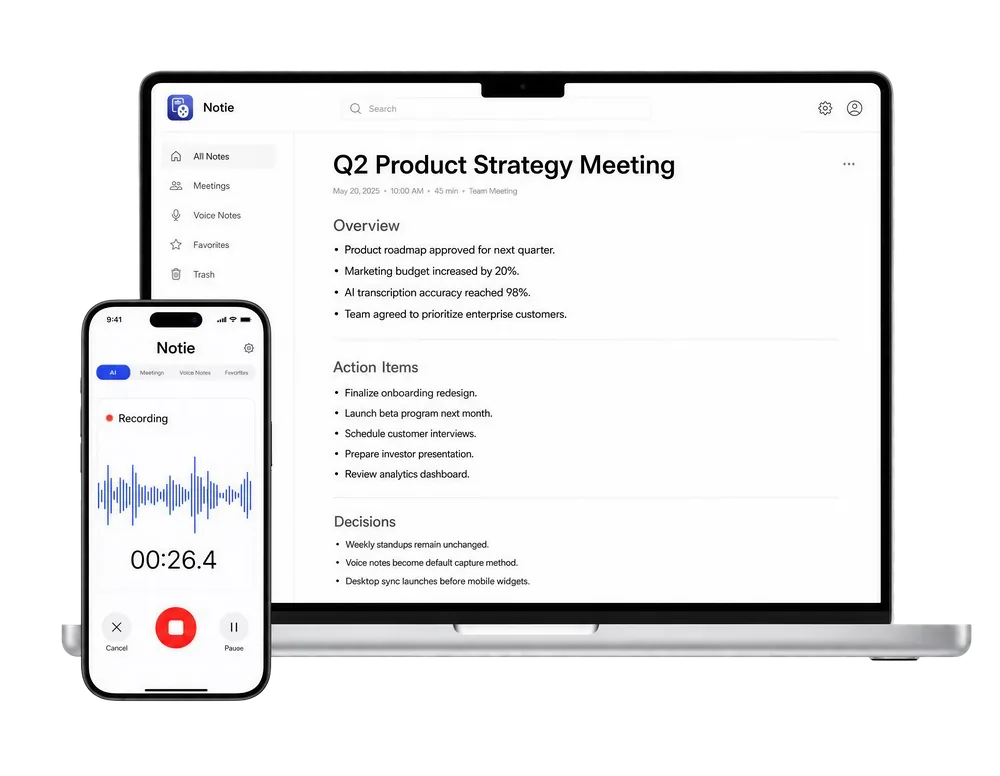
If your real goal is absorbing information on the go, Notie takes it further than narration. Import a document and get an AI summary you can review in minutes, and record meetings or lectures to get transcripts and key points automatically. Grab Notie for iOS and Android and turn commute time into catch-up time.
Start for FreeWorkaround 2: Dedicated Text to Speech Tools
For long documents, a dedicated text to speech tool is the purpose-built answer. Paste or upload your text and get natural-sounding narration with adjustable speed and voices, often exportable as an audio file you can keep on your phone. Modern neural voices are dramatically better than the robotic readers of a decade ago; our guide on how text to speech works covers why the current generation sounds so human.
Workaround 3: Convert the Document First
Sometimes formatting is the obstacle. Word files with heavy tables, comments, or tracked changes confuse readers, so extracting clean text first helps. If your file is a PDF rather than a .docx, a PDF to text converter pulls out readable text in one step, and a chat with PDF tool lets you ask questions about the document the same way you would in ChatGPT, without hitting upload limits.
Which Option Should You Use?
| Method | Effort | Best for |
|---|---|---|
| ChatGPT voice + file upload | Low | Summaries, Q&A, and short excerpts, not full narration |
| Read Aloud in Word | Very low | Listening to a document you already have open |
| macOS Spoken Content / iOS Speak Screen | Very low | Reading any on-screen text in any app |
| Dedicated text to speech tool | Low | Long documents with natural voices and audio export |
| Notie summaries and transcripts | Low | Digesting documents, meetings, and lectures on the go |
The Bottom Line
So, can ChatGPT voice read Word documents? It can discuss them, summarize them, and speak short passages, but it is not a document narrator, and treating it like one leads to frustration. Use Word's own Read Aloud or your operating system's reader for quick listening, reach for a dedicated text to speech tool when you want quality narration of a long file, and use conversational AI for what it is genuinely great at: turning a dense document into answers.
And if the documents piling up are meeting notes, lecture recordings, and reports you never find time to read, Notie was built for exactly that gap: it condenses them into summaries and searchable transcripts so listening becomes optional, not mandatory.