First impressions in audio happen fast. Whether you are narrating an e-learning module, recording a product walkthrough, or building an IVR phone menu, a robotic voice can undermine your credibility within seconds. The good news is that the most professional text to speech AI software now produces narration that many listeners cannot distinguish from a human voice actor.
In this roundup, we compare seven professional text to speech tools for business use, break down what actually makes an AI voice generator sound polished, and give you a simple framework for picking the right platform for voiceovers, accessibility, e-learning, and customer-facing audio.
What Makes a Text to Speech Voice Sound Professional?
Older TTS engines stitched together pre-recorded sound fragments, which is why they sounded choppy and flat. Modern neural systems generate speech from scratch by modeling how humans actually talk. When you evaluate professional text to speech software, listen for a few specific qualities:
- Natural prosody: the rhythm, stress, and intonation should rise and fall like real conversation, never a monotone read.
- Accurate pronunciation: brand names, acronyms, and industry terms should come out right, ideally with controls to fix any misses.
- Emotional range: professional narration needs to shift tone between tutorials, ads, and support lines.
- Clean output: studio-grade audio without artifacts, hiss, or awkward pauses.
- Fine control: speed, pitch, pause, and emphasis settings (often via SSML) let you direct the performance like a producer.
The 7 Most Professional Text to Speech AI Tools
1. Notie
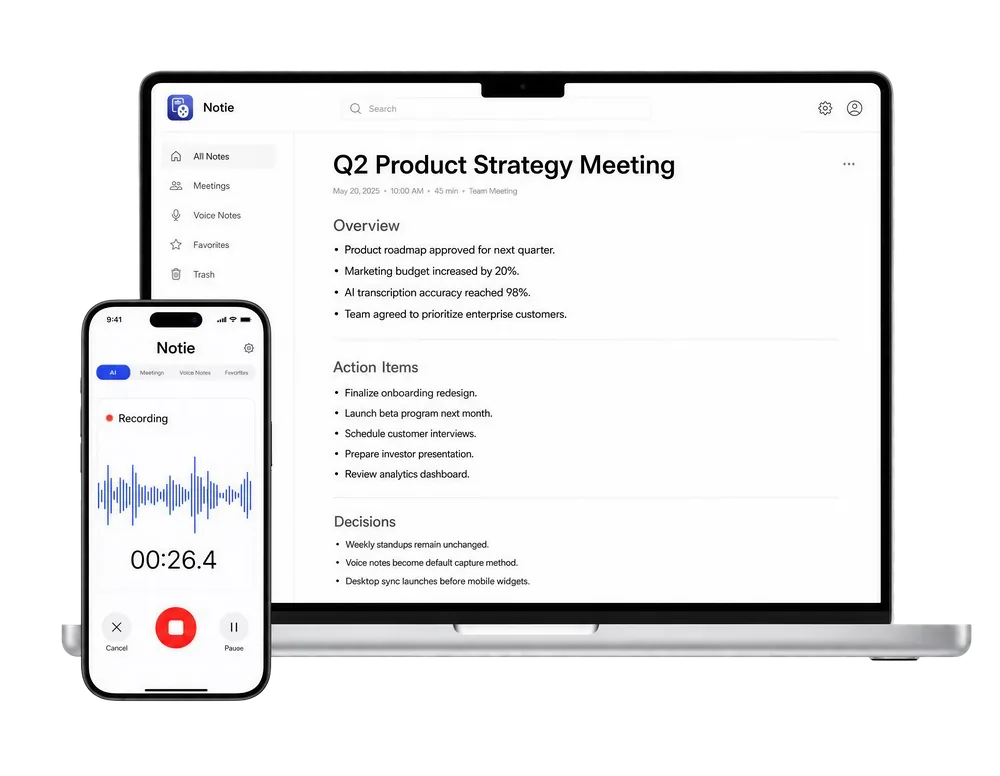
Notie is best known as an AI note taker and meeting transcription app for iOS and Android, so we will be upfront: it is not a dedicated voiceover studio. But its free text to speech tool makes it a genuinely useful pick for professionals who work with spoken content every day. You can turn meeting summaries, notes, or drafts into natural-sounding audio, then pair that with Notie's AI transcription to move between voice and text in both directions. If you need TTS as one part of a broader note-taking and meeting workflow rather than a standalone production suite, Notie covers both sides in a single app.
2. ElevenLabs
ElevenLabs has become the reference point for realism. Its voices handle emotion, pacing, and subtle vocal quirks impressively well, and voice cloning lets brands create a consistent signature sound. It is a favorite for audiobooks, video narration, and character work, though costs can climb at high volume.
3. Murf AI
Murf targets business content head-on: e-learning modules, explainer videos, presentations, and ads. Its studio-style editor lets teams sync narration with slides and video, tweak emphasis word by word, and collaborate on projects, which makes it popular with training and marketing departments.
Turn Notes Into Audio, and Audio Into Notes
Notie pairs a free text to speech tool with AI meeting transcription, summaries, and translation in one mobile app. Record a meeting, get clean notes automatically, then listen to them read aloud on your commute. Try Notie free on iOS or Android.
Start for Free4. Amazon Polly
Amazon Polly is a developer-focused cloud service built for scale. It powers IVR systems, news readers, and apps that need to generate speech on the fly, with pay-as-you-go pricing and deep AWS integration. There is no polished consumer studio, so expect to work through APIs and the AWS console.
5. Google Cloud Text-to-Speech
Google's cloud TTS offers a large catalog of natural voices across dozens of languages, backed by the same research that powers Google Assistant. Strong SSML support and reliable infrastructure make it a solid choice for products serving global audiences.
6. Microsoft Azure Speech
Azure Speech stands out for enterprise needs: custom neural voices trained on your own brand talent, strict compliance options, and tight integration with the Microsoft ecosystem. It is a common pick for large organizations building accessibility features or branded voice assistants.
7. NaturalReader
NaturalReader focuses on reading documents aloud rather than producing voiceovers. It converts PDFs, web pages, and ebooks into listenable audio, making it popular with students, professionals with long reading lists, and users with dyslexia or visual impairments.
Professional TTS Software Compared
Here is a quick side-by-side view of where each tool fits best.
| Tool | Best for | Standout strength |
|---|---|---|
| Notie | Notes, meetings, and TTS in one app | Free TTS plus transcription and AI summaries |
| ElevenLabs | Ultra-realistic narration | Emotional range and voice cloning |
| Murf AI | E-learning and marketing videos | Studio editor with media sync |
| Amazon Polly | Apps and IVR at scale | Pay-as-you-go API on AWS |
| Google Cloud TTS | Global, multilingual products | Huge language and voice catalog |
| Microsoft Azure Speech | Enterprise and compliance | Custom branded neural voices |
| NaturalReader | Listening to documents | Simple document-to-audio workflow |
How to Choose the Right TTS Software
- Define your use case first. A phone system, a training library, and a YouTube channel have very different needs for realism, volume, and control.
- Test with your own script. Free tiers exist for a reason: paste in your actual copy, including tricky names and jargon, and listen critically.
- Check the commercial license. Make sure the plan you choose covers where the audio will be published, from ads to paid courses.
- Look at languages and integrations. If you localize content or need API access, confirm support before committing to a platform.
- Model the cost at scale. Per-character or per-minute pricing that looks cheap in a demo can add up quickly across a full content library.
Pair TTS with Speech to Text for a Complete Workflow
Professional audio work rarely flows in one direction. The same teams generating voiceovers usually need to transcribe interviews, meetings, and raw recordings back into text, and a free speech to text converter closes that loop. Apps like Notie combine both directions in a single mobile workflow, so a recorded conversation becomes notes and those notes can become audio again. If you are new to the technology, our guide to how text to speech works covers the fundamentals in plain English.
Bottom line: ElevenLabs and Murf lead for pure production quality, the cloud giants win on scale and customization, and Notie is the practical choice when text to speech is one piece of a bigger note-taking and meeting routine.