Recruiters spend only a handful of seconds on a first resume scan, and the summary at the top decides whether they keep reading. A sharp three-line opener can do more for your response rate than another bullet point buried on page two.
Below you will find resume summary examples for seven common situations, a simple four-step formula for writing your own, and tips for tailoring it to every job description. Whether you call it a professional summary, a career profile, or you searched for job summary examples, the mechanics are exactly the same.
Resume summary vs. resume objective
A resume summary states what you offer; an objective states what you want. Summaries win in almost every case, because hiring managers care about the value you bring, not your wishlist. Objectives still make sense for a first job or a dramatic pivot, where a line of context helps the reader connect the dots.
| Element | Resume summary | Resume objective |
|---|---|---|
| Focus | What you offer the employer | What you want from the role |
| Best for | Most job seekers with any experience | First jobs or major career changes |
| Length | 2-4 sentences | 1-2 sentences |
| Tone | Evidence and results | Goals and motivation |
The 4-step resume summary formula
- Lead with your title and years of experience. "Customer success manager with 6 years in SaaS" instantly frames everything that follows.
- Name two or three skills the job description asks for. Mirror the employer's exact language so both human readers and applicant tracking systems recognize the match.
- Add one quantified achievement. A number — revenue, percentage, team size — is what makes the summary credible instead of generic.
- Cut it to 2-4 sentences. Read it aloud and delete anything that sounds like filler; "hard-working team player" tells a recruiter nothing.
Resume summary examples by role
Every example below is original — treat them as scaffolding, then swap in your own titles, numbers, and keywords.
Recent graduate
Recent finance graduate with internship experience at a regional bank and a minor in data analytics. Built Excel models that flagged $40K in cost savings during a summer internship. Seeking an analyst role where attention to detail and fast learning translate into immediate contributions.
Career changer
Former high school teacher transitioning into corporate training, bringing 8 years of curriculum design and public speaking to employee development. Designed programs that raised standardized test pass rates 22%. Certified in instructional design and experienced with major LMS platforms.
Sales
Account executive with 5 years closing B2B software deals averaging $85K. Exceeded quota in 11 of the last 12 quarters and grew a mid-market territory 40% year over year. Known for consultative discovery calls that shorten sales cycles.
Software engineer
Full-stack software engineer with 6 years building web applications in React and Node.js. Led the migration of a monolith serving 2M users to microservices, cutting deployment time from hours to minutes. Passionate about clean code, testing, and mentoring junior developers.
Project manager
PMP-certified project manager with 9 years delivering IT projects up to $3M on time and under budget. Managed cross-functional teams of up to 25 people across three time zones. Reduced project overruns 30% by introducing risk reviews at every phase gate.
Customer service
Customer service specialist with 4 years in high-volume support, maintaining a 96% satisfaction score across more than 8,000 annual interactions. Trained 12 new hires and cut average handle time 15% by rewriting the team's knowledge base.
Marketing
Digital marketing manager with 7 years running paid and organic campaigns for DTC brands. Grew organic traffic 180% in 18 months and managed a $50K monthly ad budget at a 4.2x return. Comfortable owning strategy through hands-on execution.
Turn career conversations into an action plan
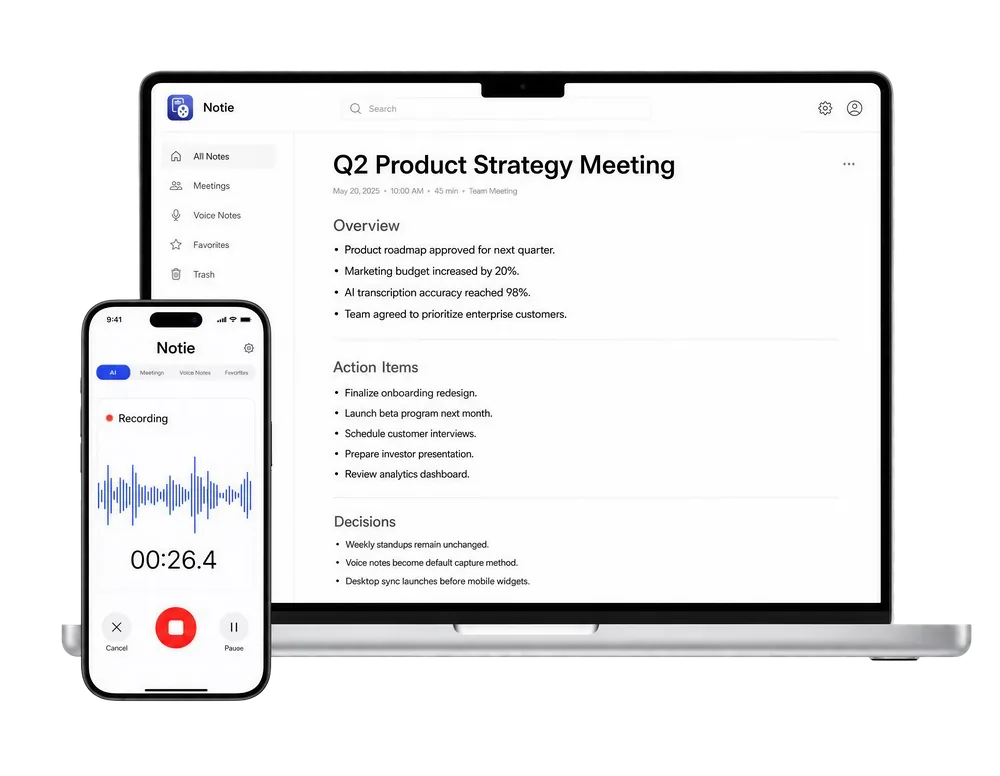
Job hunting runs on conversations — informational interviews, coaching calls, networking chats. Notie records and summarizes them into clean notes, so the advice and the exact language hiring managers use never slip away. Download Notie on iOS or Android before your next call.
Start for FreeTailor it to every job description
One generic summary is the most common self-inflicted wound in job searching. Before each application, pull the three or four most repeated skills from the posting and work the exact phrases into your summary — applicant tracking systems match keywords literally, and recruiters skim for them too. The discipline is the same as writing an executive summary: lead with what the reader cares about, not what you happen to want to say. In fact, condensing a career into three sentences is really a summarizing exercise, and our guide on how to make a summary applies surprisingly well.
Common mistakes to avoid
- Vague buzzwords — "results-driven professional" — with no evidence behind them.
- Using one generic summary for every application instead of tailoring keywords.
- First-person overload; resume summaries usually drop "I" entirely.
- Running past four sentences — recruiters stop reading, not skimming faster.
- Listing duties instead of outcomes; recruiters want results, not a job description.
Use AI to draft and polish — carefully
AI is a strong first-draft partner. Feed an AI paragraph generator your title, years of experience, top skills, and best achievement, and let it produce a rough opener in seconds. If a draft reads stiff, run it through a paragraph rewriter, or tighten a single clunky line with an AI sentence rewriter. Then edit ruthlessly: replace generic claims with your real numbers, match the job posting's keywords, and never submit a sentence you could not defend in an interview. Tools draft; you verify.
The bottom line
A great resume summary is small but dense: title and years, the skills the posting asks for, and one number that proves you deliver. Steal the structure from the examples above, tailor the keywords for every application, and let AI handle the polish while you supply the substance. Three sentences done well can be the highest-leverage writing of your entire job search.