Executives do not read your 40-page business plan — they read the first page and decide whether the rest deserves their time. That first page is the executive summary, and it is routinely the difference between a proposal that gets funded and one that gets filed. Investors commonly admit they stop reading after it.
This guide covers what an executive summary is, when you need one, exactly what to include, how long it should run, and a structure you can follow section by section — plus an annotated example outline and the AI shortcuts that turn a long document into a tight first draft.
What is an executive summary?
An executive summary is a short, self-contained overview of a longer document that gives busy decision-makers everything they need to grasp the argument — the problem, the proposed solution, the evidence, and the recommendation — without reading the full text. "Self-contained" is the key phrase: it must stand entirely on its own, because for many readers it is the only part they will ever see.
That makes it different from a teaser or an introduction. An introduction sets up the document; an executive summary replaces it for people who will not read it. Write it last, after the full document exists, so it reflects what you actually wrote rather than what you planned to write.
When you need one
Any time the reader's decision matters more than their patience, you need an executive summary. The most common cases:
- Business plans — investors and lenders expect the summary to make the case on its own.
- Reports and research — leadership wants findings and recommendations up front, not on page 30.
- Project proposals — approvers decide budget and priority from the summary alone.
- RFP responses and bids — evaluators often screen dozens of submissions by summary first.
- Long internal memos — anything past a few pages benefits from a decision-ready opener.
What to include
Whatever the document type, strong executive summaries answer the same five questions:
- The problem — what pain, gap, or opportunity makes this document necessary.
- The solution — what you propose, in concrete terms, and why it will work.
- The market or context — who is affected, how big the opportunity is, and what the evidence shows.
- The financials — costs, projected returns, savings, or budget impact, kept to headline numbers.
- The ask — exactly what you want the reader to approve, fund, or decide, and by when.
How long should an executive summary be?
The working rule is 5-10% of the source document, with a hard ceiling of one to two pages. A 20-page proposal earns one page; a 100-page report might justify two. If your executive summary needs its own summary, it has failed. Cut until every sentence either informs the decision or asks for it.
Structure walkthrough: six moves in order
- Open with the hook. One or two sentences stating the problem and its stakes in plain numbers.
- Present the solution. What you are proposing and the single most compelling reason it will work.
- Prove the opportunity. Market size, pilot results, or key findings that back the claim.
- Show the numbers. Headline financials only: cost, expected return, and timeline to payback.
- Address the obvious objection. One line on the main risk and how you mitigate it builds credibility.
- End with the ask. The specific decision, amount, or approval you need, stated without hedging.
Draft your executive summary with Notie
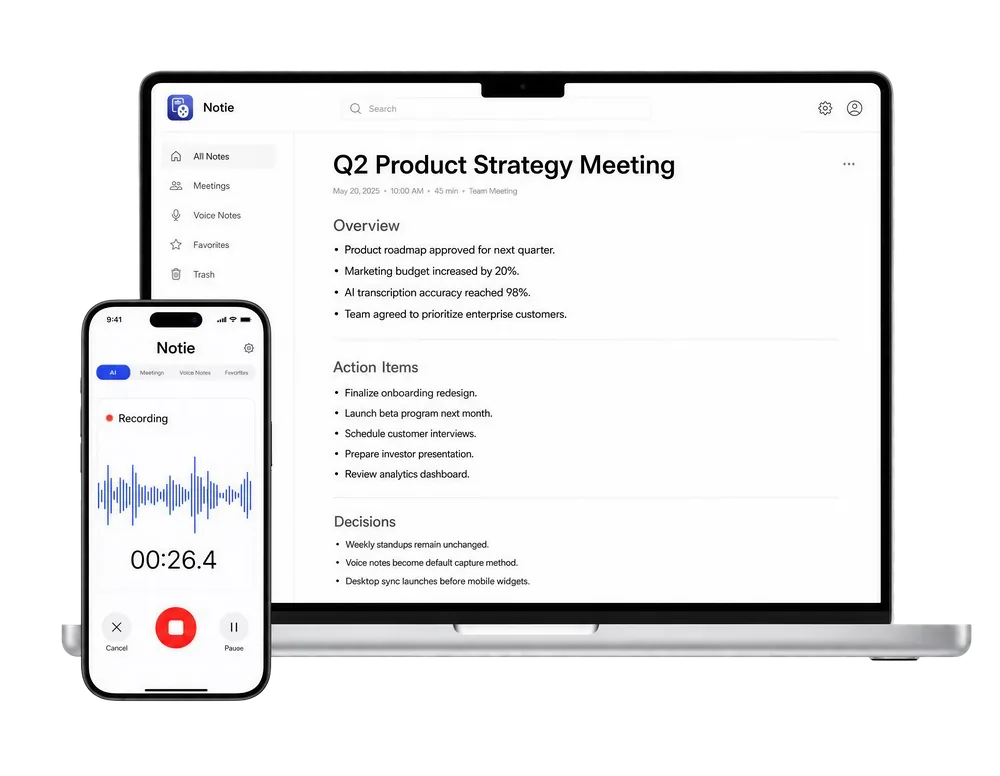
The raw material for a great summary is often spoken, not written — the pitch you rehearsed, the strategy meeting where the plan came together. Notie records and transcribes those conversations, then generates structured summaries you can shape into a boardroom-ready executive summary in minutes.
Start for FreeExecutive summary vs. abstract vs. introduction
| Element | Audience | Job it does |
|---|---|---|
| Executive summary | Decision-makers who may read nothing else | Stands alone; delivers findings, numbers, and a clear recommendation |
| Abstract | Researchers scanning academic work | Previews a paper's methods and results in 150-300 words; never a substitute for the paper |
| Introduction | People about to read the full document | Provides background and sets up the structure; makes no recommendation |
The practical difference: an abstract summarizes what the document contains, while an executive summary argues what the reader should do about it.
Writing tips that separate good from great
- Write it last, even though it appears first.
- Lead with conclusions, not background — decision-makers read top-down and quit early.
- Follow the same order as the full document, so readers can dive deeper exactly where they want.
- Replace adjectives with numbers: "significant savings" convinces no one; "$240K annually" does.
- Read it aloud once before sending — executive summaries fail on flow more often than on content.
A short annotated example outline
Here is the skeleton of a one-page summary for a software proposal, with the purpose of each line noted:
- "Support tickets have doubled in 18 months while resolution times rose 40%." — the problem, quantified.
- "We propose deploying an AI-assisted helpdesk, cutting average resolution from 26 hours to 8." — the solution plus its headline benefit.
- "A six-week pilot with the billing team reduced ticket backlog by 61%." — the evidence.
- "Total first-year cost is $180K against projected savings of $410K." — the financials.
- "We request approval of the $180K budget by March 1 to deploy before peak season." — the ask, with a deadline.
Draft it faster with AI
AI will not know your ask, but it can compress your source material fast. Run a long report through a PDF summarizer to surface the key findings, or use a general AI summarizer for drafts and memos. If the plan lives in recorded pitches and meetings, Notie's AI summaries turn those conversations into organized key points automatically. Then apply the structure above — the thinking about problem, proof, and ask still has to be yours. For the fundamentals of condensing any document, see our guide on how to make a summary.