Summarizing looks easy until you actually sit down to do it. You have read the chapter, watched the lecture, or survived the hour-long meeting — and now you need to shrink it all into a few sentences that keep the meaning without copying the wording. Do it badly and you either miss the point entirely or end up rewriting the whole thing.
The good news is that knowing how to make a summary is a learnable process, not a talent. This guide walks through a six-step method that works for articles, books, reports, meetings, and podcasts, explains how to provide a detailed summary when a short one will not do, and shows where AI can shave hours off the job.
What a summary is (and what it isn't)
A summary is a shortened version of a source, written in your own words, that keeps the main idea and the most important supporting points. It is not a paraphrase, which restates a passage at roughly the same length, and it is not your opinion of the material. A good test: someone who never saw the original should walk away with an accurate picture of what it said.
Summaries show up everywhere — study notes, meeting recaps, literature reviews, book reports, project status emails. Employers consistently rank distilling information among the most valuable communication skills, because every summary you write saves someone else the time of consuming the original.
How to make a summary in six steps
This method works for any source, written or recorded. The order matters: each step protects you from the most common failure of the one after it.
- Read (or listen) all the way through first. Do not summarize as you go — you cannot tell what matters until you have seen the whole argument. Skim once for shape, then read carefully.
- Identify the main idea. Ask yourself: what is this really about, in one sentence? Titles, opening paragraphs, and conclusions usually carry the answer.
- Note the key points. Mark the handful of claims, findings, or decisions the piece cannot stand without. If you struggle here, our guide on how to identify key points breaks the skill down.
- Draft in your own words. Close the source and write from your notes. This forces genuine rewording instead of light editing, which also protects you from accidental plagiarism.
- Trim ruthlessly. Cut examples, repetition, and anything the main idea does not need to survive. Most first drafts of a summary can lose a third of their length.
- Review against the original. Reopen the source and check your version for accuracy, missing essentials, and anything you accidentally copied word for word.
Summary vs. paraphrase vs. abstract
Three related skills, three different jobs. Here is how they compare.
| Format | Length vs. original | Purpose |
|---|---|---|
| Summary | Much shorter — usually 10-25% | Condense the main idea and key points for someone who hasn't read the source |
| Paraphrase | About the same length | Restate a specific passage in new words, often to simplify it or weave it into your own writing |
| Abstract | Very short — typically 150-300 words | Preview a full academic paper or report in a standardized, formal format |
How long should a summary be?
A common rule of thumb is 10-25% of the original, but purpose matters more than percentage. A summary of a novel for a book report might run a page; a summary of a meeting for absent teammates might be five bullet points. Ask what your reader needs to decide or do, then include exactly enough to support that — and no more. For business documents, the executive summary has its own conventions worth learning.
If you are given a word limit, honor it exactly — length limits are usually a test of judgment, not arithmetic. If you have no limit, err shorter. It is far easier for a reader to ask a follow-up question than to dig your main point out of an overgrown summary.
Let Notie summarize your meetings for you
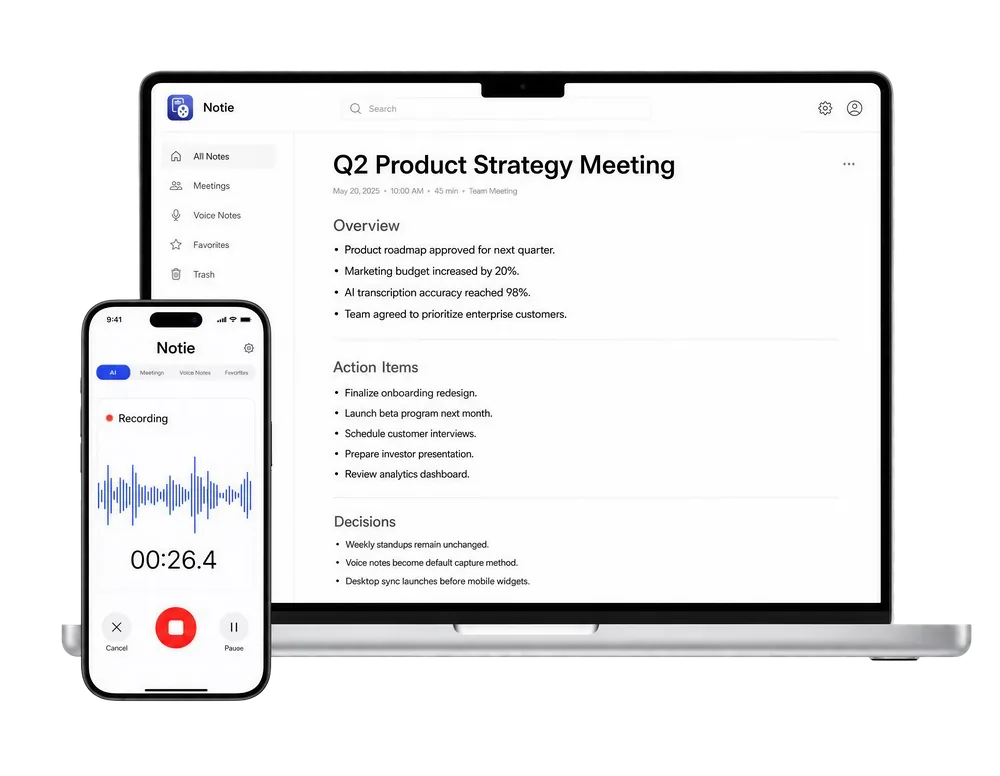
The hardest sources to summarize are live ones — nobody can take clean notes and fully participate at the same time. Notie records your meetings and lectures, transcribes them, and automatically delivers a structured summary with key points and action items before you are back at your desk.
Start for FreeHow to provide a detailed summary
Sometimes brevity is the wrong goal. When a professor or manager asks you to provide a detailed summary, they want completeness with compression — every major section covered and the evidence preserved, but still shorter and clearer than the source.
- Structure it by the source's sections, so nothing gets skipped and readers can trace your summary back to the original.
- Keep essential evidence — key statistics, named findings, and dates — rather than flattening everything into generalities.
- Preserve the logic, not just the conclusions. Note why the author reaches each claim, not merely that they reach it.
- Stay neutral. Detail is not commentary; save your analysis for a separate section if it is wanted.
A detailed summary of a 30-page report might run two pages; the same report's executive brief might be two paragraphs. Same skills, different dial settings.
Common summarizing mistakes
- Copying sentences and swapping a few words — that is patchwriting, not summarizing.
- Including every detail because you are afraid to cut — a summary that keeps everything summarizes nothing.
- Adding your own opinions or conclusions the source never made.
- Summarizing the beginning thoroughly and rushing the end because you ran out of energy.
- Skipping the final accuracy check against the original.
Speed it up with AI
AI has made the slowest part of summarizing — the reading and rereading — optional. Paste any text into a free AI summarizer and get a draft summary in seconds, or use a dedicated article summarizer for long web reads. Treat the output as a first draft: verify it against the source, then polish it in your own voice.
For spoken content, Notie handles the whole pipeline: it records audio, transcribes it, and generates summaries automatically, so an hour-long lecture becomes a page of key points. The six-step method still matters, though — it is how you judge whether any summary, human or AI, is actually good.