Every week brings a new wave of AI marketing tools, and every one of them promises to 10x your output. The reality is more grounded: AI is genuinely excellent at a handful of marketing jobs — drafting, summarizing, analyzing, and repurposing — and mediocre at strategy. The trick is knowing which category solves which problem.
This guide maps the AI marketing landscape by category, names representative tools in each, and gives you a simple framework for choosing without burning your budget on shelfware.
What Counts as an AI Marketing Tool?
An AI marketing tool uses machine learning or generative AI to automate or accelerate a marketing task: writing copy, scoring leads, generating creatives, transcribing customer calls, or surfacing insights from data. That is different from classic marketing automation, which executes pre-built rules. AI tools generate and interpret; automation tools schedule and deliver. The strongest stacks combine both.
AI Marketing Tools by Category
Here are the six categories where AI delivers measurable value today:
| Category | What it does | Representative tools |
|---|---|---|
| Content creation | Drafts blog posts, ads, emails, and social copy | ChatGPT, Claude, Jasper, Copy.ai |
| SEO | Keyword research, briefs, content optimization | Surfer, Clearscope, Semrush AI features |
| Visual and video | Generates images, edits video, adds captions | Midjourney, Canva AI, Descript |
| Email and ads | Subject lines, audience targeting, creative testing | Klaviyo AI, Meta Advantage+, Google PMax |
| Analytics | Summarizes performance and finds anomalies | GA4 insights, Tableau AI, ChatGPT data analysis |
| Meetings and research | Records, transcribes, and summarizes calls | Notie, Otter.ai, Fireflies |
The Overlooked Category: Customer Conversations
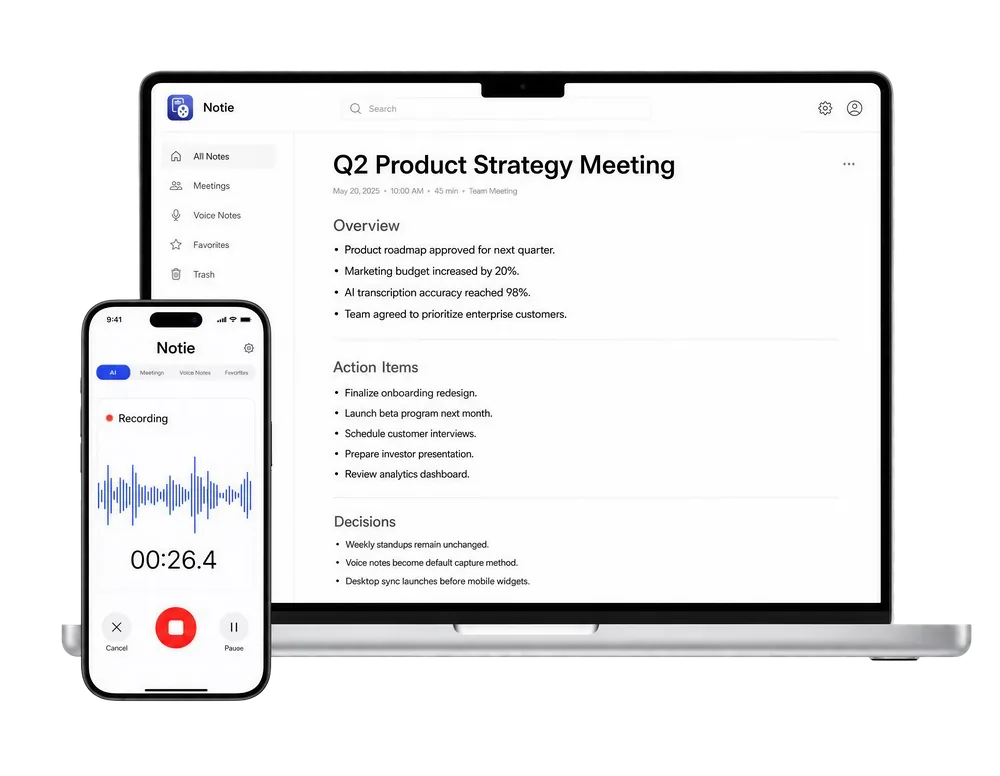
Most marketers obsess over content tools and ignore the richest input they have: conversations. Customer interviews, sales calls, and campaign retros are full of the exact language your audience uses. An AI meeting assistant like Notie captures those conversations, transcribes them, and produces summaries you can mine for messaging, objections, and testimonial material — voice-of-customer research on autopilot.
Turn every customer call into marketing insight
Notie records and transcribes interviews, sales calls, and team meetings, then summarizes the key takeaways with AI. Stop losing your best messaging ideas to bad notes — try Notie free on iOS and Android.
Start for FreeHow to Choose AI Marketing Tools
Resist the urge to buy the whole stack at once. Work through this sequence instead:
- Start from a bottleneck, not a tool. Identify the task eating the most hours — drafting, reporting, note-taking — and shop for that.
- Pilot with one workflow for two weeks. Measure hours saved, not vibes.
- Check data policies. Marketing tools touch customer data; confirm how vendors store and train on it.
- Prefer tools your team already opens daily. Adoption beats capability.
- Keep a human edit pass. AI drafts, humans decide — especially for brand voice.
Common Mistakes to Avoid
- Publishing raw AI output. Unedited AI copy is generic and increasingly easy for readers to spot.
- Tool sprawl. Five overlapping subscriptions cost more than one well-adopted tool.
- Ignoring inputs. Tools like an article summarizer or an AI text generator are only as good as the briefs and research you feed them.
- Automating strategy. AI accelerates execution; positioning and creative judgment stay human.
The Bottom Line
AI marketing tools are no longer optional experiments — they are table stakes for keeping pace. Start with the category that removes your biggest bottleneck, prove the time savings, then expand. For most teams, the quickest wins are content drafting and conversation capture, because both replace hours of manual typing with minutes of review.