Most people take notes the way they learned in seventh grade: write fast, hope for the best, never look at them again. Research on learning consistently shows the problem isn't effort — it's that transcribing words verbatim bypasses the thinking that makes notes useful. A good note taking method forces processing: deciding what matters, connecting it to what you know, and structuring it for future retrieval.
The six methods below are the ones that have survived decades of student and professional use. Each optimizes for something different — speed, review, connections, or synthesis — and the right choice depends on the situation, not on personality. Plus: how AI note takers have quietly changed which parts of this skill still need to be manual.
The 6 Note Taking Methods Worth Knowing
1. The Cornell Method
Divide the page into a main notes column, a narrow cue column, and a summary strip at the bottom. During the session, write in the main column; afterward, add questions and keywords to the cues and a two-sentence summary at the bottom. Its superpower is built-in review — cover the notes column and quiz yourself from the cues. Best for students and anyone preparing for exams or certifications.
2. The Outline Method
Hierarchical bullets: main topics, subtopics, details. It is the fastest structured method and maps perfectly onto slide-based lectures and agenda-driven meetings. It struggles when the content jumps around — reorganizing a hand-written outline mid-lecture is painful.
3. Mind Mapping
The topic sits in the center; branches radiate outward for subtopics and connections. Ideal for brainstorming, big-picture subjects, and visual thinkers — weak for detail-heavy or sequential material like math derivations or legal clauses.
4. The Charting Method
Columns for categories, rows for items — essentially taking notes directly into a comparison table. Unbeatable when the content is inherently comparative: product evaluations, historical periods, drug interactions, competitor research.
5. The Sentence Method
Every new thought gets its own numbered line. Zero structure overhead makes it the fastest method for chaotic, fast-moving content — with the cost that you must reorganize afterward or the notes rot.
6. Zettelkasten (Slip-Box)
Each idea becomes one atomic note, written in your own words and linked to related notes. Over years, the network becomes a thinking partner that surfaces unexpected connections. Highest payoff of any method — and the highest maintenance cost. Best for researchers, writers, and lifelong-learning nerds.
Which Method for Which Situation?
| Situation | Best method | Why |
|---|---|---|
| Exam-focused studying | Cornell | Review is built into the page |
| Structured lectures and meetings | Outline | Mirrors the content's hierarchy |
| Brainstorming and planning | Mind mapping | Encourages connections |
| Comparing options | Charting | Side-by-side clarity |
| Fast, unstructured talks | Sentence | Capture now, organize later |
| Long-term knowledge building | Zettelkasten | Compounds over years |
Let AI handle the capture — you handle the thinking
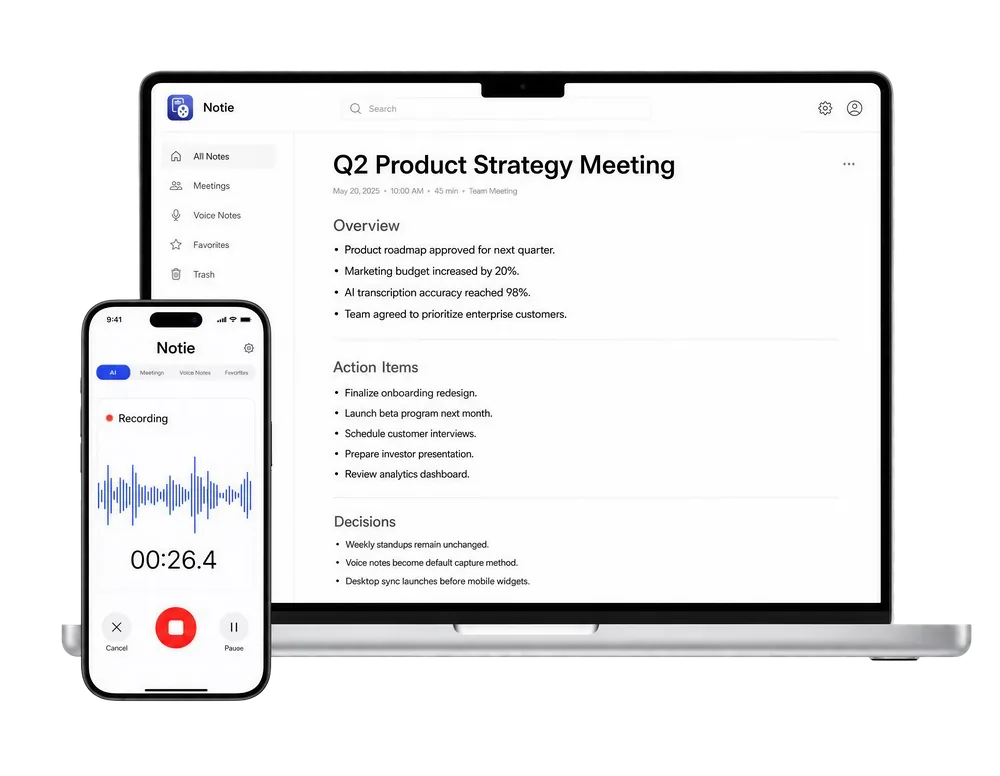
The weakness of every manual method is the same: you can't write and fully listen at once. Notie records and transcribes meetings and lectures in 100+ languages, then delivers AI summaries with key points — so your own notes can focus on ideas, not stenography. Try Notie free on iOS and Android.
Start for FreeHow AI Changes Note Taking
The classic dilemma — listen deeply or capture completely — is now a false choice. An AI note taker captures the verbatim record with live transcription while you jot only insights, questions, and reactions. Afterward, AI summaries give you the structured recap, and you can even use voice to text to dictate your own reflections on the way out of the room. The research still holds: processing in your own words is what builds memory. AI doesn't replace that — it removes the transcription burden that was crowding it out.
Building Your Personal System
- Pick one method per context — Cornell for courses, outline for meetings — rather than one for everything.
- Let AI capture the verbatim layer in meetings and lectures so your hand-written layer stays small and sharp.
- Review notes within 24 hours; even five minutes dramatically improves retention.
- Rewrite the messiest notes in your own words — the rewriting is the studying.
- Store everything searchable: paper notes photographed, audio transcribed, summaries filed.
There is no single best note taking method — there is a best method per situation, multiplied by an AI layer that handles the capture. Choose the structure that matches the content, and spend the attention you save on actually understanding it.