Here is the uncomfortable truth about your 30-page report: the people who decide its fate will read one page of it. That page is the executive summary, and it has a brutal job — deliver the situation, the findings, and the recommendation fast enough that a busy reader can act without reading anything else.
Most executive summaries fail because they are written as introductions ("This report will explore...") instead of conclusions ("We recommend X because Y"). This guide gives you the structure that works, a complete example you can adapt, and ways to let AI produce a strong first draft from the full document.
What an Executive Summary Must Contain
- The problem or opportunity: one or two sentences of context — why this document exists.
- Key findings: the 3-5 facts that drive everything, with the most important numbers included.
- The recommendation: what you want the reader to approve, decide, or do.
- The impact: costs, benefits, and risks in concrete terms.
- Next steps: who does what, by when, if the recommendation is accepted.
A Complete Example of the Executive Summary
Customer churn rose from 4% to 7% over the past two quarters, putting $1.2M of annual recurring revenue at risk. Exit surveys and support data show 68% of churned customers cited slow onboarding as their primary frustration; accounts that completed onboarding within 14 days churned at less than half the average rate. We recommend investing $150K in a guided onboarding program and two dedicated onboarding specialists. Based on pilot results, we project churn returning to 4.5% within two quarters, protecting roughly $900K in ARR. Pending approval, the program can launch within 30 days, with the first cohort results reported to leadership by end of quarter.
Notice what makes it work: it opens with the stakes, quantifies the cause, makes one clear recommendation, prices it, projects the return, and ends with a timeline. A reader can say yes or no without opening the full report — which is exactly the point.
Executive Summary Templates by Document Type
| Document | Lead with | Length target |
|---|---|---|
| Business plan | The opportunity and the ask | 1 page |
| Research report | Key findings and implications | Half to 1 page |
| Project proposal | The problem and recommended solution | 3-5 paragraphs |
| Post-mortem | What happened and what changes | 3 paragraphs |
| Meeting brief | Decisions made and action items | 5-8 bullets |
Let AI write the first draft from your meeting
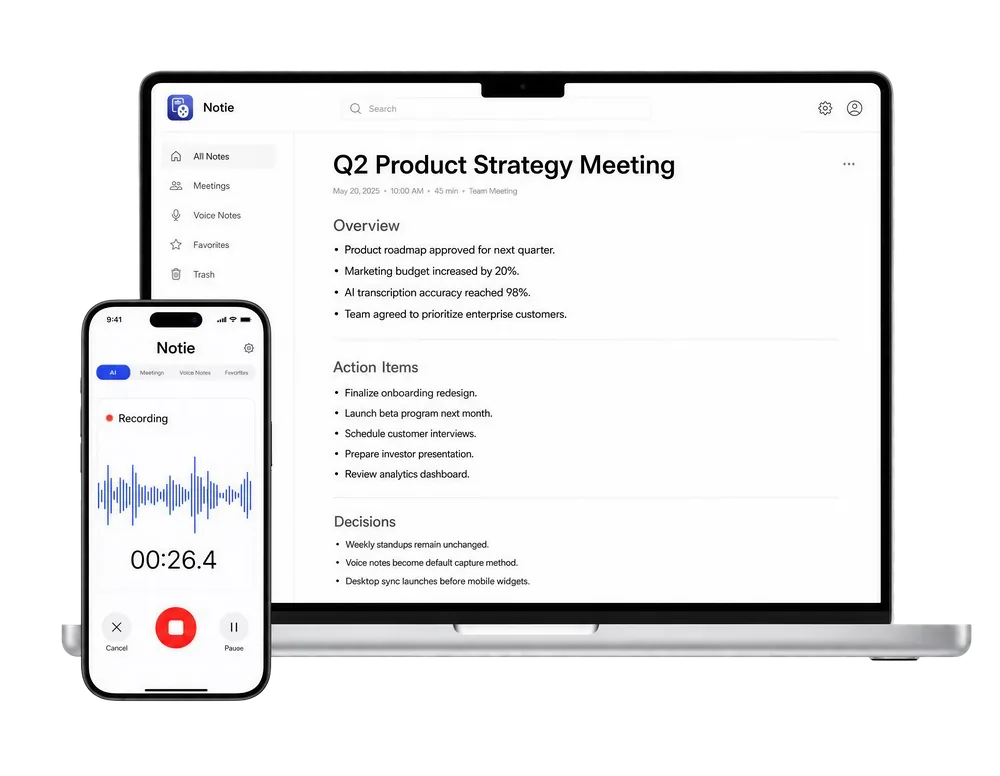
Half of every executive summary already exists — spoken aloud in the meetings behind it. Notie records and transcribes those discussions in 100+ languages, then generates AI summaries with decisions and action items that drop straight into your draft. Try Notie free on iOS and Android.
Start for FreeHow to Write One in 5 Steps
- Write it last. You cannot summarize conclusions you haven't reached.
- Draft the one-sentence version first: "We should do X because Y, and it will cost Z." Expand from there.
- Keep it to 5-10% of the document's length — one page for most reports.
- Cut every phrase that describes the document ("this report examines...") and keep only phrases that describe reality.
- Test it on someone who hasn't read the report. If they can state your recommendation back to you, it works.
Using AI to Draft Executive Summaries
AI is genuinely good at this specific compression task. Paste your document into an AI summarizer and prompt for structure: "Write a one-page executive summary with the problem, three key findings with numbers, a recommendation, and next steps." For long reports, a PDF summarizer processes the file directly. And for summaries of discussions rather than documents, Notie's AI summaries turn recorded meetings into structured briefs automatically. Treat the AI output as a first draft — verify every number and sharpen the recommendation yourself, because the judgment is still your job.
The executive summary is not a formality; for most readers it is the entire document. Lead with the conclusion, quantify the stakes, make one clear ask — and let AI handle the compression so you can focus on the decision.