Client calls with verbal agreements, interviews for an article, a support call you'll need evidence of, or just a conversation with too many details to remember — there are plenty of legitimate reasons to record a phone call. The mechanics vary by phone, and the legal rules vary by state, so it pays to get both right before you hit record.
This guide covers the law first (because it changes everything), then every practical method for iPhone and Android, and finally the step that turns a recording into something useful: transcription and AI summaries.
First: The Legal Rules You Must Know
In the United States, call recording is governed by consent laws. One-party consent states (the majority, and federal law) allow recording if you are a participant in the call. Two-party (all-party) consent states — including California, Florida, Illinois, Massachusetts, Pennsylvania, and Washington — require every participant's consent. Because calls often cross state lines, the safe practice is simple: tell the other person you are recording and get a yes on tape. It takes five seconds and removes the legal question entirely. Nothing here is legal advice; check your state's current rules for anything sensitive.
Recording on iPhone
- Built-in Call Recording: recent iOS versions can record calls natively from the call screen — tap the record button and iOS announces the recording to both sides automatically. Recordings and transcripts land in the Notes app. Availability varies by region and carrier.
- Speakerphone + a recording app: put the call on speaker and record with another device or app. This is the most universal method and works on any phone.
- Three-way call services: apps that merge a recording line into your call. They work, but read privacy policies carefully — your audio passes through their servers.
- Google Voice: incoming calls can be recorded free by pressing 4, with an automatic announcement.
Recording on Android
- Google Phone app: in supported regions, tap Record during a call; both parties hear an announcement. Availability depends on country and carrier.
- Manufacturer dialers: some Samsung and other OEM dialers include call recording where local law permits.
- Speakerphone method: as with iPhone, speaker plus a second recording device is the universal fallback.
- Google Voice: same free incoming-call recording as on iPhone.
The recording is step one — Notie does the rest
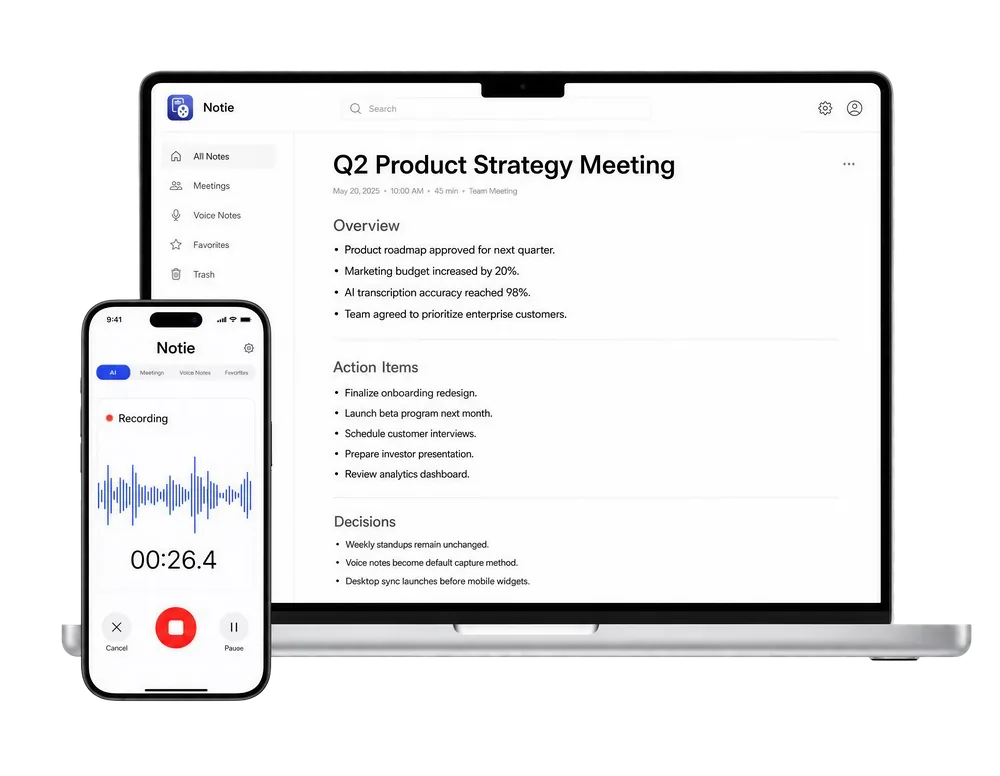
An hour-long call is useless if you have to relisten to find one number. Notie records with speakerphone, transcribes in 100+ languages, and delivers AI summaries with decisions and action items. It even keeps recording in the background while you use other apps. Try Notie free on iOS and Android.
Start for FreeThe Speakerphone Method, Done Right
- Use a quiet room — background noise hits the far side of the call hardest.
- Place the recording phone 12 to 18 inches from the speaker, mic facing it.
- Turn call volume up to about 80%, not maximum (max volume distorts).
- Enable background recording in Notie so checking your calendar mid-call doesn't stop the capture.
- State the date, participants, and consent at the top of the call — future you will be grateful.
After the Call: From Audio to Answers
A recording you never process is just anxiety storage. Run the file through an audio to text converter — or an MP3 to text converter for exported files — and you get a searchable document in minutes. With Notie the pipeline is automatic: transcript, speaker-aware notes, and an AI summary with action items appear as soon as the call ends. For calls in other languages, translation into your language happens in the same pass.
Quick Reference: Which Method for Which Situation
| Situation | Best method |
|---|---|
| Occasional important calls | Built-in recording (iOS or Google Phone) |
| Any phone, any time | Speakerphone + Notie |
| Frequent incoming calls | Google Voice |
| Interviews you'll quote from | Speakerphone + Notie, then verify quotes in the transcript |
| Sensitive or legal matters | Announce consent on tape, keep the original file |
Recording a phone call comes down to three moves: get consent on tape, pick the method your phone supports, and transcribe the result so the information is actually usable. Master the consent line — "Mind if I record this so I don't miss anything?" — and the rest is one tap.