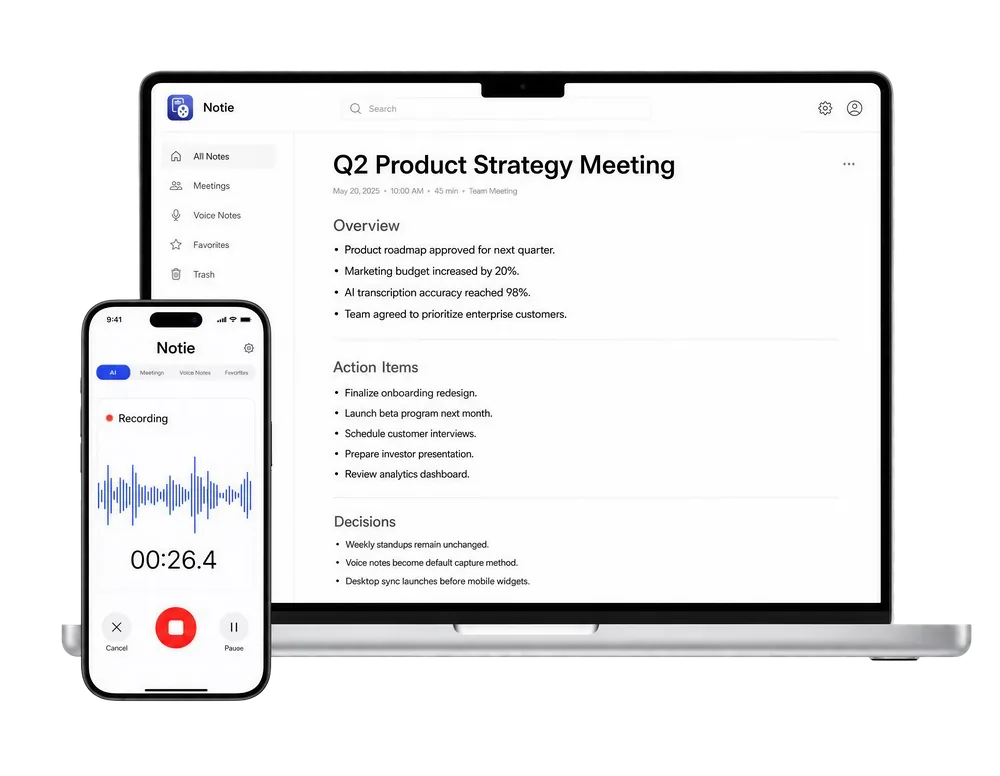
Every document, meeting, and lecture contains a small core of ideas that actually matter, wrapped in a much larger shell of context, examples, and filler. People who seem to read faster or remember more are usually not processing every word; they have simply learned how to identify key points and let the rest go.
This guide explains what key points are, why finding them quickly is one of the highest-leverage skills you can build, and the concrete techniques that make it almost automatic, whether you are skimming a report, sitting in a meeting, or reviewing a recorded lecture.
What Are Key Points, Exactly?
Key points are the essential ideas that carry the meaning of a text or conversation: the claims, decisions, findings, and conclusions that everything else exists to support. A useful test is subtraction. If you removed a sentence and the argument would collapse or the reader would miss something critical, that sentence holds a key point. If you removed it and nothing important would change, it is supporting detail.
Key points are not the same as topics. "Quarterly revenue" is a topic; "revenue grew 12 percent, driven almost entirely by one product line" is a key point. The difference is that a key point makes a claim you could act on, agree with, or challenge.
Why Identifying Key Points Matters
- Reading: You process reports, articles, and emails in a fraction of the time, because you stop giving every paragraph equal attention.
- Meetings: You leave with decisions and action items instead of a vague memory of an hour of discussion.
- Studying: Exams and real-world recall both reward the core concepts, and condensing material is itself one of the most effective ways to learn it.
- Communication: Once you can spot key points, you also get better at leading with them, which makes your own writing and speaking sharper.
Techniques for Spotting Key Points Fast
Skim the structure first
Before reading a word of body text, scan the title, headings, subheadings, bolded phrases, and any tables or figures. Authors put enormous effort into structure, and it usually forms a rough outline of the key points all by itself. Thirty seconds of skimming tells you where the important ideas live.
Watch for signal phrases
Writers and speakers flag their own key points with phrases like "the main takeaway," "most importantly," "in conclusion," "the bottom line," and enumerations like "first, second, finally." In meetings, listen for "so what we decided is" and "the next step is." These phrases are neon signs pointing at the content worth capturing.
Read topic sentences
In well-edited writing, the first sentence of each paragraph states its main idea and the rest elaborates. Reading only the first sentence of every paragraph, plus the introduction and conclusion in full, often captures the majority of a document's key points in a fifth of the time.
Track repetition and the 80/20 rule
Ideas that recur across sections, slides, or speakers are almost always central. Apply the 80/20 lens: in most texts, roughly a fifth of the content carries most of the meaning, and repetition is the clearest clue to which fifth that is. If a point shows up in the intro, a heading, and the conclusion, it belongs in your notes.
A Step-by-Step Method You Can Use Today
- Preview the structure: title, headings, bolded text, and any summary or abstract.
- Read the introduction and conclusion in full, since key points cluster at the edges.
- Read the first sentence of each paragraph, slowing down only where a claim seems central.
- Mark repeated ideas and anything introduced by a signal phrase.
- Apply the subtraction test: would the argument survive without this point?
- Rewrite each surviving point in your own words in one sentence. If you cannot, you have not found the point yet.
Let Notie Pull Out the Key Points for You
Spotting key points in a document is a skill; spotting them in a live meeting while also participating is nearly impossible. Notie records and transcribes your meetings and lectures, then automatically surfaces the key points, decisions, and action items as clean AI notes. Try Notie free on iOS and Android.
Start for FreeKey Points in Meetings vs. Documents vs. Lectures
Where key points hide depends on the format, so it pays to adjust your approach:
| Context | Where key points hide | How to capture them |
|---|---|---|
| Meetings | Decisions, commitments, and disagreements, often stated once in passing | Record and transcribe, or log every decision and owner the moment it is spoken |
| Documents | Introductions, conclusions, headings, and topic sentences | Skim structure first, then apply the subtraction test paragraph by paragraph |
| Lectures | Whatever the speaker repeats, writes down, or spends the most time on | Note emphasis and repetition, then condense your notes within 24 hours |
Note-Taking Frameworks That Help
A good framework forces you to separate key points from detail as you go. The Cornell method splits the page into notes, cues, and a summary strip, making you distill key points twice. The outline method nests supporting details under main ideas so hierarchy stays visible. Even simple highlight-then-summarize, where you close the document and write three sentences from memory, beats passive rereading, as we cover in our guide on how to make a summary.
Let AI Find the Key Points Automatically
Manual techniques are worth mastering, but they take time you do not always have. An AI summarizer condenses long text into its main ideas in seconds, and an article summarizer does the same for web content and research. For business writing, studying the shape of an executive summary shows what fully distilled key points look like in practice.
For anything spoken, Notie closes the loop end to end. Record a meeting, class, or interview, and Notie transcribes it and generates AI summaries that surface the key points, decisions, and follow-ups automatically. You stay present in the conversation, and the distillation happens for you, ready to search whenever you need that one detail from three weeks ago.
Key points are the difference between information you consumed and information you can use. Learn to find them by hand, let AI handle the volume, and every document and meeting starts paying you back in saved time.