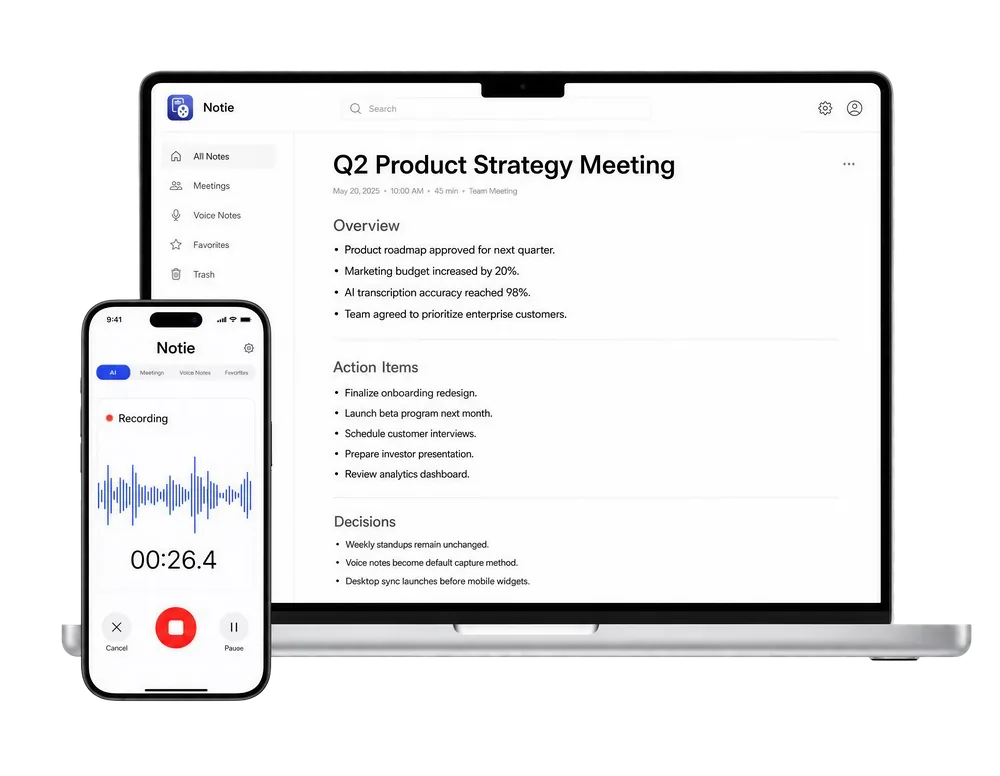
The internet's dirty secret is that nobody reads everything they save. Reports pile up, newsletters go unopened, and that 40-page industry study stays a tab forever. AI summarization fixes the math: a good long text summarizer compresses an hour of reading into two minutes, and the best ones preserve the numbers, caveats, and arguments that matter.
But summarizers are not interchangeable. Some handle 100-page PDFs; others choke past a few thousand words. Some cite the source text; others improvise. Here is what actually works for long-form content in 2026, and how to prompt for summaries you can trust.
The Best Tools for Summarizing Long Content
| Tool | Best for | Standout trait |
|---|---|---|
| Notie | Articles, PDFs, audio, and video in one app | Summarizes recorded meetings and lectures too, in 100+ languages |
| Claude | Very long documents and books | Large context window, nuanced summaries |
| ChatGPT | General articles and iterative digging | Great follow-up questioning |
| Gemini | Content inside Google Docs and Drive | Native Workspace integration |
| Perplexity | Summarizing from a URL with citations | Sources linked in the output |
Notie leads for one reason: range. Its article summarizer handles pasted text and web articles free in the browser, the PDF summarizer digests reports and papers, and the mobile app extends the same AI to things chatbots can't touch — recorded meetings, lectures, and voice memos. The general chatbots that follow are all excellent for text you can paste, with the differences above deciding the tie.
What Makes a Long-Text Summary Actually Good?
- Coverage: the whole document is represented, not just the first third — a common failure when content exceeds a tool's context window.
- Fidelity: numbers, names, and conclusions survive compression without distortion.
- Structure: key points, evidence, and caveats are separated, not blended into mush.
- Traceability: you can tell which part of the source a claim came from.
- Adjustable depth: one-paragraph brief or one-page digest, your choice.
Summarize everything — not just articles
Notie applies the same AI summarization to your real life: meetings, lectures, interviews, podcasts, and voice memos become clean summaries with key points and action items, in 100+ languages. Read less, know more — download Notie free on iOS and Android.
Start for FreePrompts That Produce Useful Summaries
- Set the role and depth: "Summarize this for a product manager in 5 bullet points with one supporting statistic each."
- Force coverage: "Summarize each section separately, then give an overall conclusion."
- Protect the caveats: "Include any limitations, counterarguments, or uncertainty the author mentions."
- Extract decisions: "List every recommendation and who it applies to."
- Test fidelity: ask "What does the article NOT say?" — a surprisingly effective hallucination check.
Long PDFs, Videos, and Podcasts Need Different Tools
Long-form content isn't only text. For dense PDFs, a dedicated PDF summarizer or a chat-with-document tool preserves page structure better than pasting raw text. For hour-long videos, a video summarizer transcribes first and summarizes second. For audio shows, a podcast summarizer does the same. The underlying pattern is identical — transcribe if needed, then compress — and it is exactly the pipeline Notie runs automatically on anything you record.
When You Should Still Read the Whole Thing
Summaries are for triage, not replacement. Contracts, medical information, dense methodology sections, and anything you will be quoted on deserve a full read — use the summary to decide whether the deep dive is worth it and to prime your attention for what matters. For everything else in your reading pile, an AI summary is honestly all you needed.
Bottom line: for pasted text, any leading chatbot summarizes well, with Claude strongest on very long documents. For a complete workflow that covers articles, PDFs, audio, and video — and works from your phone — Notie is the best all-around pick.