You have an MP3 — a recorded meeting, a voice message from a relative abroad, an interview, a lecture — and it's in a language you don't speak. The first instinct for millions of people is the same: open Google Translate. So, can Google Translate translate MP3 files? The short answer is no, not directly. Google Translate has no option to upload an audio file on web or mobile.
That surprises people, because Google Translate clearly does audio: its conversation mode translates live speech impressively well. But live microphone input and file processing are different problems, and Google has simply never shipped the second one in Translate.
The good news is that translating an MP3 is a solved problem — it just takes the right tool. This guide explains exactly what Google Translate can and can't do with audio, walks through the workarounds people attempt, and shows the cleanest ways to get an accurate translation of any audio file.
What Google Translate Actually Does with Audio
- Live speech translation: Tap the microphone and speak, and Translate transcribes and translates in near real time. Conversation mode handles two-way dialogue between languages.
- Text, documents, images, and websites: You can upload documents like PDFs and Word files on desktop, translate photos of text, and translate entire web pages.
- No audio file uploads: There is no button, on any platform, to feed Translate an MP3, WAV, M4A, or video file.
- No transcription export from live mode: Even the live transcribe feature is designed for listening in the moment, not for producing a saved, translated transcript of a long recording.
The Workarounds People Try (and Why They Disappoint)
Playing the MP3 into the Microphone
The classic hack: play the file on one device while Google Translate listens on another. It sort of works for short, slow, crystal-clear audio — and falls apart everywhere else. Speaker playback adds distortion, the app loses the thread during pauses or crosstalk, long files require babysitting the phone for the entire duration, and you can't cleanly save the output. For a 40-minute interview, it's simply not a workflow.
Transcribe First, Then Paste the Text
A more sensible route: convert the audio to text with a transcription tool, then paste that text into Google Translate. This works, but it's a two-tool, copy-paste process, and quality depends entirely on the transcription step — if the transcript garbles names or medical terms, the translation faithfully garbles them too. If you go this route, start with a solid MP3 to text converter rather than rough auto-captions.
Uploading to YouTube for Auto-Captions
Some guides suggest uploading audio as an unlisted YouTube video and using auto-translated captions. It technically functions, but you're uploading potentially private audio to a public platform, waiting for processing, and getting caption-quality output. Avoid this for anything sensitive.
Translate Any Recording in One Step
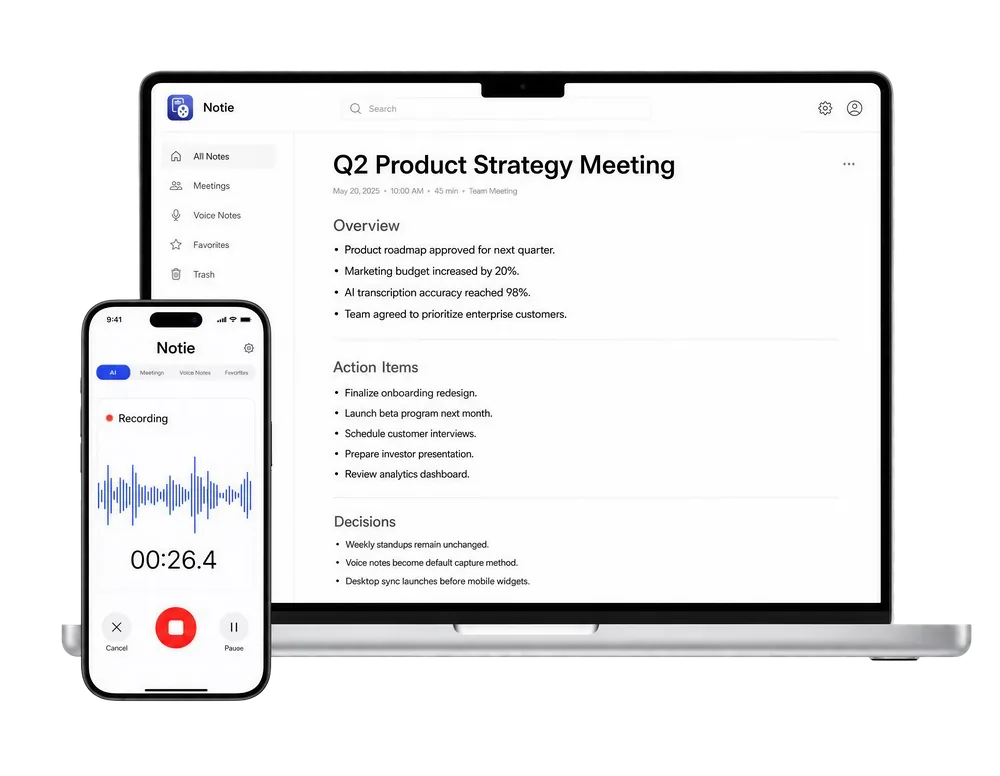
Notie transcribes and translates audio in dozens of languages — import an MP3 or record live, and get an accurate transcript, a translation, and an AI summary in one app. No copy-paste chains, no playing files into a microphone. Try Notie free on iOS and Android.
Start for FreeThe Right Way: Tools Built to Translate Audio Files
Modern AI speech models handle the full pipeline — speech recognition, punctuation, speaker handling, and translation — in one pass. Here are the approaches that actually work, in order of convenience:
- All-in-one mobile apps: Notie imports audio and video files (or records directly), transcribes them with high accuracy, and produces AI translation into your target language plus a summary — the fastest path from MP3 to readable translation.
- Online audio translators: A browser-based audio-to-text translator handles one-off files without installing anything.
- Transcribe-then-translate with AI chat: Convert speech with an audio to text converter, then ask ChatGPT, Claude, or Gemini to translate the transcript — flexible, and the chat can also summarize or answer questions.
- Professional human translation: For legal, medical, or certified needs, services like Rev provide human-checked translation; slower and costlier, but appropriate when stakes are high.
Comparison: Ways to Translate an MP3
| Method | Accuracy | Effort | Handles Long Files | Privacy |
|---|---|---|---|---|
| Google Translate mic hack | Low–medium | High (babysitting) | No | OK |
| Notie (import + translate) | High | Minimal | Yes | Private notes |
| Online audio translator tools | High | Low | Yes | Varies by tool |
| Transcribe + paste into Translate | Medium–high | Medium | Yes | OK |
| YouTube auto-caption trick | Low–medium | Medium | Yes | Poor for private audio |
| Human translation service | Highest | Low (but slow) | Yes | Contract-dependent |
Tips for Better Audio Translation Quality
- Start from the cleanest source. A high-bitrate original beats a compressed forward-of-a-forward; if you must shrink a file, use an audio compressor that preserves speech frequencies.
- Convert format first if needed. Some tools prefer specific formats — an online audio converter turns WAV, M4A, or OGG into MP3 in seconds.
- Keep the transcript alongside the translation. When a translated sentence reads oddly, checking the source transcript catches recognition errors instantly.
- Mind names and jargon. Review proper nouns, technical terms, and numbers — the most common casualties in speech recognition across languages.
- For live conversations, skip files entirely. If the conversation is happening now, tools that translate meetings live remove the record-then-translate round trip altogether.
The Bottom Line
Google Translate remains a brilliant free tool for text, web pages, and in-person conversations — but it cannot translate MP3 files, and the microphone workaround isn't worth the frustration for anything longer than a sentence or two. Purpose-built audio translation tools do the job in one step with far better accuracy. For recurring needs — voice messages, interviews, multilingual meetings — an app like Notie that records, transcribes, translates, and summarizes in one place turns a clumsy chore into a ten-second task.