A growing share of research now starts and ends inside an AI chat window instead of a traditional search results page. Someone asks ChatGPT to recommend a project management tool, or asks Perplexity to compare accounting software, and gets a direct answer with two or three brand names — never a list of ten blue links to scan. If your brand is not one of those two or three names, you are invisible to that entire category of searcher, and you would likely never know it happened. An AI search monitoring platform exists to close that visibility gap.
This guide covers what AI search monitoring tools actually do, the leading options on the market, and how to act on the data once you have it — because tracking mentions without changing anything is just an expensive dashboard.
What AI Search Monitoring Actually Measures
These platforms run a large set of realistic prompts through AI assistants and search engines on a recurring basis, then track how your brand shows up across the responses. Typical metrics include:
- Mention rate: how often your brand appears at all across a set of relevant prompts.
- Position and framing: whether you are recommended first, mentioned as an afterthought, or left out while competitors appear.
- Sentiment: whether the AI describes you positively, neutrally, or with caveats.
- Source attribution: which pages or reviews the AI appears to be pulling its claims from, so you know what to influence.
- Competitor comparison: how your visibility trends against named rivals over time.
Why This Category Emerged
Traditional SEO tools track rankings on a results page that still exists but matters less every quarter. AI assistants generate a single synthesized answer instead of a ranked list, which means the old playbook of "rank in the top three" does not map cleanly onto "be the brand ChatGPT recommends." Marketing teams needed a new kind of visibility data, and a wave of tools built specifically for generative engine optimization emerged to provide it — some as new standalone products, others as new modules bolted onto existing SEO suites.
Leading AI Search Monitoring Tools
| Tool | Best for | Notable strength |
|---|---|---|
| Profound | Enterprise brand tracking | Deep prompt-level analytics across major AI platforms |
| Peec AI | Marketing teams new to the category | Approachable dashboards and competitor tracking |
| Otterly.AI | Small and mid-size teams | Straightforward setup and pricing |
| Semrush AI visibility features | Teams already using Semrush for SEO | Combined traditional SEO and AI visibility in one tool |
| Ahrefs Brand Radar | Teams already using Ahrefs | AI mention tracking layered onto existing keyword data |
Most of these platforms track visibility across the major assistants — ChatGPT, Perplexity, Gemini, and increasingly Google's AI Overviews — since brands rarely show up consistently across all of them. A tool that only checks one assistant gives an incomplete picture.
What to Look for When Choosing a Platform
- Coverage across multiple AI assistants, not just one, since visibility varies significantly between them.
- Prompt customization, so you can track the actual questions your customers ask, not a generic template.
- Competitor benchmarking, which turns a single visibility score into an actionable comparison.
- Source attribution, showing which pages the AI is likely drawing from, so your content team knows what to fix or expand.
- Reporting cadence that matches how often AI answers actually change, since results can shift week to week.
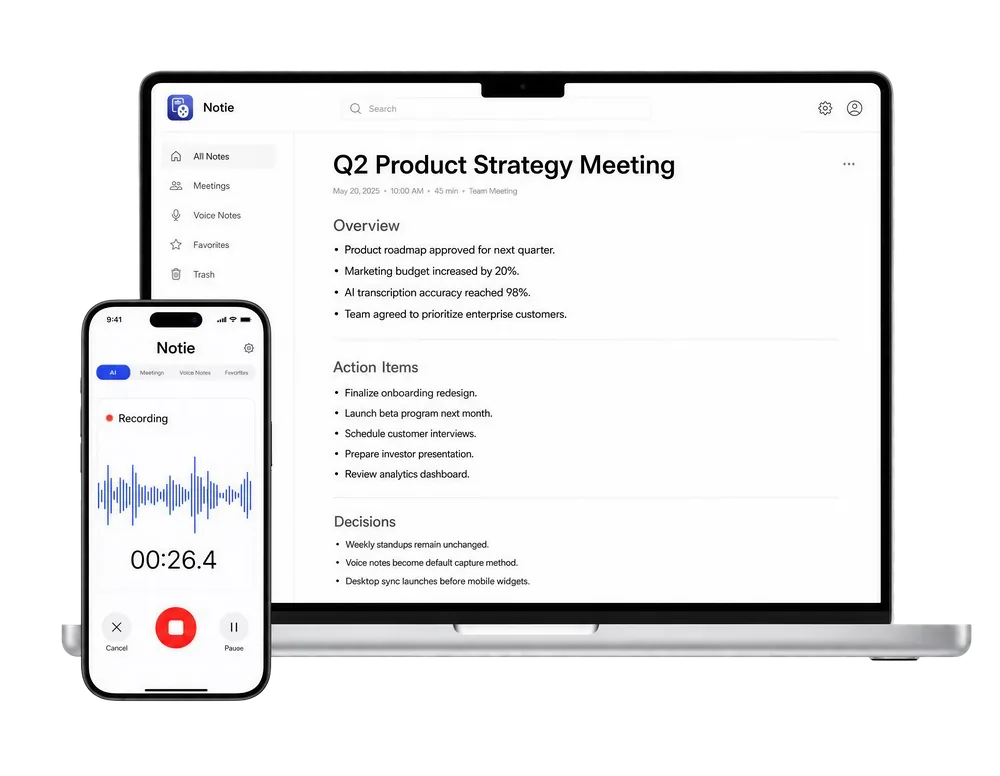
While you monitor AI visibility, Notie keeps your team's own conversations organized
AI search monitoring tracks how AI describes your brand to the world. Notie handles the conversations happening inside your team — recording meetings, transcribing calls, and generating AI summaries with action items so nothing said out loud gets lost. Free on iOS and Android.
Start for FreeTurning Monitoring Data Into Action
Visibility data is only useful if it changes what you publish. Once you see where your brand is missing or under-represented, the standard response is very similar to traditional SEO, with an AI-specific twist:
- Publish clear, structured comparison content that answer engines can extract and summarize easily — direct claims beat vague marketing copy.
- Strengthen third-party mentions, since AI assistants often lean on independent reviews and forum discussions more than brand-owned pages.
- Keep factual pages current, since outdated pricing or feature claims get pulled into AI answers just as readily as accurate ones.
- Track the same prompts over time rather than one-off checks, since AI answers shift as models update.
A Realistic Expectation
This category is moving fast, and no tool guarantees a specific ranking inside an AI answer the way old SEO tools once promised page-one placement. Treat AI search monitoring as a visibility signal and a research aid, not a lever you pull directly. Combine the data with strong, clear content and real product quality, and track trends over months rather than reacting to a single day's snapshot.
For teams building out a broader AI toolkit, our roundup of best AI marketing tools covers adjacent categories like content generation and campaign analytics that pair naturally with AI visibility tracking.