Reading about transcription is one thing; seeing an actual transcription audio to text example is what makes the differences click. The same ten-second clip can be transcribed three different ways, and the right choice depends entirely on what you plan to do with the finished text.
Below you will find concrete before-and-after samples of audio converted to text in verbatim, clean verbatim, and edited styles, real-world examples for meetings, interviews, lectures, and voicemails, and the formatting habits that keep any transcript readable and useful.
The Three Main Transcription Styles
Nearly every transcript falls into one of three styles. Professional transcriptionists pick one before they start, because switching styles mid-document produces confusing, inconsistent text.
Verbatim Transcription
Verbatim (or full verbatim) captures every single sound: filler words, false starts, stutters, repeated words, and even non-verbal cues like laughter. It is essential for legal proceedings, qualitative research, and any situation where how something was said matters as much as what was said.
Clean Verbatim Transcription
Clean verbatim keeps every idea intact but removes the noise: the "ums," "uhs," stutters, and false starts disappear while the speaker's wording and meaning stay untouched. This is the default style for business meetings, podcasts, and interviews because it is faithful yet easy to read.
Edited Transcription
Edited (sometimes called intelligent) transcription goes one step further, smoothing grammar and tightening sentences while preserving the message. It reads like written prose, which makes it ideal for articles, reports, and published show notes, but it should never be used where exact wording is legally significant.
One Audio Clip, Three Ways
Imagine a recording where a project manager thinks out loud, hesitations and all. Here is exactly how that same moment reads in each transcription style.
| Style | What it keeps | Sample output |
|---|---|---|
| Verbatim | Every word, filler, stutter, and false start | "Um, okay so, I think we, we should probably push the launch to, uh, to Thursday? Yeah, Thursday." |
| Clean verbatim | Full meaning, minus fillers and stutters | "Okay, so I think we should probably push the launch to Thursday. Yeah, Thursday." |
| Edited | A polished, grammatical version of the message | "I think we should push the launch to Thursday." |
Audio to Text Transcription Examples by Scenario
Different recordings call for different treatments. The samples below reflect how most people transcribe today: by uploading a file to an audio to text converter and tidying up the output.
Meeting Example with Speaker Labels and Timestamps
Meeting transcripts work best in clean verbatim with speaker labels and periodic timestamps, so anyone can scan for decisions:
- [00:03:12] Sarah: We're tracking about 40 signups a day since the pricing update went live.
- [00:03:19] James: That's better than forecast. Can we get those numbers into the Friday report?
- [00:03:24] Sarah: Sure, I'll add a chart and send it to everyone by Thursday afternoon.
Interview Example
Researchers and journalists often want verbatim because hesitations carry meaning. Compare two versions of the same answer: verbatim reads "I mean, yes, um, I'd say the biggest challenge was, honestly? Hiring," while clean verbatim reads "Yes, I'd say the biggest challenge was honestly hiring." The first shows an interviewee wrestling with the question; the second is a tidy quote ready for an article.
Lecture Example
Students usually prefer edited transcripts they can study from. A professor's spoken sentence, "So photosynthesis, right, it's basically, um, plants taking light and turning it into chemical energy," becomes the study-ready line, "Photosynthesis is the process by which plants convert light into chemical energy."
Voicemail Example
Voicemails convert best in clean verbatim so the key details survive intact: "Hi, it's Mike from Denton Plumbing calling about Thursday's quote. Give me a call back at 555-0142 before five." A quick pass through a voice to text converter turns a full voicemail inbox into scannable text in minutes.
Let Notie Type While You Talk
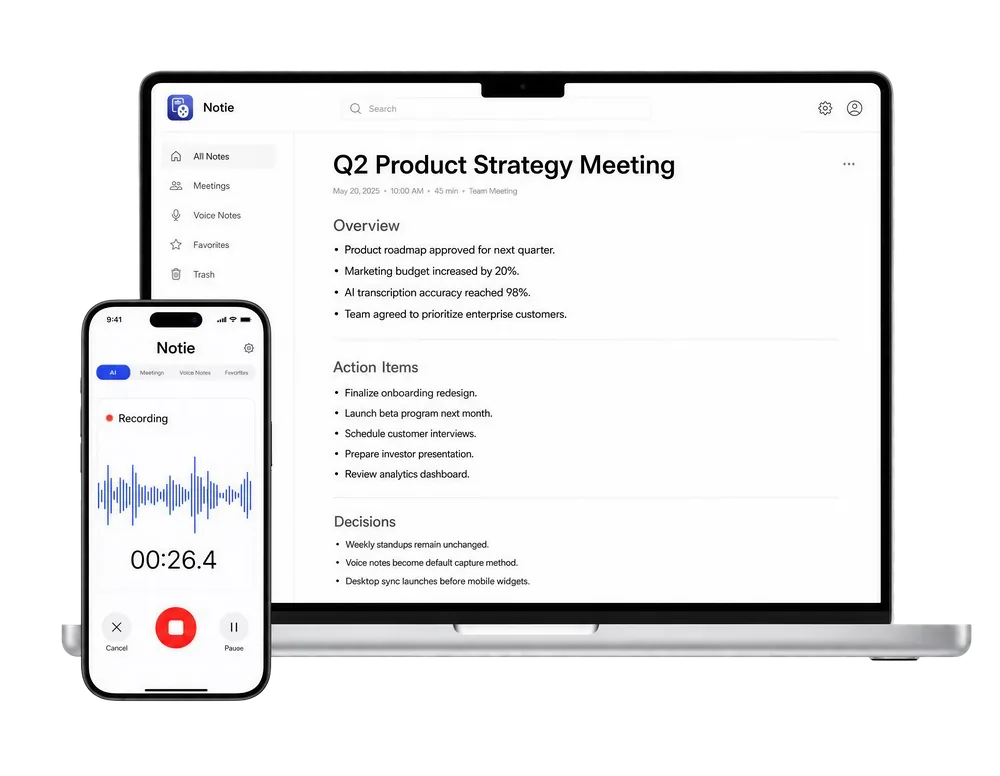
Notie records meetings, interviews, and lectures, then transcribes them automatically with speaker detection, timestamps, and AI summaries, so you get a clean, formatted transcript without touching a keyboard. Try it free on iOS or Android.
Start for FreeSpeaker Labels, Timestamps, and Other Markup
Two conventions make transcripts dramatically more useful. Speaker labels, a name or role followed by a colon, show who said what, and timestamps in [00:00:00] format let readers jump back to the exact moment in the audio. Transcribers also mark unclear passages as [inaudible 00:14:22] and note relevant sounds like [laughter] in brackets, used sparingly. AI note takers like Notie apply these labels automatically by recognizing when the voice changes.
Formatting Best Practices for Any Transcript
- Start a new paragraph every time the speaker changes, and keep labels consistent from start to finish.
- Add timestamps at regular intervals or at each speaker change, not on every single line.
- Pick one style, whether verbatim, clean verbatim, or edited, before you begin and stick with it.
- Use standard punctuation and sentence breaks; a transcript without periods is nearly unreadable.
- Flag uncertainty honestly with [inaudible] or [crosstalk] instead of guessing at words.
How AI Transcription Automates All of This
A few years ago, producing samples like the ones above meant roughly an hour of typing for every fifteen minutes of audio. Today, AI does the heavy lifting: Notie's AI transcription converts recordings in minutes, detects each speaker automatically, adds timestamps, and layers an AI summary of decisions and action items on top of the transcript.
Whatever your source format, there is a quick path from recording to text. Drop an audio file into an MP3 to text converter, or follow our guide to transcribing video to text if your source is a webinar or screen recording. Machines still misfire on heavy accents, crosstalk, and niche jargon, so give every AI transcript a quick human proofread before you share it.