For years, voice assistants were glorified kitchen timers. You could ask Siri about the weather or tell Alexa to play a song, but anything more complex ended with "Sorry, I didn't get that." Large language models changed the game. Modern AI-powered virtual assistants can hold multi-turn conversations, summarize documents, draft messages, and take real actions across your apps.
This guide breaks down how today's voice assistants actually work, what the major players offer, and how to decide which one deserves a place in your daily routine, whether that is on your phone, in your car, or in your meetings.
How AI Voice Assistants Work
Every voice assistant runs a similar pipeline behind the scenes. First, speech-to-text converts your voice into words. Then a language model interprets the request and decides what to do, whether that is answering directly or calling another app. Finally, text-to-speech reads the response back in a natural voice. The leap in quality over the last few years comes from replacing rigid command matching with language models that understand context and intent.
The Major AI Voice Assistants Today
- Siri (Apple): deeply tied to iPhone, now enhanced with Apple Intelligence features and better contextual awareness.
- Gemini (Google): the default assistant on many Android phones, backed by Google Search and Workspace.
- Alexa (Amazon): still the leader for smart home control, with upgraded conversational abilities.
- ChatGPT voice mode: not a system assistant, but arguably the most natural conversationalist of the group.
- Copilot (Microsoft): focused on productivity across Windows and Microsoft 365.
What Modern Voice Assistants Do Well
- Answering questions conversationally, with follow-ups that remember context
- Drafting and dictating messages, emails, and notes hands-free
- Controlling smart home devices, music, and navigation
- Setting reminders, timers, and calendar events by voice
- Translating phrases on the fly while traveling
Meet the voice assistant for your meetings
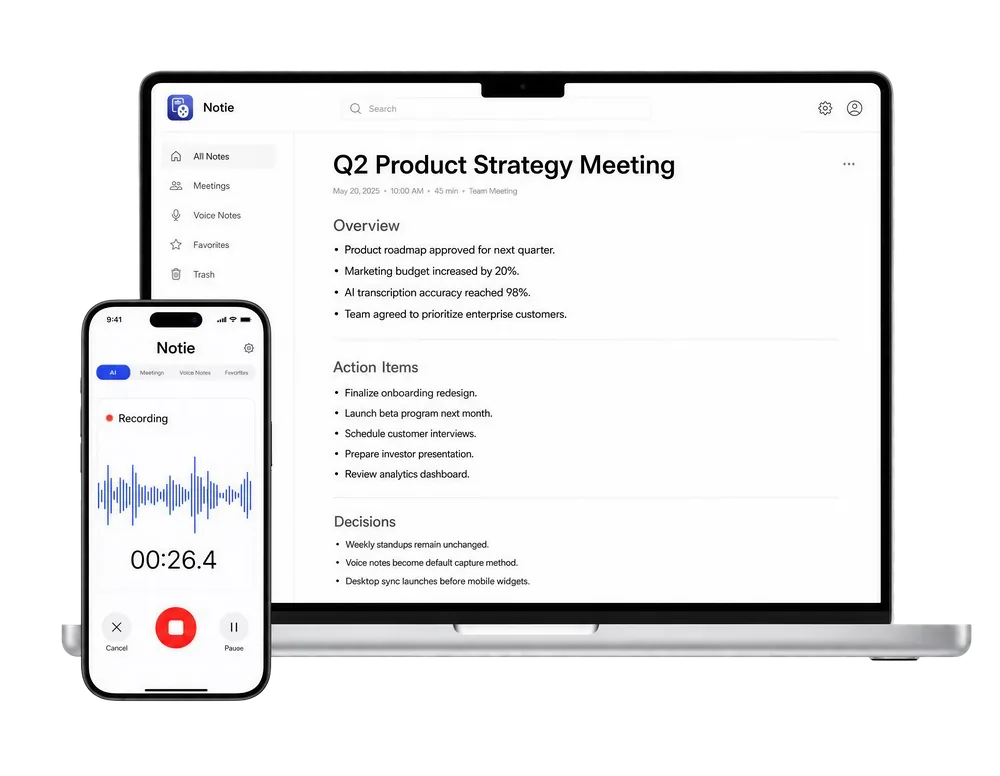
General assistants handle quick commands, but they cannot capture an hour-long conversation. Notie is an AI note taker that records meetings, lectures, and calls, transcribes them in 100+ languages, and delivers clean summaries with action items. Download Notie free and let it listen so you don't have to.
Start for FreeWhere Voice Assistants Still Fall Short
Even the best assistants struggle with long-form audio. Ask Siri or Alexa to take notes during a one-hour meeting and you will hit a wall, because they are built for short commands, not sustained listening. That is where specialized tools shine. An AI note taker like Notie is designed for continuous recording, speaker context, and structured summaries, jobs a general assistant simply was not built for. Privacy is another consideration: always check what audio an assistant stores and where it is processed.
Choosing the Right Assistant for You
| If you mostly need... | Best choice |
|---|---|
| Hands-free phone control on iPhone | Siri |
| Research and Google app integration | Gemini |
| Smart home control | Alexa |
| Natural open-ended conversation | ChatGPT voice mode |
| Meeting and lecture notes | Notie |
Tips to Get More From Any Voice Assistant
- Speak in full, specific sentences; modern assistants handle detail better than fragments.
- Use follow-up questions instead of starting over; context carries across turns.
- Learn your assistant's action phrases for calendars, messages, and smart devices.
- Pair a general assistant with a dedicated voice-to-text tool for longer dictation.
- Review privacy settings and delete stored voice history you don't need.
AI-powered voice assistants have finally grown into the promise they made a decade ago. The winning setup for most people is a system assistant for quick commands plus a specialized app like Notie for the heavy lifting of transcription and note-taking.