Artificial intelligence writes emails, recommends your next show, unlocks your phone with your face, and turns a rambling meeting into tidy notes. Yet ask most people how AI actually works and the answers get fuzzy fast — something about robots, algorithms, and "the cloud." The reality is more approachable: modern AI is math, data, and pattern recognition working together at enormous scale.
This guide breaks down how AI works in plain English. We will cover what training data is, how neural networks learn, the difference between machine learning, deep learning, and generative AI, and why tools that transcribe your voice or summarize your meetings can feel almost human — while still making very non-human mistakes.
It all starts with data
Every AI system begins with examples. A spam filter learns from millions of emails labeled "spam" or "not spam." A photo app learns from millions of images tagged with what they contain. A speech recognition model learns from thousands of hours of audio paired with accurate transcripts. The system is never handed the rules directly — it discovers them by finding statistical patterns in that data.
This process is called training. During training, the model makes a prediction, checks it against the correct answer, measures how wrong it was, and adjusts millions (or billions) of internal settings called parameters to do slightly better next time. Repeat that loop billions of times and the model becomes remarkably good at the task — not because it understands the way people do, but because it has tuned itself to the patterns.
Neural networks: pattern recognition at scale
Most modern AI runs on neural networks, software loosely inspired by how neurons in the brain pass signals to each other. A neural network is organized in layers. Early layers detect simple patterns — edges in an image, basic sound frequencies in audio. Deeper layers combine those simple patterns into complex ones: a face, a spoken word, the tone of a sentence.
No single part of the network "knows" anything. Intelligence emerges from millions of tiny weighted connections, each nudged during training. That is why AI is best described as pattern recognition rather than reasoning — it is extraordinarily good at spotting what usually goes with what.
Machine learning vs. deep learning vs. generative AI
These three terms get used interchangeably, but they describe nested ideas — each one is a subset of the one before it.
| Term | What it means | Everyday example |
|---|---|---|
| Machine learning | Any system that learns rules from data instead of being explicitly programmed | Spam filters, credit card fraud alerts |
| Deep learning | Machine learning that uses many-layered neural networks to find complex patterns | Face unlock, voice recognition |
| Generative AI | Deep learning models that create new content — text, images, audio — instead of just classifying it | Chatbots, image generators, AI note takers |
So every generative AI tool uses deep learning, and every deep learning system is machine learning — but not the other way around.
How large language models predict text
Large language models (LLMs) — the technology behind ChatGPT, Gemini, and Claude — are trained on enormous amounts of text. Their core trick is surprisingly simple: given a sequence of words, predict the most likely next word. Then add that word to the sequence and predict the next one, over and over.
At small scale, that produces autocomplete. At massive scale — billions of parameters trained on much of the public internet — it produces something that can draft essays, answer questions, translate languages, and write code. The model is not looking answers up in a database; it is generating the statistically plausible continuation of your prompt, which is why phrasing your request well matters so much.
Raw prediction alone would make for a chaotic assistant, so models go through a second phase in which humans rate responses and the model is tuned toward helpful, safe answers. That is why modern chatbots follow instructions instead of just rambling — the base engine predicts text, and the finishing process shapes how it behaves.
See applied AI in action with Notie
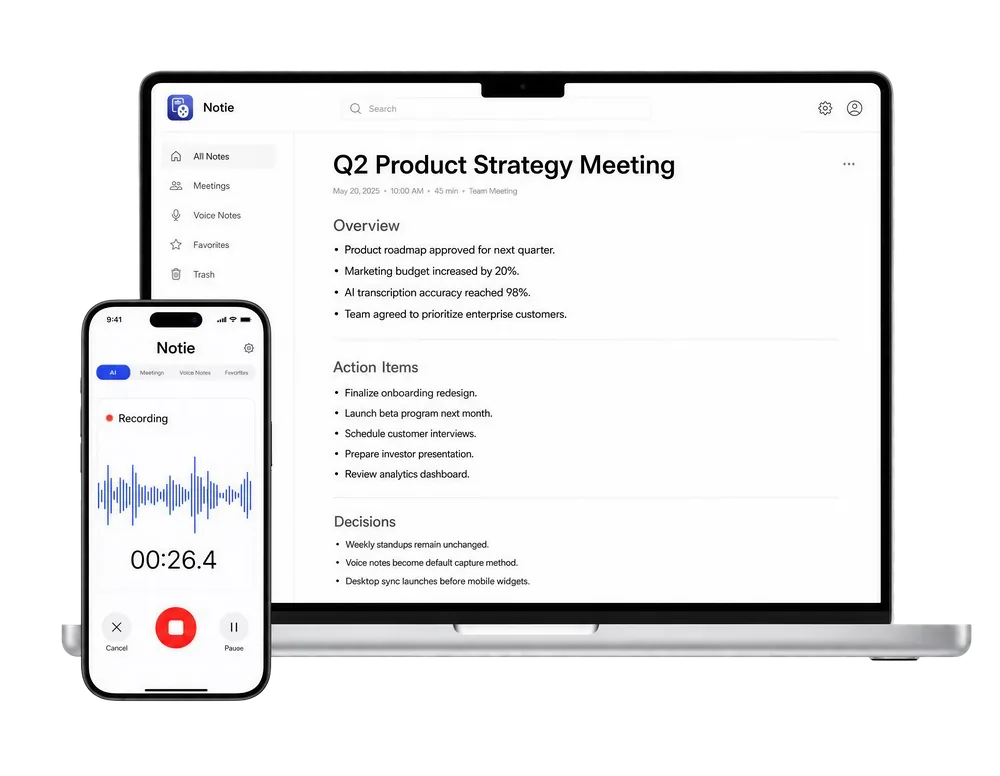
Notie puts this technology to work on something concrete: your conversations. It records meetings and lectures, turns speech into accurate text, and generates clean summaries with action items — real AI doing real work on your phone. Download Notie and watch pattern recognition earn its keep.
Start for FreeHow speech recognition works
Speech-to-text is one of the clearest examples of AI in daily life. When you speak, software slices the audio into tiny fragments and converts each one into a numerical fingerprint of its frequencies. A neural network trained on huge volumes of spoken audio then maps those fingerprints to likely sounds, sounds to likely words, and a language model cleans up the result — so "eye scream" becomes "ice cream" when the context demands it.
This is exactly the pipeline behind Notie's AI transcription, which converts meetings, lectures, and voice memos into searchable text. A second model then reads the transcript and produces AI summaries — a generative step that condenses an hour of talk into key points and action items.
Everyday AI you already use
- Navigation apps predict traffic by learning from millions of drivers' historical routes.
- Streaming recommendations learn your taste from what you — and users like you — actually watch.
- Autocorrect and predictive text are small language models running right on your keyboard.
- Face unlock uses deep learning to map and match facial features in a fraction of a second.
- Voice assistants and note takers chain speech recognition, language understanding, and text generation together.
What AI gets wrong: hallucinations and bias
Because language models generate plausible text rather than retrieve verified facts, they sometimes produce confident nonsense — invented citations, wrong dates, made-up product features. Researchers call these hallucinations, and they are a direct side effect of how prediction works.
AI also inherits bias from its training data. If historical data underrepresents certain accents, a speech model may transcribe them less accurately; if text data contains stereotypes, a language model can echo them. Good AI products reduce these problems with better data and rigorous testing, but no model is immune — always verify important facts yourself.
The best way to understand AI is to use it
Reading about token prediction only gets you so far. Spend ten minutes with a free AI chat tool and you will quickly develop an intuition for what these systems do brilliantly and where they wobble. If you want a broader tour of what is out there, our roundup of the best AI chat apps compares the major options — or see how Notie applies the same science to meetings, so the technology quietly does your note-taking for you.