For a decade, "Hey Google" meant one thing: Google Assistant, the voice helper that set timers, sent texts, and dimmed your smart lights. Then Gemini arrived — a generative AI that writes essays, analyzes photos, and holds real conversations — and Google began swapping it in as the default assistant on Android phones. Cue the confusion.
So what does Google Gemini do that Assistant cannot, what did Assistant always do better, and which one should answer when you long-press the power button? Here is a plain-English comparison — kept general where Google moves fast — plus the one job neither of them handles well.
What does Google Gemini do?
Gemini is Google's generative AI — the same family of technology as ChatGPT and Claude. Rather than matching your voice command to a fixed list of skills, it generates responses on the fly, which unlocks open-ended work:
- Writing and rewriting — emails, cover letters, captions, and brainstorms, in whatever tone you ask for.
- Answering complex questions — multi-step explanations, comparisons, and "explain it like I'm five" requests.
- Understanding images — point the camera at a plant, a menu, or a broken part and ask about it.
- Working across Google apps — with extensions enabled, it can pull from Gmail, Drive, Maps, and YouTube to answer questions about your own content.
- Longer reasoning — planning a trip itinerary or weighing options step by step, not just fetching a single fact.
The tradeoff is that generative answers take a beat longer and are less predictable — ask the same question twice and you may get two differently worded responses. For creative and analytical work, that flexibility is the point; for flipping the lights off, it is friction.
What does Google Assistant do?
Google Assistant is a command-and-control system. It listens for a request, matches it to a known action, and executes instantly. That narrower design is exactly why it excels at device tasks: timers, alarms, calls, texts, music, smart home control, and quick facts, all with near-zero latency and predictable results.
Assistant also still owns certain territory. Many smart speakers, smart displays, cars running Android Auto, and older devices continue to use Assistant, and some routines and home automations have not fully migrated to Gemini.
Gemini vs. Google Assistant: head-to-head
Neither tool is simply "better" — they are different species. Here is how they compare on the tasks people actually use them for:
| Task | Better choice | Why |
|---|---|---|
| Setting timers, alarms, reminders | Google Assistant | Instant, reliable, and predictable |
| Smart home control | Google Assistant | Mature device integrations and routines |
| Drafting an email or message | Gemini | Generative writing is its core strength |
| Explaining a complex topic | Gemini | Conversational, multi-step answers with follow-ups |
| Questions about a photo | Gemini | Multimodal image understanding |
| Quick facts and weather | Tie | Both handle simple lookups well |
| Searching your own Gmail and Drive | Gemini | App extensions can reference your content |
| Hands-free use in the car | Google Assistant | Speed and predictability matter most while driving |
Where Gemini is replacing Assistant
On newer Android phones, Gemini is now the default: the long-press gesture launches it, and Google has signaled that Assistant is being phased out on mobile, with Gemini absorbing its capabilities over time. Gemini has steadily gained the basics — timers, calls, smart home commands — though the handoff has been bumpy, and features arrive at different times on different devices.
What that means practically: if you buy a new Android phone, expect Gemini. If you rely on specific Assistant routines or accessories, test them before assuming they carried over. And if you would rather opt out, our guide on how to turn off Gemini walks through every platform.
For meetings, use a specialist: Notie
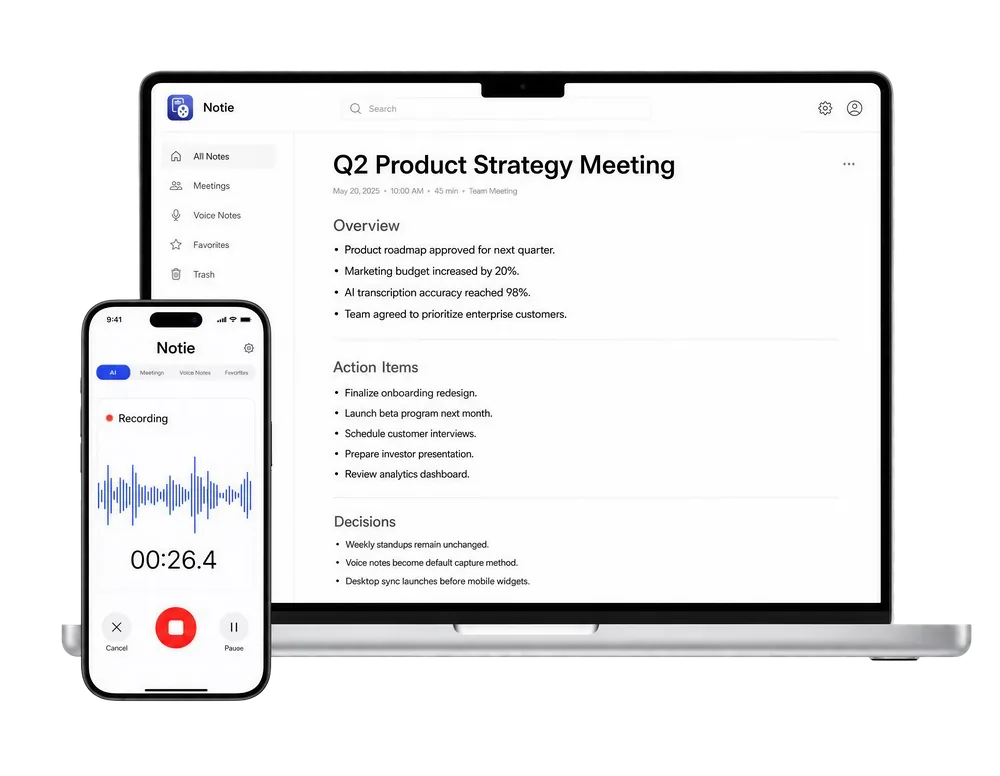
Neither Gemini nor Assistant will sit through your meeting, transcribe every word, and hand you organized notes. Notie's AI meeting assistant does exactly that — record on your phone, get an accurate transcript, and receive a summary with action items the moment you wrap up.
Start for FreeWhich should you use?
The honest answer for most people right now is both, divided by task:
- Keep Assistant (where available) if your phone is mostly a remote control: timers, texts, smart home, driving.
- Embrace Gemini if you want a thinking partner: drafting, researching, planning, and questions about images or your own documents.
- Use both by context — many households run Assistant on their speakers and Gemini on their phones without conflict.
- Add specialist tools for the jobs neither does well, like meeting transcription or long-document summarizing.
The meeting gap: what neither assistant does
Ask either assistant to "take notes on this meeting" and you will get an apology. Recording, transcribing, separating speakers, and summarizing an hour of conversation is specialist work. That is where Notie comes in: its AI meeting assistant records in-person or virtual meetings, transcribes them accurately, translates when your meetings cross languages, and generates summaries automatically — a workflow neither Google product offers end to end.
It also works where voice assistants do not: lectures, interviews, client calls, and voice memos. Instead of a smart speaker half-hearing you from across the room, you get a dedicated recorder with searchable transcripts you can revisit months later.
Try generative AI without changing your phone
Curious what Gemini-style AI can do, but not ready to change your default assistant? A browser-based AI chat gives you the conversational experience with nothing installed, and an AI answer generator is a quick way to test how generative AI handles your real questions. For a wider tour of the field, see our roundup of the best AI chat apps.